Multiple Choice
Passage
Language is a skill acquired during early childhood that continues to develop for many years. Communication using language involves multiple complex processes, including listening, speaking, comprehension, and cognition. Receptive language ("language input") involves language comprehension, while expressive language ("language output") involves the ability to produce intelligible language. In normally developing children, receptive language emerges first, followed by expressive language.To examine how age plays a role in the activation of the neurological networks involved in processing more complex language, researchers used functional magnetic resonance imaging (fMRI) to analyze how the use of receptive language generates metabolic activity in the brains of children. A total of 672 participants were divided into three groups by age: Age 4-6 (n = 219) , age 7-9 (n = 224) , and age 10-12 (n = 229) .Participants in each group were asked to listen to pre-recorded stories while undergoing fMRI of the brain to determine if an age-related difference could be found in activated brain tissue volume during the listening task. The recorded fMRI-monitored listening portion of the experiment lasted approximately 5 minutes. Immediately following this listening exercise, fMRI monitoring was discontinued and the children were administered tests to determine comprehension of the material. None of the children had been informed that they would be taking a comprehension test prior to its actual administration.
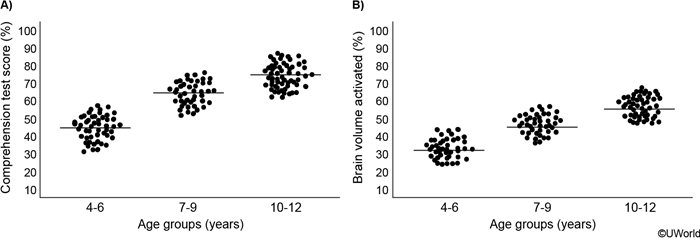 Figure 1 fMRI listening task analyzed per age group: (A) comprehension test scores, and (B) brain volume activated (Note: Solid lines represent the mean in each group.)
M. M. Berl, E. S. Duke, J. Mayo, L. R. Rosenberger, E. N. Moore, J. VanMeter, N. Bernstein Ratner, C. J. Vaidya, and W. D. Gaillard ©2010 by Elsevier, Inc.
-Which of the following brain regions should demonstrate the greatest degree of activation on fMRI during the task described in this study?
A) Primary visual cortex
B) Somatosensory cortex
C) Wernicke area
D) Broca area
Correct Answer:

Verified
Correct Answer:
Verified
Q194: Passage<br>Trait theorists believe that all people have
Q195: Passage<br>Of the biological factors impacting color perception
Q196: Passage<br>Prominent theories of emotion have long held
Q197: Passage<br>On the way home from a routine
Q198: Passage<br>Until the middle of the twentieth century,
Q200: Passage<br>Across the lifespan, mental and physical health
Q201: Passage<br>Text messaging while driving increases the risk
Q202: Passage<br>A common misconception in medicine is that
Q203: Passage<br>Epidemiologists now consider obesity to be a
Q204: Passage<br>Both institutional and interpersonal factors contribute to