Multiple Choice
Passage
Across the lifespan, mental and physical health depends on adequate sleep. Extensive research suggests that sleep needs and characteristics change throughout an individual's life (Figure 1) .
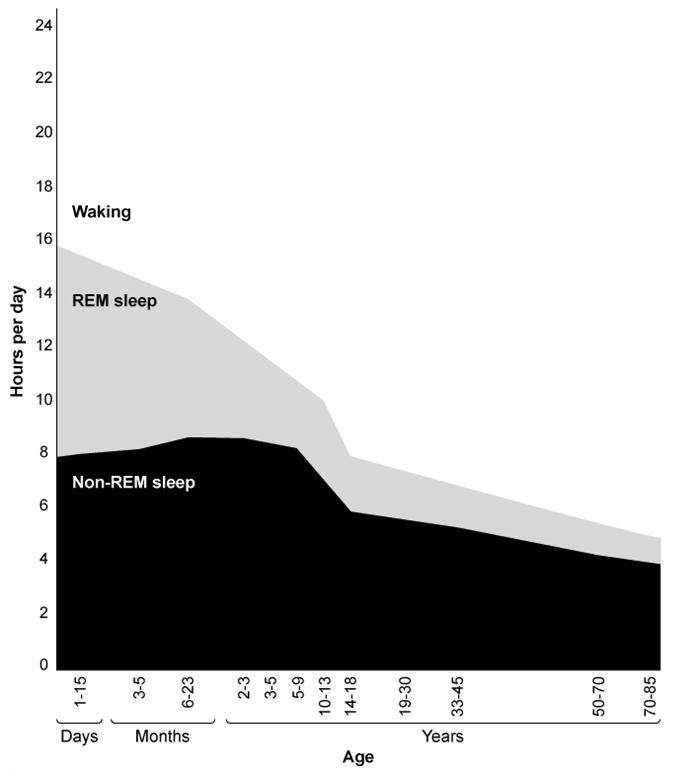 Figure 1 Average hours of rapid eye movement (REM) and non-REM sleep for different age groups across the lifespanChronic sleep deprivation acts as a physiological stressor and can have a multitude of short- and long-term negative health consequences. Studies show that over 30% of adults get less than the recommended minimum of 7 hours of sleep per night, putting them at greater risk for metabolic disorders (eg, obesity, diabetes) , cardiovascular disease (eg, high blood pressure, stroke) , and emotional disorders (eg, anxiety, depression) . Sleep deprivation is also associated with impaired cognitive functioning, decreased work performance, and an increased risk of accidents.However, the guideline that adults sleep at least 7 hours per night does not account for the considerable variation in individual sleep needs. Research suggests that some individuals, known as "long sleepers," require an average daily sleep duration of more than 9 hours, while "short sleepers" require an average daily sleep duration of less than 6 hours. One study found that biological night duration (established by one's circadian pacemaker or "master clock") appears to be a few hours shorter for short sleepers as compared to long sleepers. Other studies suggest that short sleepers regularly sleep less than 7 hours without any apparent negative consequences due to one or more genetic mutations, such as a mutation on the DEC2 gene (also known as BHLHE41) , which codes for a transcription factor involved in regulating circadian rhythms.
-According to Figure 1, the time in one's life when sleep contains the largest proportion of REM sleep best corresponds to which of the following?
A) Piaget's sensorimotor stage
B) Erikson's initiative vs. guilt stage
C) Mead's play stage
D) Kohlberg's instrumental relativist orientation stage
Correct Answer:

Verified
Correct Answer:
Verified
Q195: Passage<br>Of the biological factors impacting color perception
Q196: Passage<br>Prominent theories of emotion have long held
Q197: Passage<br>On the way home from a routine
Q198: Passage<br>Until the middle of the twentieth century,
Q199: Passage<br>Language is a skill acquired during early
Q201: Passage<br>Text messaging while driving increases the risk
Q202: Passage<br>A common misconception in medicine is that
Q203: Passage<br>Epidemiologists now consider obesity to be a
Q204: Passage<br>Both institutional and interpersonal factors contribute to
Q205: Which of the following scenarios best represents