Multiple Choice
Passage
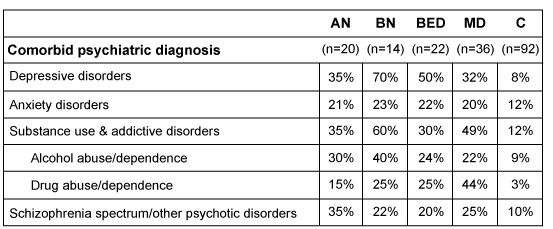
A common misconception in medicine is that eating disorders present similarly in males and females. Research suggests that this is untrue: males meeting diagnostic criteria for eating disorders are more likely than females to have another psychiatric illness, demonstrate a later age of onset, and engage in excessive exercise. They are less likely to engage in purging behaviors, be diagnosed by clinicians, or seek treatment. When males do enter treatment, they are generally further along in the course of the illness.The classification of eating disorders in males according to the Diagnostic and Statistical Manual of Mental Disorders, Fifth Edition (DSM-5) has recently been debated. Research suggests that one very common manifestation of eating disorder etiology in males, called muscle dysmorphia (MD) , includes an obsession with a larger and more muscular body, which contrasts with the thin, idealized body for females with eating disorders. Characterized as a subset of body dysmorphic disorder, MD is more recently conceptualized as part of a spectrum of eating disorders; however, it is still classified under the obsessive-compulsive and related disorders umbrella in the DSM-5.One study applied the latest DSM-5 diagnostic criteria for anorexia nervosa (AN) , bulimia nervosa (BN) , binge eating disorder (BED) , and MD to the medical records of male veterans treated in Veterans Administration (VA) hospitals across the United States from 2000 to 2015. The study (Table 1) found a significant increase in psychiatric comorbidity compared to controls (C) .Table 1 Prevalence of Psychiatric Disorders for Eating Disorder and MD Cases and Controls in a National Sample of Male Veterans Treated at VA Hospitals from 2000 to 2015
-The most appropriate control subjects for the study described in the final paragraph would be:
A) males who have never been diagnosed with an eating disorder.
B) males who have never been treated for an eating disorder.
C) females who have never been diagnosed with an eating disorder.
D) females who have never been treated for an eating disorder.
Correct Answer:

Verified
Correct Answer:
Verified
Q23: Passage<br>Before memories have been consolidated they are
Q24: Passage<br>Researchers conducted a pair of studies to
Q25: Passage<br>For decades psychologists have known that people
Q26: Passage<br>The term "health disparities" describes a systematic
Q27: Which of the following observations disconfirms the
Q29: Passage<br>Research suggests that individuals with depression experience
Q30: Passage<br>Psychotic disorders are characterized by a loss
Q31: Passage<br>Trait theorists believe that all people have
Q32: Passage<br>Research suggests that individuals with depression experience
Q33: Passage<br>Health psychologists interested in studying the influence