Multiple Choice
Passage
The highly addictive nature of cigarettes can be partly explained by how nicotine, the primary addictive ingredient, is administered. The fastest route of administration for most drugs is through inhalation; cigarette smoking results in the transmission of nicotine to the brain in about 15 seconds. In the brain, nicotine activates the nicotinic acetylcholine receptors, which stimulate the brain's reward pathway and produce mild feelings of euphoria. Those who quit smoking often relapse due to stress, weight gain, and withdrawal symptoms such as cravings and irritability. Of those who attempt to quit without formal treatment, only 3%-5% remain abstinent after a year.Research suggests that mindfulness meditation-based programs can be an effective strategy to quit smoking. Mindfulness is an aspect of meditation that involves cultivating a nonjudgmental awareness of the thoughts, emotions, and sensations arising in the present moment.For one study, researchers randomly assigned 88 smokers to either Mindfulness Training (MT) or the Freedom From Smoking (FFS) intervention developed by the American Lung Association. Both groups participated in 90-minute group training sessions twice a week for four weeks. The FFS intervention educated participants on the negative health consequences of smoking, coping strategies for cravings, and the development of healthy lifestyle habits. The MT intervention taught mindfulness meditation techniques as a way of gaining awareness and acceptance of the cognitive, emotional, and physical components of cravings. The number of cigarettes smoked per day and self-reported abstinence, as verified by exhaled carbon monoxide, were measured at the end of treatment and at a 17-week follow-up for participants in each group (Figure 1) .
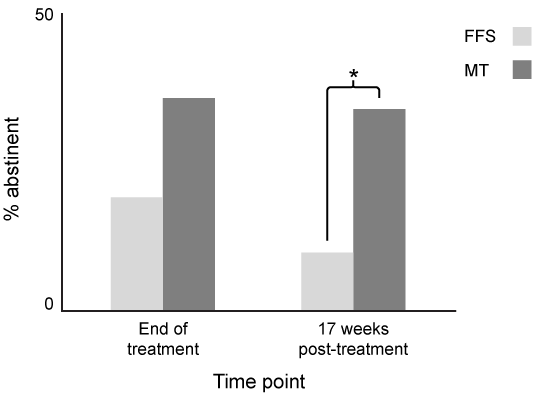 Figure 1 Percentage of participants in each group abstinent at the end of treatment and at 17-week follow-up (* indicates p < 0.05)
-Smoking behavior is:
A) positively reinforced through the removal of withdrawal symptoms and negatively reinforced through mild feelings of euphoria.
B) positively reinforced through mild feelings of euphoria and negatively reinforced through the removal of withdrawal symptoms.
C) positively reinforced through mild feelings of euphoria and negatively punished through the onset of withdrawal symptoms.
D) positively reinforced through the onset of withdrawal symptoms and positively punished through mild feelings of euphoria.
Correct Answer:

Verified
Correct Answer:
Verified
Q72: A hospital administrator claims that her hospital
Q73: Passage<br>Language is a skill acquired during early
Q74: Passage<br>Research suggests that cognitive changes occur with
Q75: According to the demographic transition model, a
Q76: Passage<br>Studies suggest that health outcomes for preventable
Q78: Passage<br>Until the middle of the twentieth century,
Q79: Passage<br>Text messaging while driving increases the risk
Q80: Passage<br>Suicide is one of the leading causes
Q81: Passage<br>Before memories have been consolidated they are
Q82: Passage<br>Health psychologists interested in studying the influence