Multiple Choice
Passage
Language is a skill acquired during early childhood that continues to develop for many years. Communication using language involves multiple complex processes, including listening, speaking, comprehension, and cognition. Receptive language ("language input") involves language comprehension, while expressive language ("language output") involves the ability to produce intelligible language. In normally developing children, receptive language emerges first, followed by expressive language.To examine how age plays a role in the activation of the neurological networks involved in processing more complex language, researchers used functional magnetic resonance imaging (fMRI) to analyze how the use of receptive language generates metabolic activity in the brains of children. A total of 672 participants were divided into three groups by age: Age 4-6 (n = 219) , age 7-9 (n = 224) , and age 10-12 (n = 229) .Participants in each group were asked to listen to pre-recorded stories while undergoing fMRI of the brain to determine if an age-related difference could be found in activated brain tissue volume during the listening task. The recorded fMRI-monitored listening portion of the experiment lasted approximately 5 minutes. Immediately following this listening exercise, fMRI monitoring was discontinued and the children were administered tests to determine comprehension of the material. None of the children had been informed that they would be taking a comprehension test prior to its actual administration.
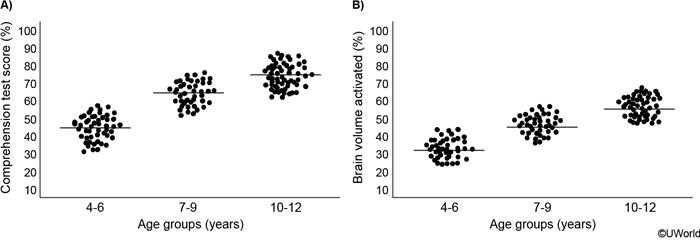 Figure 1 fMRI listening task analyzed per age group: (A) comprehension test scores, and (B) brain volume activated (Note: Solid lines represent the mean in each group.)
M. M. Berl, E. S. Duke, J. Mayo, L. R. Rosenberger, E. N. Moore, J. VanMeter, N. Bernstein Ratner, C. J. Vaidya, and W. D. Gaillard ©2010 by Elsevier, Inc.
-Does the concept of the critical period of language development help explain the differences between the age groups seen in this study?
A) Yes, because only the youngest age group was still within the critical period of language development
B) No, because all the children studied were likely still within the critical period of language development
C) Yes, because older children demonstrated greater brain volume activation than younger children
D) No, because there does not appear to be a connection between brain volume activation and language comprehension
Correct Answer:

Verified
Correct Answer:
Verified
Q252: A survey of medical students found that
Q253: Passage<br>Trait theorists believe that all people have
Q254: Passage<br>Although the terms sex, sex category, and
Q255: Passage<br>Of the biological factors impacting color perception
Q256: Passage<br>Studies suggest that health outcomes for preventable
Q258: Passage<br>Both institutional and interpersonal factors contribute to
Q259: Passage<br>Until recently, deviance has generally been conceptualized
Q260: Some studies have found an association between
Q261: Passage<br>Although the terms sex, sex category, and
Q262: Passage<br>Prominent theories of emotion have long held