Passage Both Institutional and Interpersonal Factors Contribute to Persistent Disparities in in Health
Multiple Choice
Passage
Both institutional and interpersonal factors contribute to persistent disparities in health outcomes for minorities in the U.S. In Study 1, researchers sought to categorize the major factors contributing to the disparity by surveying 2,000 African American and 3,000 Hispanic residents in a major metropolitan city. Of those surveyed, 64% met federal guidelines for living at or below the poverty threshold even though 90% of those surveyed were employed. When asked, "What prevents you from going to the doctor?" the most common responses were financial considerations (92%) , inability to get time off from work for appointments (85%) , lack of transportation (52%) , difficulty communicating with the health care provider (51%) , and fear/distrust of the health care system (48%) .Interpersonally, patients tend to fare better when their physician is of their same racial or ethnic background. Study 2 observed all Hispanic patients (n = 110) who visited a clinic in an urban lower-income community over one week. Patients met with either a Hispanic physician (n = 43) or a white, non-Hispanic physician (n = 67) . The Hispanic physician saw the patients who visited the clinic on Monday or Tuesday, and the white, non-Hispanic physician saw the patients who visited the clinic on Wednesday, Thursday, or Friday. Both physicians were men who spoke Spanish fluently, had been working at the clinic for 8-10 years, and were unaware of the study's purpose beforehand. This study collected data on the duration of the face-to-face appointment time with the physician, medication adherence one month after the appointment, and the number of symptoms disclosed to the physician by the patient. Ninety-eight of the patients were already on medication or were prescribed new medication at the time of their appointment, and patients were contacted one month later for assessment of adherence. The results of this study are shown in Figure 1.
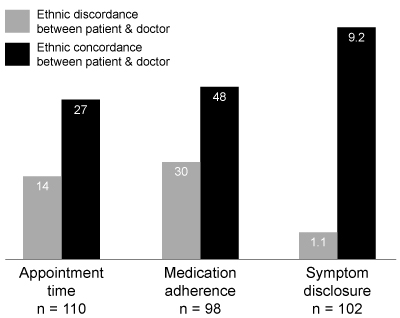 Figure 1 Average appointment time (minutes) , medication adherence (percent) , and number of symptoms disclosed according to patient-physician ethnic discordance vs. concordance
Adapted from W. Yost, (C) 2007 Academic Press.
-Based on the description of Study 2, which of the following statements identifies a potential methodological error of the study's design?
A) The physicians were unaware of the study's purpose, which may have resulted in experimenter bias.
B) The physicians were unaware of the study's purpose, which may have resulted in question-order bias.
C) The subjects were not randomly chosen, which may have resulted in sampling bias.
D) The subjects were not randomly chosen, which may have resulted in social desirability bias.
Correct Answer:

Verified
Correct Answer:
Verified
Q253: Passage<br>Trait theorists believe that all people have
Q254: Passage<br>Although the terms sex, sex category, and
Q255: Passage<br>Of the biological factors impacting color perception
Q256: Passage<br>Studies suggest that health outcomes for preventable
Q257: Passage<br>Language is a skill acquired during early
Q259: Passage<br>Until recently, deviance has generally been conceptualized
Q260: Some studies have found an association between
Q261: Passage<br>Although the terms sex, sex category, and
Q262: Passage<br>Prominent theories of emotion have long held
Q263: Passage<br>Major depression is a mood disorder that