Multiple Choice
A 49-year-old alcoholic man is admitted for diarrhea and generalized abdominal pain. His blood pressure is 134/80 mm Hg, pulse is 90/min, respirations are 16/min, and oxygen saturation is 97% on room air. He is disheveled and looks chronically ill. He is oriented to person and place. His mucous membranes are dry. His abdomen is soft and mildly tender in the epigastric region. He has no focal neurologic findings.
An electrocardiogram and chest x-ray is unremarkable. Stool samples are sent for culture and microscopic examination.
Laboratory results are as follows: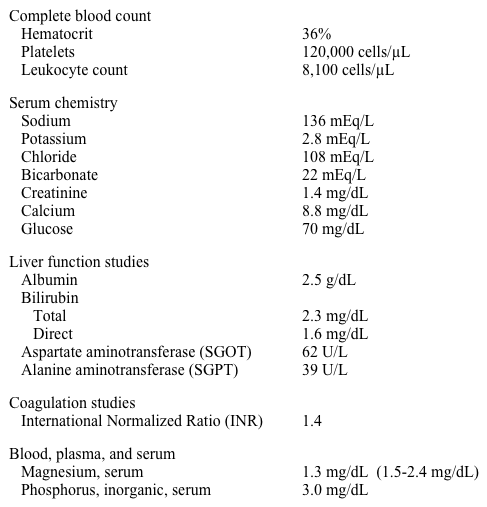
He is given thiamine and a multivitamin intravenously along with three liters of normal saline with 5% dextrose. He also receives intravenous potassium and magnesium supplementation. Thirty-six hours after admission, he complains of severe weakness. His oxygenation has decreased and he appears agitated.
Repeat laboratory results are as follows: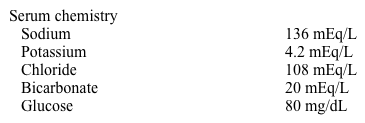
Which of the following is the most likely cause of this patient's new-onset weakness?
A) Alcohol withdrawal
B) Hypomagnesemia
C) Hypophosphatemia
D) Rhabdomyolysis
E) Wernicke's encephalopathy
Correct Answer:

Verified
Correct Answer:
Verified
Q637: A 58-year-old man with a history of
Q638: A 37-year-old man comes to the office
Q639: A 50-year-old man asks about starting a
Q640: A 25-year-old woman comes to the office
Q641: A 53-year-old woman comes to the physician
Q643: A 30-year-old woman comes to the office
Q644: You are following five patients who have
Q645: A 26-year-old man is brought to the
Q646: A 43-year-old white man comes to the
Q647: A 29-year-old woman comes to the office