Multiple Choice
You have studied the circadian clock in a certain mouse strain by monitoring the physical activity (e.g. wheel-running) of a few mice over an extended period of time. For the first week, you kept the mice under normal 12 hr light /12 hr dark cycles; they were then transferred to constant darkness. You have plotted the average activity of the mice in the following graph. The light and dark conditions are represented with white and gray backgrounds, respectively. The activity in each day is plotted in black in one row of the graph, and consecutive days are arranged from the top to the bottom. The horizontal axis represents the time of the day. Based on these results, what is the most accurate estimate for the free-running period of the circadian clock in this mouse strain? 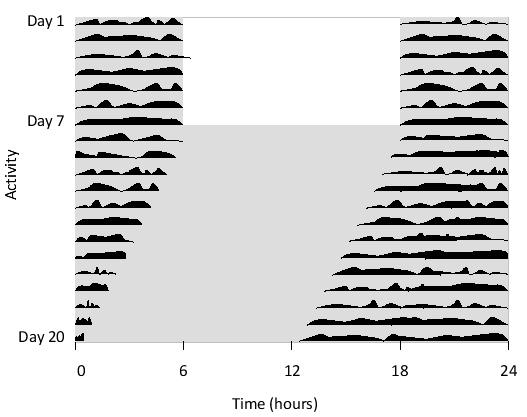
A) About 25 hr
B) About 24.5 hr
C) About 24 hr
D) About 23.5 hr
E) About 23 hr
Correct Answer:

Verified
Correct Answer:
Verified
Q2: Which of the following is NOT a
Q3: In the following graphs, the cellular response,
Q4: In the following schematic diagrams of ethylene
Q5: Consider a signaling protein that is only
Q6: Indicate true (T) and false (F) statements
Q7: Which of the following is a major
Q8: Arabidopsis thaliana seedlings show positive phototropism: they
Q9: You grow a tumor-derived cell line in
Q10: Indicate true (T) and false (F) statements
Q11: For the α subunit of a trimeric