



 Chat with AI
Exam 3: Signaling Across Synapses

Exam 1: An Invitation to Neurobiology18 Questions
Exam 2: Signaling Within Neurons45 Questions
Exam 3: Signaling Across Synapses53 Questions
Exam 4: Vision48 Questions
Exam 5: Wiring of the Visual System32 Questions
Exam 6: Olfaction, Taste, Audition, and Somatosensation43 Questions
Exam 7: Wiring of the Nervous System34 Questions
Exam 8: Motor and Regulatory Systems45 Questions
Exam 9: Sexual Behavior23 Questions
Exam 10: Memory, Learning, and Synaptic Plasticity41 Questions
Exam 11: Brain Disorders41 Questions
Exam 12: Evolution of the Nervous System33 Questions
Exam 13: Ways of Exploring43 Questions
Select questions type


Figure Q3-6 is from an experiment that helped show that neurotransmitter release is triggered by presynaptic Ca2+. In panel A, the presynaptic membrane potential was clamped at -25mV. 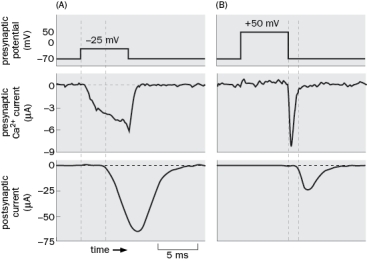 Figure Q3-6
A. How did they know Ca2+ entered the presynaptic neuron?
B. What happened in the postsynaptic neuron?
C. In panel B, the presynaptic membrane potential was clamped at -50mV. Why was there no net current during the presynaptic depolarization?
D. Why was there a current after the presynaptic potential was clamped back to -70mV?
E. What happened to the delay in postsynaptic current with the +50mV presynaptic depolarization?
Figure Q3-6
A. How did they know Ca2+ entered the presynaptic neuron?
B. What happened in the postsynaptic neuron?
C. In panel B, the presynaptic membrane potential was clamped at -50mV. Why was there no net current during the presynaptic depolarization?
D. Why was there a current after the presynaptic potential was clamped back to -70mV?
E. What happened to the delay in postsynaptic current with the +50mV presynaptic depolarization? (Essay)
4.8/5  (79)
(79) You take a 'normal' oocyte and apply ACh by iontophoresis to the oocyte and record the resulting current response with voltage clamp
A. What will the resultant current be? Explain.
B. You then inject the oocyte with mRNAs for AChR subunits and apply ACh. What will happen? Explain your answer.
(Essay)
4.8/5 (85)
(85) Figure Q3-4 documents the quantal release of neurotransmitter. 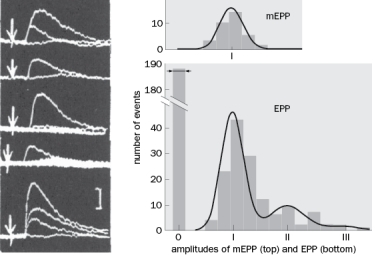 Figure Q3-4
A. The investigators stimulated the nerve in low-Ca2+ and high-Mg2+ saline so that they had many failures with nerve stimulation. Why was the presence of failures so important?
B. In the top trace, there were three motor nerve stimulations that occurred at the arrow. Why is the flat trace flat and, based on what we know now, what is the reason that the other two traces are multiples of each other?
C. The investigators compared the evoked EPPs in low Ca2+/high Mg2+ saline to spontaneous EPPs (mEPP). What did they find (see figures on the right) and what did they conclude?
D. Based on the findings in this figure, what did they conclude about transmitter release in an evoked EPP in normal saline?
Figure Q3-4
A. The investigators stimulated the nerve in low-Ca2+ and high-Mg2+ saline so that they had many failures with nerve stimulation. Why was the presence of failures so important?
B. In the top trace, there were three motor nerve stimulations that occurred at the arrow. Why is the flat trace flat and, based on what we know now, what is the reason that the other two traces are multiples of each other?
C. The investigators compared the evoked EPPs in low Ca2+/high Mg2+ saline to spontaneous EPPs (mEPP). What did they find (see figures on the right) and what did they conclude?
D. Based on the findings in this figure, what did they conclude about transmitter release in an evoked EPP in normal saline? (Essay)
4.9/5 (73)
(73) Match each of the following statements that describe either:
Correct Answer: Verified
Premises:
Responses:
(Matching)
4.8/5 (101)
(101) Fill in the missing words in the following sentence.
Glutamate is an amino acid. The neurotransmitter, _______, is derived from glutamate by the enzyme _______.
(Short Answer)
5.0/5 (85)
(85) In adult neurons, there is a higher concentration of chloride outside the cell than inside the cell. During development intracellular chloride concentrations are much higher such that GABA causes excitation of the postsynaptic neuron. Why could changing the Cl- concentration result in excitation?
(Multiple Choice)
4.9/5 (80)
(80) The canonical model for neurotransmitter release is that there is synaptic input to a dendrite which, if large enough depolarizes the voltage across the membrane and generates an action potential at the axon hillock, which travels to the axon terminal and causes the release of neurotransmitter.
Based on the concepts in this chapter, discuss how the properties below alter this model.
A. Active properties of dendrites
B. Inhibition along the dendrite
C. Presynaptic inhibition
D. Summation?
(Essay)
4.8/5 (66)
(66) Neurotransmitters can result in long-term changes in the physiological state of a neuron. One way this can happen is through activation of transcription factors, like CREB. How can neurotransmitters effect gene expression in neurons? Be as specific as possible.
(Essay)
4.7/5 (74)
(74) Otto Loewi won a Noble Prize in 1936 for showing that nerves release chemical transmitters. For one of his experiments he showed that stimulating the vagus nerve caused the heartbeat to slow down. He then collected the 'releasate' from nerve stimulation and put it on another heart, in which the heartbeat slowed as well. The substance that was release was later identified as ACh. What do we know now about the mechanism by which ACh decreases heart rate? Fill in the blanks in the following sentence.
ACh binds to the _____ cholinergic receptor, which activates a specific G protein, ____. This causes the dissociation of the trimeric G protein complex and the _____subunits bind to and activate a class of channels called _______, which OPEN/CLOSE (choose one) and result in ______ions moving INTO/OUT (choose one) of the cell. This DEPOLARIZES/HYPERPOLARIZES (choose one) the muscle cells, slowing the heartbeat.
(Short Answer)
4.7/5 (73)
(73) What are the two major/most common neurotransmitters in the vertebrate CNS?
(Multiple Choice)
4.8/5 (81)
(81) In vertebrate CNS neurons, synapses are on dendritic spines. Most of the postsynaptic receptors are on the spine head, which are attached to the dendrite through a very small spine neck. What is the consequence of this small neck? Select all that apply.
(Multiple Choice)
4.9/5 (65)
(65) The efficacy of synaptic transmission can change. What best represents synaptic facilitation?
(Multiple Choice)
4.9/5 (88)
(88) There are two main types of integration of signals, what are these and what is the difference between the two?
(Essay)
4.9/5 (73)
(73) When a trimeric G protein is activated, it dissociates into two protein complexes. What are these?
(Multiple Choice)
4.8/5 (84)
(84) When a depolarization occurs in the presynaptic terminal and Ca2+ channels open there is a large global rise in Ca2+ concentration. Defend your answer.
(True/False)
4.9/5 (76)
(76) Fill in the missing words in the following sentence.
PLC is activated by ______, a Gα variant. Activated PLC cleaves ______ to (1) ______, which in turn activates a serine/threonine kinase called ______, and (2) ______, which in turn binds to its receptor on the membrane of the endoplasmic reticulum (ER) and triggers the release of ______, interacting with an effector protein ______.
(Short Answer)
4.8/5 (87)
(87) Put the following in the correct order.
A. Neurotransmitter release
B. Ca2+ entry into the presynaptic terminal
C. Axonal action potential
D. Fusion of synaptic vesicle with the presynaptic plasma membrane
E. Opening of voltage-gated Ca2+ channels
F. Depolarization of the presynaptic terminal
(Short Answer)
4.8/5 (91)
(91) If you stimulate a glutamatergic presynaptic neuron and record the response in the postsynaptic neuron with NMDA receptors, what response will you get? Why?
(a) Depolarizing
(b) Hyperpolarizing
(c) No response
(Essay)
4.8/5 (66)
(66) 
Filters
- Essay(0)
- Multiple Choice(0)
- Short Answer(0)
- True False(0)
- Matching(0)