



 Chat with AI
Exam 12: Evolution of the Nervous System

Exam 1: An Invitation to Neurobiology18 Questions
Exam 2: Signaling Within Neurons45 Questions
Exam 3: Signaling Across Synapses53 Questions
Exam 4: Vision48 Questions
Exam 5: Wiring of the Visual System32 Questions
Exam 6: Olfaction, Taste, Audition, and Somatosensation43 Questions
Exam 7: Wiring of the Nervous System34 Questions
Exam 8: Motor and Regulatory Systems45 Questions
Exam 9: Sexual Behavior23 Questions
Exam 10: Memory, Learning, and Synaptic Plasticity41 Questions
Exam 11: Brain Disorders41 Questions
Exam 12: Evolution of the Nervous System33 Questions
Exam 13: Ways of Exploring43 Questions
Select questions type


What evidence best supports the independent gain of gyri and sulci in neocortex multiple times in the mammalian lineage?
(Multiple Choice)
4.9/5  (80)
(80) Hox genes are highly conserved players in anteroposterior patterning and were named for the homeotic transformations exhibited by their mutants in Drosophila. 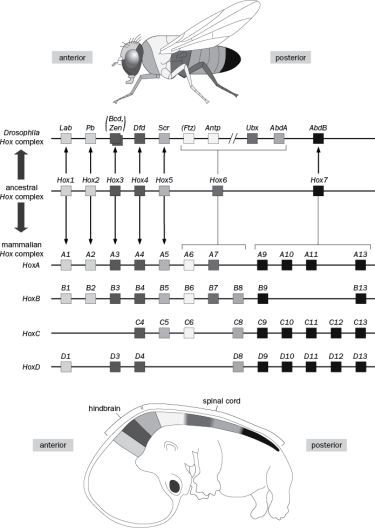 Figure
A. The original Antp mutant has legs in place of antennae. Is this a gain- or loss-of-function mutation?
B. The original Ubx mutant has a second set of wings instead of halteres (flying organs normally found on the third thoracic segment). Is this a gain- or loss-of-function mutation?
C. Although the role of Hox genes in anteroposterior patterning is conserved in vertebrates, HoxA9-13 and D9-13 are used in proximodistal limb patterning. What evolutionary events made acquisition of this novel function possible?
Figure
A. The original Antp mutant has legs in place of antennae. Is this a gain- or loss-of-function mutation?
B. The original Ubx mutant has a second set of wings instead of halteres (flying organs normally found on the third thoracic segment). Is this a gain- or loss-of-function mutation?
C. Although the role of Hox genes in anteroposterior patterning is conserved in vertebrates, HoxA9-13 and D9-13 are used in proximodistal limb patterning. What evolutionary events made acquisition of this novel function possible? (Essay)
5.0/5 (86)
(86) In clever experiments, expression of the human L-opsin gene was shown to be sufficient to improve spectral discrimination in both female mice and male squirrel monkeys.
A. Would male mice with the knocked-in human L-opsin gene be expected to perform spectral discrimination tasks as well as their heterozygous female siblings? Briefly explain your reasoning.
B. Would male squirrel monkeys with virally transduced human L-opsin be expected to perform spectral discrimination tasks as well as their heterozygous female siblings? Briefly explain your reasoning.
Evolution of Nervous System Structure and Development
(Essay)
4.8/5 (81)
(81) Some dragonfish (Stomiidae) family members have rod opsins tuned to short-wave (blue) wavelengths, which is a very common adaptation found in deep-sea fish. However, other dragonfish species both emit and detect long-wave (red) emissions. Use maximum parsimony analysis along with the phylogenetic tree in Figurein order to deduce when red color vision was lost and/or gained. 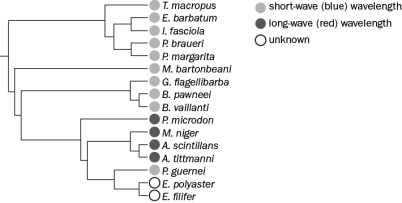 Figure
 (Essay)
4.9/5 (67)
(67) Which of the following is an example of a metazoan (animal) innovation?
(Multiple Choice)
4.7/5 (91)
(91) Humans that are born blind or deaf depend more on their remaining senses and may even experience rewiring of the neocortex for other functions. This could explain why cochlear implants or hearing aids often do not work well in individuals who have experienced extended hearing loss prior to treatment.
A. What is the experimental evidence in ferrets for adaptive specialization of the neonatal neocortex?
B. Bats that use echolocation to identify prey have expanded areas in the auditory cortex specifically tuned to the ultrasonic frequencies that they emit, while non-echolocating bats do not. Describe an experiment that could demonstrate whether this difference is due to developmental plasticity of the properties of the neocortex.
(Essay)
4.9/5 (77)
(77) Draw a parallel between gene duplication and cell duplication in the evolution of increasing specialization and complexity, and give an example of the latter.
(Essay)
4.9/5 (68)
(68) Which of the following would be an example of convergent evolution?
(Multiple Choice)
4.9/5 (74)
(74) Which of the following is an example of evolution as a result of selection acting on genetic variation?
(Multiple Choice)
4.8/5 (73)
(73) How can natural selection explain both the loss and gain of color vision at different points in our evolutionary history?
(Essay)
4.8/5 (69)
(69) Fill in each of the blanks with the best word or phrase selected from the list below. Not all words or phrases will be used; each word or phrase should be used only once.
Genetic variation arises from random ____________-changes in DNA that insert, delete, or substitute one or more base pairs, resulting in a new ____________ (version of the gene). If this change results in a phenotype that gives the organism a reproductive advantage, the new allele is likely to ____________ in frequency in the population. The ____________ of an allele can be defined as the ratio of offspring (or grandchildren) produced by individuals of a certain genotype over the highest number produced by any genotype in the population. ____________ selection increases the frequency of alleles with higher fitness. In a ____________ population, allele frequency can also change over generations due to sampling error (because not all individuals produce the same number of offspring). This change in allele frequency by chance is called genetic ____________ and could in principle even lead to the ____________ (frequency of 1) of an allele with relatively low fitness.
allele large
decrease mutation
drift negative
fitness positive
fixation shift
increase small
Evolution of Neuronal Communication
(Short Answer)
5.0/5 (73)
(73) 
Filters
- Essay(0)
- Multiple Choice(0)
- Short Answer(0)
- True False(0)
- Matching(0)