



 Chat with AI
Exam 4: Logical Database Design and the Relational Model

Exam 1: The Database Environment and Development Process173 Questions
Exam 2: Modeling Data in the Organization121 Questions
Exam 3: The Enhanced E-R Model and Business Rules74 Questions
Exam 4: Logical Database Design and the Relational Model120 Questions
Exam 5: Physical Database Design and Performance105 Questions
Exam 6: Introduction to SQL119 Questions
Exam 7: Advanced SQL111 Questions
Exam 8: Database Application Development100 Questions
Exam 9: Data Warehousing117 Questions
Exam 10: Data Quality and Integration102 Questions
Exam 11: Data and Database Administration116 Questions
Exam 12: Distributed Databases109 Questions
Exam 13: Object-Oriented Data Modeling91 Questions
Exam 14: Using Relational Databases to Provide Object Persistence113 Questions
Select questions type


The attribute on the left-hand side of the arrow in a functional dependency is the:
(Multiple Choice)
4.8/5  (85)
(85) The ________ states that no primary key attribute can be null.
(Short Answer)
4.8/5 (90)
(90) An attribute that may have more than one meaning is called a(n)________.
(Short Answer)
4.8/5 (70)
(70) When creating tables using the CREATE TABLE statement,NOT NULL constrains an attribute from being assigned a(n)________ value.
(Short Answer)
4.9/5 (83)
(83) In the figure below,what type of relationship is depicted?
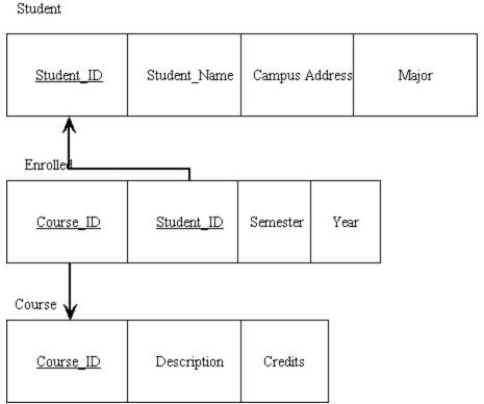
(Multiple Choice)
4.8/5 (86)
(86) The normal form which removes any remaining functional dependencies because there was more than one primary key for the same nonkeys is called:
(Multiple Choice)
4.8/5 (76)
(76) When two or more attributes describe the same characteristic of an entity,they are synonyms.
(True/False)
4.7/5 (80)
(80) In the SQL language,the ________ statement is used to make table definitions.
(Multiple Choice)
4.8/5 (82)
(82) When normalizing,the goal is to decompose relations with anomalies to produce smaller,well-structured relations.
(True/False)
4.9/5 (82)
(82) When transforming a one-to-one relationship,a new relation is always created.
(True/False)
5.0/5 (75)
(75) An attribute (or attributes)that uniquely identifies each row in a relation is called a:
(Multiple Choice)
4.9/5 (71)
(71) Sample data are useful for developing prototype applications and for testing queries.
(True/False)
4.9/5 (89)
(89) A referential integrity constraint states that each ________ value must match a(n)________ value in another relation or be blank.
(Short Answer)
4.9/5 (70)
(70) Explain how subtype/supertype relationships are converted to relations.
(Essay)
4.8/5 (74)
(74) The primary key of the many side migrates to the one side when transforming a one-to-many relationship.
(True/False)
5.0/5 (78)
(78) 
Filters
- Essay(0)
- Multiple Choice(0)
- Short Answer(0)
- True False(0)
- Matching(0)