



 Chat with AI
Exam 4: Linear Programming: Modeling Examples

Exam 1: Management Science121 Questions
Exam 2: Linear Programming: Model Formulation and Graphical Solution122 Questions
Exam 3: Linear Programming: Computer Solution and Sensitivity Analysis95 Questions
Exam 4: Linear Programming: Modeling Examples90 Questions
Exam 5: Integer Programming107 Questions
Exam 6: Transportation, Transshipment, and Assignment Problems98 Questions
Exam 7: Network Flow Models104 Questions
Exam 8: Project Management116 Questions
Exam 9: Multicriteria Decision Making103 Questions
Exam 10: Nonlinear Programming72 Questions
Exam 11: Probability and Statistics152 Questions
Exam 12: Decision Analysis122 Questions
Exam 13: Queuing Analysis123 Questions
Exam 14: Simulation100 Questions
Exam 15: Forecasting133 Questions
Exam 16: Inventory Management157 Questions
Exam 17: the Simplex Solution Method90 Questions
Exam 18: Transportation and Assignment Solution Methods86 Questions
Exam 19: Integer Programming: the Branch and Bound Method63 Questions
Exam 20: Nonlinear Programming: Solution Techniques55 Questions
Exam 21: Game Theory64 Questions
Exam 22: Markov Analysis64 Questions
Select questions type


Bullseye Shirt Company makes three types of shirts: athletic, varsity, and surfer. The shirts are made from different combinations of cotton and rayon. The cost per yard of cotton is $5 and the cost for rayon is $7. Bullseye can receive up to 4000 yards of cotton and 3000 yards of rayon per week.
The table below shows relevant manufacturing information:
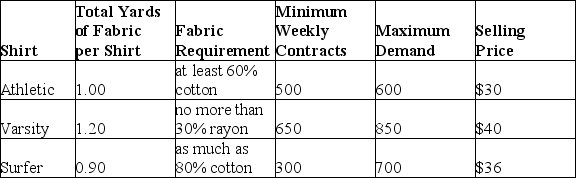 -Assume that the decision variables are defined as follows:
A = total number of athletic shirts produced
V = total number of varsity shirts produced
S = total number of surfer shirts produced
C = yards of cotton purchased
R = yards of rayon purchased
Xij = yards of fabric i (C or R) blended into shirt j (A, V or S)
Write the objective function.
-Assume that the decision variables are defined as follows:
A = total number of athletic shirts produced
V = total number of varsity shirts produced
S = total number of surfer shirts produced
C = yards of cotton purchased
R = yards of rayon purchased
Xij = yards of fabric i (C or R) blended into shirt j (A, V or S)
Write the objective function. (Short Answer)
4.8/5  (79)
(79) Let xij = gallons of component i used in gasoline j. Assume that we have two components and two types of gasoline. There are 8000 gallons of component 1 available, and the demand gasoline types 1 and 2 are 11,000 and 14,000 gallons, respectively. Write the constraint stating that the component 1 cannot account for more than 35% of the gasoline type 1.
(Multiple Choice)
5.0/5 (74)
(74) Andy Tyre manages Tyre's Wheels, Inc. Andy has received an order for 1000 standard wheels and 1200 deluxe wheels for next month, and for 750 standard wheels and 1000 deluxe wheels the following months. He must fill all the orders. The cost of regular time production for standard wheels is $25 and for deluxe wheels, $40. Overtime production costs 50% more. For each of the next two months there are 1000 hours of regular time production and 500 hours of overtime production available. A standard wheel requires .5 hour of production time and a deluxe wheel, .6 hour. The cost of carrying a wheel from one month to the next is $2.
-Write the constraints for this problem.
(Essay)
4.7/5 (89)
(89) In a transportation problem, a supply constraint (the maximum amount of product available for shipment or distribution at a given source) is a greater-than-or equal-to constraint (≥).
(True/False)
4.8/5 (87)
(87) When using a linear programming model to solve the diet problem, the objective is generally to maximize nutritional content.
(True/False)
4.9/5 (79)
(79) Assume that x2, x7 and x8 are the dollars invested in three different common stocks from New York Stock Exchange. In order to diversify the investments, the investing company requires that no more than 60% of the dollars invested can be in "stock 2". The constraint for this requirement can be written as:
(Multiple Choice)
4.8/5 (85)
(85) The owner of Chips etc. produces two kinds of chips: lime (L) and vinegar (V). He has a limited amount of the three ingredients used to produce these chips available for his next production run: 4800 ounces of salt, 9600 ounces of flour, and 2000 ounces of herbs. A bag of lime chips requires 2 ounces of salt, 6 ounces of flour, and 1 ounce of herbs to produce; while a bag of vinegar chips requires 3 ounces of salt, 8 ounces of flour, and 2 ounces of herbs. Profits for a bag of lime chips are $0.40, and for a bag of vinegar chips $0.50.
-The production combination of 450 bags of lime and 800 bags of vinegar is not feasible because one resource is exceeded. Which resource is exceeded and how much more is needed to produce this combination?
(Short Answer)
4.8/5 (100)
(100) A conservative approach to a balanced transportation model would be to make all constraints less-than-or-equal-to constraints.
(True/False)
4.9/5 (77)
(77) In a transportation problem, the supply constraint represents the maximum amount of product available for shipment or distribution at a given source (plant, warehouse, mill).
(True/False)
4.9/5 (81)
(81) Let xij = gallons of component i used in gasoline j. Assume that we have two components and two types of gasoline. There are 8000 gallons of component 1 available, and the demand gasoline types 1 and 2 are 11,000 and 14,000 gallons, respectively. Write the supply constraint for component 1.
(Multiple Choice)
4.9/5 (67)
(67) Determining the production quantities of different products manufactured by a company based on resource constraints is a product mix linear programming problem.
(True/False)
4.9/5 (81)
(81) The owner of Chips etc. produces two kinds of chips: lime (L) and vinegar (V). He has a limited amount of the three ingredients used to produce these chips available for his next production run: 4800 ounces of salt, 9600 ounces of flour, and 2000 ounces of herbs. A bag of lime chips requires 2 ounces of salt, 6 ounces of flour, and 1 ounce of herbs to produce; while a bag of vinegar chips requires 3 ounces of salt, 8 ounces of flour, and 2 ounces of herbs. Profits for a bag of lime chips are $0.40, and for a bag of vinegar chips $0.50.
-What is the constraint for salt?
(Multiple Choice)
5.0/5 (75)
(75) Balanced transportation problems have the following type of constraints:
(Multiple Choice)
4.9/5 (75)
(75) The owner of Black Angus Ranch is trying to determine the correct mix of two types of beef feed, A and B, which cost 50 cents and 75 cents per pound, respectively. Five essential ingredients are contained in the feed, shown in the table below. The table also shows the minimum daily requirements of each ingredient.
Percent per Percent per Minimum daily requirement Ingredient pound in Feed A pound in Feed B (pounds) 1 20 24 30 2 30 10 50 3 0 30 20 4 24 15 60 5 10 20 40
The constraint for ingredient 3 is:
(Multiple Choice)
4.7/5 (95)
(95) A linear programming model of a media selection problem is used to determine the relative value of each advertising media.
(True/False)
4.8/5 (84)
(84) Product mix problems cannot have greater-than-or-equal-to (≥) constraints.
(True/False)
4.9/5 (85)
(85) Solutions to diet problems in linear programming are always realistic.
(True/False)
4.9/5 (89)
(89) If Xab = the production of product a in period b, then to indicate that the limit on production of the company's 3 products in period 2 is 400, we write:
(Multiple Choice)
4.8/5 (80)
(80) In a media selection problem, maximization of audience exposure may not result in maximization of total profit.
(True/False)
4.7/5 (75)
(75) 
Filters
- Essay(0)
- Multiple Choice(0)
- Short Answer(0)
- True False(0)
- Matching(0)