



 Chat with AI
Exam 17: the Simplex Solution Method

Exam 1: Management Science121 Questions
Exam 2: Linear Programming: Model Formulation and Graphical Solution122 Questions
Exam 3: Linear Programming: Computer Solution and Sensitivity Analysis95 Questions
Exam 4: Linear Programming: Modeling Examples90 Questions
Exam 5: Integer Programming107 Questions
Exam 6: Transportation, Transshipment, and Assignment Problems98 Questions
Exam 7: Network Flow Models104 Questions
Exam 8: Project Management116 Questions
Exam 9: Multicriteria Decision Making103 Questions
Exam 10: Nonlinear Programming72 Questions
Exam 11: Probability and Statistics152 Questions
Exam 12: Decision Analysis122 Questions
Exam 13: Queuing Analysis123 Questions
Exam 14: Simulation100 Questions
Exam 15: Forecasting133 Questions
Exam 16: Inventory Management157 Questions
Exam 17: the Simplex Solution Method90 Questions
Exam 18: Transportation and Assignment Solution Methods86 Questions
Exam 19: Integer Programming: the Branch and Bound Method63 Questions
Exam 20: Nonlinear Programming: Solution Techniques55 Questions
Exam 21: Game Theory64 Questions
Exam 22: Markov Analysis64 Questions
Select questions type


The linear programming problem whose output follows determines how many red nail polishes, blue nail polishes, green nail polishes, and pink nail polishes a beauty salon should stock. The objective function measures profit; it is assumed that every piece stocked will be sold. Constraint 1 measures display space in units, constraint 2 measures time to set up the display in minutes. Constraints 3 and 4 are marketing restrictions.
MAX 100x1 + 120x2 + 150x3 + 125x4
Subject to 1. x1 + 2x2 + 2x3 + 2x4 ? 108
2. 3x1 + 5x2 + x4 ? 120
3. x1 + x3 ? 25
4. x2 + x3 + x4 > 50
x1, x2, x3, x4 ? 0
Optimal Solution:
Objective Function Value = 7475.000
Variable Value Reduced Costs X1 8 0 X2 0 5 X3 17 0 X4 33 0
Constraint Slack/Surplus Dual Prices 1 0 75 2 63 0 3 0 25 4 0 -25 Objective Coefficient Ranges
Variable Lower Limit Current Value Upper Limit X1 87.5 100 none X2 none 120 125 X3 125 150 162 X4 120 125 150 Right Hand Side Ranges
Constraint Lower Limit Current Value Upper Limit 1 100 108 123.75 2 57 120 none 3 8 25 58 4 41.5 50 54
-What is the profit?
(Short Answer)
4.8/5  (75)
(75) The linear programming problem whose output follows determines how many red nail polishes, blue nail polishes, green nail polishes, and pink nail polishes a beauty salon should stock. The objective function measures profit; it is assumed that every piece stocked will be sold. Constraint 1 measures display space in units, constraint 2 measures time to set up the display in minutes. Constraints 3 and 4 are marketing restrictions.
MAX 100x1 + 120x2 + 150x3 + 125x4
Subject to 1. x1 + 2x2 + 2x3 + 2x4 ? 108
2. 3x1 + 5x2 + x4 ? 120
3. x1 + x3 ? 25
4. x2 + x3 + x4 > 50
x1, x2, x3, x4 ? 0
Optimal Solution:
Objective Function Value = 7475.000
Variable Value Reduced Costs X1 8 0 X2 0 5 X3 17 0 X4 33 0
Constraint Slack/Surplus Dual Prices 1 0 75 2 63 0 3 0 25 4 0 -25 Objective Coefficient Ranges
Variable Lower Limit Current Value Upper Limit X1 87.5 100 none X2 none 120 125 X3 125 150 162 X4 120 125 150 Right Hand Side Ranges
Constraint Lower Limit Current Value Upper Limit 1 100 108 123.75 2 57 120 none 3 8 25 58 4 41.5 50 54
-By how much can the profit on green nail polish increase before the solution would change?
(Short Answer)
4.8/5 (76)
(76) Consider the following linear programming problem and the corresponding final tableau.
MAX =3+5 s.t. \leq4 2\leq12 3+2\geq18
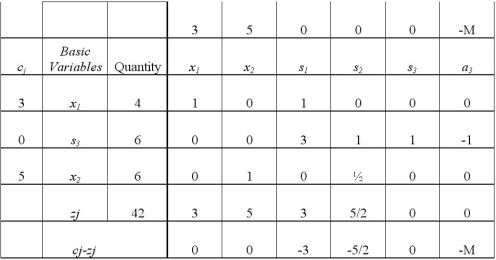 What is the sensitivity range for the first constraint?
 (Essay)
4.9/5 (78)
(78) The ________ form of a linear program is used to determine how much one should pay for additional resources.
(Short Answer)
5.0/5 (73)
(73) In the simplex procedure, if all cj - zj ≤ 0 and one or more of the basic variables are artificial, this indicates that
(Multiple Choice)
4.9/5 (82)
(82) Given the following linear programming problem:
maximize 4+3 subject to 4+3\leq23 5-\leq5 ,\geq0
What is the (Cj - Zj) value for S1 at the initial solution?
(Short Answer)
4.7/5 (69)
(69) The simplex method ________ be used to solve quadratic programming problems.
(Multiple Choice)
4.7/5 (82)
(82) In using the simplex method, ________ optimal solutions are identified by cj - zj = 0 for a non-basic variable.
(Short Answer)
4.8/5 (76)
(76) The leaving variable is determined by ________ the quantity values ________ the pivot column values and selecting the minimum possible value or zero.
(Multiple Choice)
4.8/5 (84)
(84) A change in the objective function coefficient of a basic variable cannot change the value of zj for a non-basic variable in the final simplex tableau.
(True/False)
4.7/5 (74)
(74) The first step in solving a linear programming model manually with the simplex method is to convert the model into ________ form.
(Short Answer)
4.9/5 (88)
(88) Row operations are used to solve simultaneous equations where equations are ________ by constants and added to or subtracted from each other.
(Multiple Choice)
4.8/5 (83)
(83) A primal maximization model with ≤ constraints converts to a ________ minimization model with constraints.
(Short Answer)
4.9/5 (62)
(62) At the initial basic feasible solution at the origin, only slack variables have a value greater than 1.
(True/False)
4.9/5 (72)
(72) A(n) ________ maximization linear programming problem has an artificial variable in the final simplex tableau where all cj - zj values are less than or equal to zero.
(Short Answer)
4.7/5 (80)
(80) Given the following linear programming problem:
maximize =\ 100+80 subject to +2\leq40 3+\leq60 ,\geq0
Using the simplex method, what is the value for S1 in the final basic feasible solution?
(Short Answer)
4.8/5 (86)
(86) The ________ variable allows for an initial basic feasible solution, but it has no meaning. Therefore, after we get the simplex tableau started, they are discarded in later iterations.
(Short Answer)
4.8/5 (87)
(87) The ________ column is the column corresponding to the entering variable.
(Short Answer)
4.8/5 (85)
(85) At the initial basic feasible solution at the origin, only slack variables have a value greater than:
(Multiple Choice)
4.8/5 (73)
(73) Given the following linear programming problem:
maximize =\ 100+80 subject to +2\leq40 3+\leq60 ,\geq0
Using the simplex method, what is the value for S2 in the optimal tableau?
(Short Answer)
4.9/5 (76)
(76) 
Filters
- Essay(0)
- Multiple Choice(0)
- Short Answer(0)
- True False(0)
- Matching(0)