



 Chat with AI
Exam 15: Body Mechanics and Patient Mobility

Exam 1: the Evolution of Nursing35 Questions
Exam 2: Legal and Ethical Aspects of Nursing30 Questions
Exam 3: Communication48 Questions
Exam 4: Vital Signs27 Questions
Exam 5: Physical Assessment88 Questions
Exam 6: Nursing Process and Critical Thinking56 Questions
Exam 7: Documentation29 Questions
Exam 8: Cultural and Ethnic Considerations44 Questions
Exam 9: Life Span Development70 Questions
Exam 10: Loss, grief , dying, and Death23 Questions
Exam 11: Admission, Transfer, and Discharge18 Questions
Exam 12: Medical-Surgical Asepsis and Infection Prevention and Control43 Questions
Exam 13: Surgical Wound Care35 Questions
Exam 14: Safety16 Questions
Exam 15: Body Mechanics and Patient Mobility21 Questions
Exam 16: Pain Management, Comfort, Rest, and Sleep39 Questions
Exam 17: Complementary and Alternative Therapies29 Questions
Exam 18: Hygiene and Care of the Patient’s Environment37 Questions
Exam 19: Specimen Collection and Diagnostic Examination40 Questions
Exam 20: Selected Nursing Skills24 Questions
Exam 21: Basic Nutrition and Nutrition Therapy39 Questions
Exam 22: Fluids and Electrolytes29 Questions
Exam 23: Mathematics Review and Medication Administration43 Questions
Exam 24: Emergency First Aid Nursing35 Questions
Exam 25: Health Promotion and Pregnancy35 Questions
Exam 26: Labor and Delivery37 Questions
Exam 27: Care of the Mother and Newborn38 Questions
Exam 28: Care of the High-Risk Mother, Newborn, and Family with Special Needs42 Questions
Exam 29: Health Promotion for the Infant, Child, and Adolescent24 Questions
Exam 30: Basic Pediatric Nursing Care43 Questions
Exam 31: Care of the Child with a Physical Disorder53 Questions
Exam 32: Care of the Child with a Mental or Cognitive Disorder33 Questions
Exam 33: Health Promotion and Care of the Older Adult39 Questions
Exam 34: Basic Concepts of Mental Health41 Questions
Exam 35: Care of the Patient with a Psychiatric Disorder39 Questions
Exam 36: Care of the Patient with an Addictive Personality38 Questions
Exam 37: Home Health Nursing35 Questions
Exam 38: Long-Term Care34 Questions
Exam 39: Rehabilitation Nursing39 Questions
Exam 40: Hospice Care38 Questions
Exam 41: Professional Roles and Leadership29 Questions
Select questions type


Place the nursing activities in priority order for the preparation of a patient to ambulate.
1.Dangle the patient at the side of the bed.
2.Apply a gait belt.
3.Assist the patient to stand.
4.Inform the patient of activity.
5.Roll up the head of the bed.
Put a comma between each solve choice (1,2,3,4,etc.).

Free
(Short Answer)
4.8/5  (66)
(66) Correct Answer: Verified
4,5,1,2,3
4,5,1,2,3
The order that is most organized is inform,roll up head of bed,dangle,apply belt,and assist to stand.
Studies of workers' compensation claims show that the profession that has the highest claim rates of any occupation or industry is:
Free
(Multiple Choice)
4.7/5 (89)
(89) Correct Answer:Verified
VerifiedD
The nurse explains that the minimum number of hours of daily activity necessary to prevent the negative consequences of immobility is:
Free
(Multiple Choice)
4.9/5 (89)
(89) Correct Answer:Verified
VerifiedA
When carrying heavy objects,the nurse should place the load:
(Multiple Choice)
4.9/5 (84)
(84) When lifting or moving a patient,the nurse should protect his or her back by:
(Multiple Choice)
4.9/5 (82)
(82) The nurse counsels the immobilized patient that to prevent muscle atrophy and contractures,the patient must have:
(Multiple Choice)
4.9/5 (88)
(88) A nurse instructing a nursing assistant about moving older adult patients in bed should intervene after observing the nursing assistant:
(Multiple Choice)
4.9/5 (74)
(74) The nurse informs the patient that to regain the ability to perform ADLs and maintain normal physiological activities requires:
(Multiple Choice)
4.9/5 (85)
(85) Because moving or ambulation may be painful for the patient,to assist the patient with moving,the nurse should:
(Multiple Choice)
4.9/5 (90)
(90) To maintain a wide base of support,the nurse should stand with the feet separated by the distance of _______ times the length of the nurse's shoe.
(Short Answer)
4.9/5 (76)
(76) When performing passive range-of-motion (ROM)exercises,the number of times the nurse should move each joint through the ROM is:
(Multiple Choice)
4.7/5 (84)
(84) The most common cause of musculoskeletal disorders in nurses involves a movement that requires the nurse to ________ and _________ at the same time.
(Short Answer)
4.9/5 (88)
(88) An implementation the nurse may use to improve safety during a transfer is:
(Multiple Choice)
4.8/5 (78)
(78) The nurse explains that when range of motion (ROM)is performed by the patient,it is called:
(Multiple Choice)
4.8/5 (82)
(82) The nurse points to the X in the illustration below and describes this point as the ________ of _________.
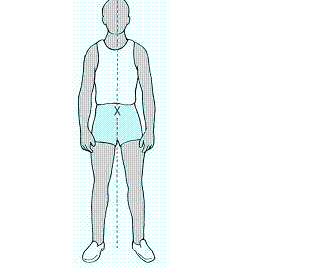
(Short Answer)
4.8/5 (78)
(78) The nurse performing passive range of motion (ROM)for the patient will move the joint through the ROM to:
(Multiple Choice)
4.8/5 (80)
(80) Although many nurses file worker's compensation claims as a result of injury on the job,the most common injury is strain of the:
(Multiple Choice)
4.8/5 (77)
(77) To reduce the effort of moving a heavy object,the nurse should:
(Multiple Choice)
4.9/5 (77)
(77) The nurse instructs a nursing assistant to use large muscle groups when lifting because:
(Multiple Choice)
4.8/5 (77)
(77) When a fall occurs,the nurse should document the incident and initiate a(n)___________ report.
(Short Answer)
4.9/5 (66)
(66) 
Filters
- Essay(0)
- Multiple Choice(0)
- Short Answer(0)
- True False(0)
- Matching(0)