



 Chat with AI
Exam 2: Trade-Offs, comparative Advantage, and the Market System

Exam 1: Economics: Foundations and Models213 Questions
Exam 2: Trade-Offs, comparative Advantage, and the Market System237 Questions
Exam 3: Where Prices Come From: the Interaction of Demand and Supply234 Questions
Exam 4: Economic Efficiency,government Price Setting,and Taxes212 Questions
Exam 5: The Economics of Health Care166 Questions
Exam 6: Firms, the Stock Market, and Corporate Governance258 Questions
Exam 7: Comparative Advantage and the Gains From International Trade188 Questions
Exam 8: Gdp: Measuring Total Production and Income261 Questions
Exam 9: Unemployment and Inflation291 Questions
Exam 10: Economic Growth, the Financial System, and Business Cycles253 Questions
Exam 11: Long-Run Economic Growth: Sources and Policies262 Questions
Exam 12: Aggregate Expenditure and Output in the Short Run299 Questions
Exam 13: Aggregate Demand and Aggregate Supply Analysis286 Questions
Exam 14: Money,banks,and the Federal Reserve System281 Questions
Exam 15: Monetary Policy275 Questions
Exam 16: Fiscal Policy306 Questions
Exam 17: Inflation,unemployment,and Federal Reserve Policy257 Questions
Exam 18: Macroeconomics in an Open Economy278 Questions
Exam 19: The International Financial System258 Questions
Select questions type


Figure 2-9  Figure 2-9 shows the production possibilities frontiers for Greenland and Iceland.Each country produces two goods,snow cones and popsicles.
-Refer to Figure 2-9.What is the opportunity cost of producing 1 popsicle in Iceland?
Figure 2-9 shows the production possibilities frontiers for Greenland and Iceland.Each country produces two goods,snow cones and popsicles.
-Refer to Figure 2-9.What is the opportunity cost of producing 1 popsicle in Iceland? (Multiple Choice)
5.0/5  (85)
(85) Figure 2-13 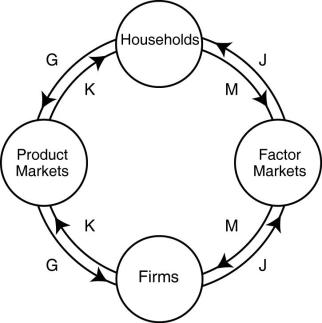 -Refer to Figure 2-13.Which two arrows in the diagram depict the following transaction: Carter earns a $400 commission for selling men's designer shoes at Brooks Brothers.
 (Multiple Choice)
4.9/5 (85)
(85) Figure 2-1 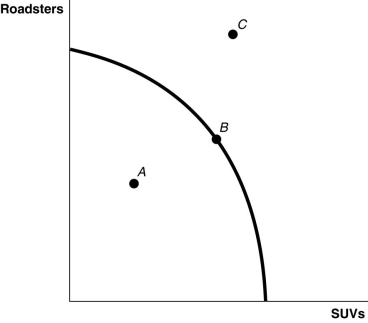 -Refer to Figure 2-1.________ is (are)technically efficient.
 (Multiple Choice)
4.9/5 (88)
(88) Figure 2-4  Figure 2-4 shows various points on three different production possibilities frontiers for a nation.
-Refer to Figure 2-4.Consider the following events: a.a reduction in the patent protection period to no more than 2 years
B.a war that destroys a substantial portion of a nation's capital stock
C.the lack of secure and enforceable property rights system
Which of the events listed above could cause a movement from W to V?
Figure 2-4 shows various points on three different production possibilities frontiers for a nation.
-Refer to Figure 2-4.Consider the following events: a.a reduction in the patent protection period to no more than 2 years
B.a war that destroys a substantial portion of a nation's capital stock
C.the lack of secure and enforceable property rights system
Which of the events listed above could cause a movement from W to V? (Multiple Choice)
4.8/5 (86)
(86) Figure 2-8  Figure 2-8 shows the production possibilities frontiers for Costa Rica and Guatemala.Each country produces two goods,pineapples and coconuts.
-Refer to Figure 2-8.Which country has a comparative advantage in the production of pineapples?
Figure 2-8 shows the production possibilities frontiers for Costa Rica and Guatemala.Each country produces two goods,pineapples and coconuts.
-Refer to Figure 2-8.Which country has a comparative advantage in the production of pineapples? (Multiple Choice)
5.0/5 (83)
(83) Table 2-8
 Table 2-8 shows the output per month of two people,Wilma and Betty.They can either devote their time to making marble statues or making marble benches.
-Refer to Table 2-8.What is Betty's opportunity cost of making a bench?
Table 2-8 shows the output per month of two people,Wilma and Betty.They can either devote their time to making marble statues or making marble benches.
-Refer to Table 2-8.What is Betty's opportunity cost of making a bench? (Multiple Choice)
4.8/5 (68)
(68) Table 2-5
 Table 2-5 shows the number of labor hours required to produce a cell phone and a board foot of lumber in Estonia and Finland.
-Refer to Table 2-5.Finland has a comparative advantage in the production of
Table 2-5 shows the number of labor hours required to produce a cell phone and a board foot of lumber in Estonia and Finland.
-Refer to Table 2-5.Finland has a comparative advantage in the production of (Multiple Choice)
4.9/5 (94)
(94) In the desire to have a celebrity's image protected to prevent it from being used in ways he would not approve,a celebrity's estate
(Multiple Choice)
4.9/5 (74)
(74) Figure 2-9 Figure 2-9 shows the production possibilities frontiers for Greenland and Iceland.Each country produces two goods,snow cones and popsicles.
-Refer to Figure 2-9.Which country has a comparative advantage in the production of popsicles?
Figure 2-9 shows the production possibilities frontiers for Greenland and Iceland.Each country produces two goods,snow cones and popsicles.
-Refer to Figure 2-9.Which country has a comparative advantage in the production of popsicles? (Multiple Choice)
4.9/5 (86)
(86) The unattainable points in a production possibilities diagram are
(Multiple Choice)
4.8/5 (83)
(83) All of the following are examples of spending on goods and services in the circular flow model except
(Multiple Choice)
4.8/5 (69)
(69) Table 2-7
 Table 2-7 shows the output per week of two people,Minnie and Mickey.They can either devote their time to making hats or making umbrellas.
-Refer to Table 2-7.What is Minnie's opportunity cost of making an umbrella?
Table 2-7 shows the output per week of two people,Minnie and Mickey.They can either devote their time to making hats or making umbrellas.
-Refer to Table 2-7.What is Minnie's opportunity cost of making an umbrella? (Multiple Choice)
4.8/5 (73)
(73) Figure 2-1
-Refer to Figure 2-1.________ is (are)unattainable with current resources.
-Refer to Figure 2-1.________ is (are)unattainable with current resources. (Multiple Choice)
4.9/5 (88)
(88) Figure 2-2  Figure 2-2 above shows the production possibilities frontier for Vidalia,a nation that produces two goods,roses and orchids.
-Refer to Figure 2-2.If Vidalia chooses to produce 80 dozen roses,how many orchids can it produce to maximize production?
Figure 2-2 above shows the production possibilities frontier for Vidalia,a nation that produces two goods,roses and orchids.
-Refer to Figure 2-2.If Vidalia chooses to produce 80 dozen roses,how many orchids can it produce to maximize production? (Multiple Choice)
4.9/5 (82)
(82) Table 2-5
Table 2-5 shows the number of labor hours required to produce a cell phone and a board foot of lumber in Estonia and Finland.
-Refer to Table 2-5.What is Estonia's opportunity cost of producing one board foot of lumber?
Table 2-5 shows the number of labor hours required to produce a cell phone and a board foot of lumber in Estonia and Finland.
-Refer to Table 2-5.What is Estonia's opportunity cost of producing one board foot of lumber? (Multiple Choice)
4.9/5 (77)
(77) The idea underlying Adam Smith's "invisible hand" is that people tend to behave in ways that go unnoticed in society.
(True/False)
4.8/5 (89)
(89) For each watch that Switzerland produces,it gives up the opportunity to make 50 pounds of chocolate.Germany can produce 1 watch for every 100 pounds of chocolate it produces.Which of the following is true about the comparative advantage between the two countries?
(Multiple Choice)
4.9/5 (81)
(81) Figure 2-9 Figure 2-9 shows the production possibilities frontiers for Greenland and Iceland.Each country produces two goods,snow cones and popsicles.
-Refer to Figure 2-9.What is the opportunity cost of producing 1 snow cone in Greenland?
Figure 2-9 shows the production possibilities frontiers for Greenland and Iceland.Each country produces two goods,snow cones and popsicles.
-Refer to Figure 2-9.What is the opportunity cost of producing 1 snow cone in Greenland? (Multiple Choice)
4.8/5 (86)
(86) 
Filters
- Essay(0)
- Multiple Choice(0)
- Short Answer(0)
- True False(0)
- Matching(0)