



 Chat with AI
Exam 4: Economic Efficiency,government Price Setting,and Taxes

Exam 1: Economics: Foundations and Models213 Questions
Exam 2: Trade-Offs, comparative Advantage, and the Market System237 Questions
Exam 3: Where Prices Come From: the Interaction of Demand and Supply234 Questions
Exam 4: Economic Efficiency,government Price Setting,and Taxes212 Questions
Exam 5: The Economics of Health Care166 Questions
Exam 6: Firms, the Stock Market, and Corporate Governance258 Questions
Exam 7: Comparative Advantage and the Gains From International Trade188 Questions
Exam 8: Gdp: Measuring Total Production and Income261 Questions
Exam 9: Unemployment and Inflation291 Questions
Exam 10: Economic Growth, the Financial System, and Business Cycles253 Questions
Exam 11: Long-Run Economic Growth: Sources and Policies262 Questions
Exam 12: Aggregate Expenditure and Output in the Short Run299 Questions
Exam 13: Aggregate Demand and Aggregate Supply Analysis286 Questions
Exam 14: Money,banks,and the Federal Reserve System281 Questions
Exam 15: Monetary Policy275 Questions
Exam 16: Fiscal Policy306 Questions
Exam 17: Inflation,unemployment,and Federal Reserve Policy257 Questions
Exam 18: Macroeconomics in an Open Economy278 Questions
Exam 19: The International Financial System258 Questions
Select questions type


Figure 4-10 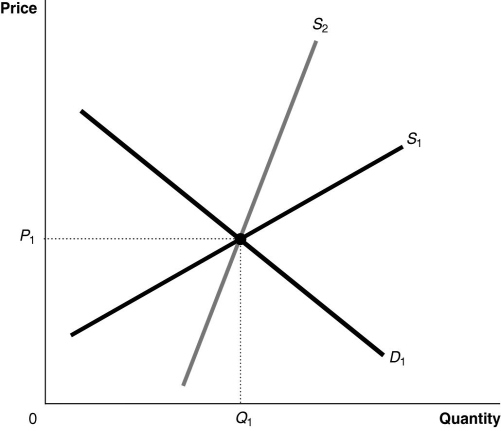 -Refer to Figure 4-10.Suppose the market is initially in equilibrium at price P1 and now the government imposes a tax on every unit sold.Which of the following statements best describes the impact of the tax? For demand curve D1
 (Multiple Choice)
4.7/5  (77)
(77) Figure 4-1  Figure 4-1 shows Kendra's demand curve for ice cream cones.
-Refer to Figure 4-1.What is the total amount that Kendra is willing to pay for 1 ice cream cone?
Figure 4-1 shows Kendra's demand curve for ice cream cones.
-Refer to Figure 4-1.What is the total amount that Kendra is willing to pay for 1 ice cream cone? (Multiple Choice)
4.8/5 (90)
(90) The demand and supply equations for the peach market are:
Demand: P = 24 - 0.5Q
Supply: P = -6 + 2.5Q
where P = price per bushel,and Q = quantity (in thousands).
a.Calculate the equilibrium price and quantity.
b.Suppose the government guaranteed producers a price of $24 per bushel.What would be the effect on quantity supplied? Provide a numerical value.
c.By how much would the $24 price change the quantity of peaches demanded? Provide a numerical value.
d.Would there be a shortage or surplus of peaches?
e.What is the size of this shortage or surplus? Provide a numerical value.
(Essay)
4.9/5 (86)
(86) Figure 4-1 Figure 4-1 shows Kendra's demand curve for ice cream cones.
-Refer to Figure 4-1.If the market price is $2.50,what is Kendra's consumer surplus?
Figure 4-1 shows Kendra's demand curve for ice cream cones.
-Refer to Figure 4-1.If the market price is $2.50,what is Kendra's consumer surplus? (Multiple Choice)
4.9/5 (71)
(71) Table 4-4
 Table 4-4 shows the demand and supply schedules for the low-skilled labor market in the city of Westover.
-Refer to Table 4-4.If a minimum wage of $9.50 an hour is mandated,what is the quantity of labor supplied?
Table 4-4 shows the demand and supply schedules for the low-skilled labor market in the city of Westover.
-Refer to Table 4-4.If a minimum wage of $9.50 an hour is mandated,what is the quantity of labor supplied? (Multiple Choice)
4.8/5 (82)
(82) The division of the burden of a tax between buyers and sellers in a market is called tax incidence.
(True/False)
4.8/5 (78)
(78) Table 4-5
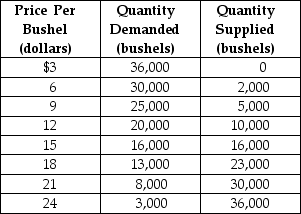 Table 4-5 above contains information about the wheat market.Answer the following questions based on this table.
-Refer to Table 4-5.An agricultural price floor is a price that the government guarantees farmers will receive for a particular crop.Suppose the federal government sets a price floor for wheat at $21 per bushel.
a.What is the amount of shortage or surplus in the wheat market as result of the price floor?
b.If the government agrees to purchase any surplus output at $21,how much will it cost the government?
c.If the government buys all of the farmers' output at the floor price,how many bushels of wheat will it have to purchase and how much will it cost the government?
d.Suppose the government buys up all of the farmers' output at the floor price and then sells the output to consumers at whatever price it can get.Under this scheme,what is the price at which the government will be able to sell off all of the output it had purchased from farmers? What is the revenue received from the government's sale?
e.In this problem we have considered two government schemes: (1)a price floor is established and the government purchases any excess output and (2)the government buys all the farmers' output at the floor price and resells at whatever price it can get.Which scheme will taxpayers prefer?
f.Consider again the two schemes.Which scheme will the farmers prefer?
g.Consider again the two schemes.Which scheme will wheat buyers prefer?
Table 4-5 above contains information about the wheat market.Answer the following questions based on this table.
-Refer to Table 4-5.An agricultural price floor is a price that the government guarantees farmers will receive for a particular crop.Suppose the federal government sets a price floor for wheat at $21 per bushel.
a.What is the amount of shortage or surplus in the wheat market as result of the price floor?
b.If the government agrees to purchase any surplus output at $21,how much will it cost the government?
c.If the government buys all of the farmers' output at the floor price,how many bushels of wheat will it have to purchase and how much will it cost the government?
d.Suppose the government buys up all of the farmers' output at the floor price and then sells the output to consumers at whatever price it can get.Under this scheme,what is the price at which the government will be able to sell off all of the output it had purchased from farmers? What is the revenue received from the government's sale?
e.In this problem we have considered two government schemes: (1)a price floor is established and the government purchases any excess output and (2)the government buys all the farmers' output at the floor price and resells at whatever price it can get.Which scheme will taxpayers prefer?
f.Consider again the two schemes.Which scheme will the farmers prefer?
g.Consider again the two schemes.Which scheme will wheat buyers prefer? (Essay)
4.8/5 (81)
(81) Congress passed the Freedom to Farm Act in 1996.What was the purpose of this Act?
(Multiple Choice)
4.8/5 (73)
(73) 
Filters
- Essay(0)
- Multiple Choice(0)
- Short Answer(0)
- True False(0)
- Matching(0)