



 Chat with AI
Exam 5: The Economics of Health Care

Exam 1: Economics: Foundations and Models213 Questions
Exam 2: Trade-Offs, comparative Advantage, and the Market System237 Questions
Exam 3: Where Prices Come From: the Interaction of Demand and Supply234 Questions
Exam 4: Economic Efficiency,government Price Setting,and Taxes212 Questions
Exam 5: The Economics of Health Care166 Questions
Exam 6: Firms, the Stock Market, and Corporate Governance258 Questions
Exam 7: Comparative Advantage and the Gains From International Trade188 Questions
Exam 8: Gdp: Measuring Total Production and Income261 Questions
Exam 9: Unemployment and Inflation291 Questions
Exam 10: Economic Growth, the Financial System, and Business Cycles253 Questions
Exam 11: Long-Run Economic Growth: Sources and Policies262 Questions
Exam 12: Aggregate Expenditure and Output in the Short Run299 Questions
Exam 13: Aggregate Demand and Aggregate Supply Analysis286 Questions
Exam 14: Money,banks,and the Federal Reserve System281 Questions
Exam 15: Monetary Policy275 Questions
Exam 16: Fiscal Policy306 Questions
Exam 17: Inflation,unemployment,and Federal Reserve Policy257 Questions
Exam 18: Macroeconomics in an Open Economy278 Questions
Exam 19: The International Financial System258 Questions
Select questions type


Under current tax law individuals do not pay taxes on health insurance benefits they receive from their employers.As a result,
(Multiple Choice)
4.8/5  (83)
(83) A goal of ________ is to give patients an incentive to pay more attention to the prices of medical services.This would tend to increase economic efficiency by decreasing the costs of medical services.
(Multiple Choice)
4.9/5 (79)
(79) In the United States since 1900,life expectancy at birth has ________ and the death rate has ________.
(Multiple Choice)
4.9/5 (81)
(81) Insurance companies use deductibles and coinsurance to reduce moral hazard.
(True/False)
4.8/5 (84)
(84) Under the Patient Protection and Affordable Care Act (ACA),every company with more than 200 employees must offer health insurance to its employees and must automatically enroll them in the plan.
(True/False)
4.9/5 (74)
(74) In 2015,the average height of adult males in the United States was
(Multiple Choice)
4.7/5 (86)
(86) Figure 5-1  Figure 5-1 represents the market for vaccinations.Vaccinations are considered a benefit to society,and the figure shows both the marginal private benefit and the marginal social benefit from vaccinations.
-Refer to Figure 5-1.The market equilibrium price is
Figure 5-1 represents the market for vaccinations.Vaccinations are considered a benefit to society,and the figure shows both the marginal private benefit and the marginal social benefit from vaccinations.
-Refer to Figure 5-1.The market equilibrium price is (Multiple Choice)
4.8/5 (85)
(85) Figure 5-4 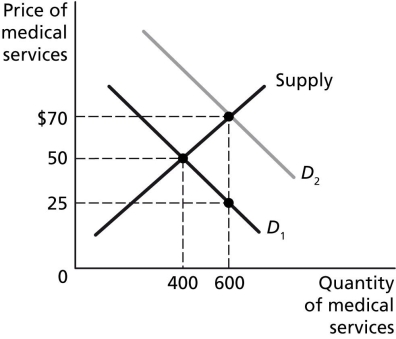 Figure 5-4 represents the supply and demand for medical services with and without a third-party payer.
-Refer to Figure 5-4.Answer the following questions:
1.What would be the equilibrium price and quantity if consumers had to pay the full price of medical services?
2.With insurance acting as a third-party payer,what price will consumers pay for medical service?
3.With insurance acting as a third-party payer,what price will doctors receive for medical service?
4.With insurance acting as a third-party payer,what will be the equilibrium quantity of medical services?
5.With insurance acting as a third-party payer,what will be the value of the deadweight loss?
Figure 5-4 represents the supply and demand for medical services with and without a third-party payer.
-Refer to Figure 5-4.Answer the following questions:
1.What would be the equilibrium price and quantity if consumers had to pay the full price of medical services?
2.With insurance acting as a third-party payer,what price will consumers pay for medical service?
3.With insurance acting as a third-party payer,what price will doctors receive for medical service?
4.With insurance acting as a third-party payer,what will be the equilibrium quantity of medical services?
5.With insurance acting as a third-party payer,what will be the value of the deadweight loss? (Essay)
4.9/5 (84)
(84) How do adverse selection and moral hazard affect the market for insurance?
(Essay)
4.7/5 (65)
(65) A doctor pursuing the interests of his patients rather than his own interests is an example of the principal-agent problem.
(True/False)
4.9/5 (66)
(66) The United Kingdom has a health care system under which the government owns most of the hospitals and employs most of the doctors.
(True/False)
4.9/5 (77)
(77) On average,people in low-income countries ________ than people in high-income countries.
(Multiple Choice)
4.7/5 (79)
(79) The Congressional Budget Office estimates that the Patient Protection and Affordable Care Act (ACA)will increase government spending
(Multiple Choice)
4.9/5 (75)
(75) Which of the following is not part of the "state health insurance marketplaces" provision of the Patient Protection and Affordable Care Act (ACA)?
(Multiple Choice)
4.8/5 (80)
(80) In the United States,the bulk of health care spending is paid by health insurance companies.Such a system is also called a ________ where consumers of health care pay a nominal fee and the rest is paid by the health insurance provider.
(Multiple Choice)
4.7/5 (78)
(78) As a percentage of GDP,health care spending on Medicare and Medicaid is expected to double over the next 40 years unless health care costs begin to grow at a slower rate.
(True/False)
4.9/5 (87)
(87) Which of the following is not part of the "regulation of health insurance" provision of the Patient Protection and Affordable Care Act (ACA)?
(Multiple Choice)
4.8/5 (83)
(83) ________ occurs when one party takes advantage of having more information than another party about the attributes of the good or service they will exchange.
(Multiple Choice)
4.9/5 (86)
(86) What are two reasons why employees would prefer for their employer to pay for their health insurance rather than receiving increased wages and paying for their own health insurance?
(Essay)
4.9/5 (79)
(79) 
Filters
- Essay(0)
- Multiple Choice(0)
- Short Answer(0)
- True False(0)
- Matching(0)