



 Chat with AI
Exam 7: Comparative Advantage and the Gains From International Trade

Exam 1: Economics: Foundations and Models213 Questions
Exam 2: Trade-Offs, comparative Advantage, and the Market System237 Questions
Exam 3: Where Prices Come From: the Interaction of Demand and Supply234 Questions
Exam 4: Economic Efficiency,government Price Setting,and Taxes212 Questions
Exam 5: The Economics of Health Care166 Questions
Exam 6: Firms, the Stock Market, and Corporate Governance258 Questions
Exam 7: Comparative Advantage and the Gains From International Trade188 Questions
Exam 8: Gdp: Measuring Total Production and Income261 Questions
Exam 9: Unemployment and Inflation291 Questions
Exam 10: Economic Growth, the Financial System, and Business Cycles253 Questions
Exam 11: Long-Run Economic Growth: Sources and Policies262 Questions
Exam 12: Aggregate Expenditure and Output in the Short Run299 Questions
Exam 13: Aggregate Demand and Aggregate Supply Analysis286 Questions
Exam 14: Money,banks,and the Federal Reserve System281 Questions
Exam 15: Monetary Policy275 Questions
Exam 16: Fiscal Policy306 Questions
Exam 17: Inflation,unemployment,and Federal Reserve Policy257 Questions
Exam 18: Macroeconomics in an Open Economy278 Questions
Exam 19: The International Financial System258 Questions
Select questions type


In the past two decades the United States lost its comparative advantage in automobiles to Japan.What factor was most responsible for the development of Japan's comparative advantage in automobiles?
(Multiple Choice)
5.0/5  (69)
(69) In 1995,the General Agreement on Tariffs and Trade (GATT),which was established in 1948,was replaced by the World Trade Organization (WTO).Why did members of the GATT push for the establishment of the WTO?
(Multiple Choice)
4.8/5 (86)
(86) Figure 7-3  Since 1953 the United States has imposed a quota to limit the imports of peanuts.Figure 7-3 illustrates the impact of the quota.
-Refer to Figure 7-3.What is the value of revenue to foreign producers who are granted permission to sell in the U.S.market when there is a quota?
Since 1953 the United States has imposed a quota to limit the imports of peanuts.Figure 7-3 illustrates the impact of the quota.
-Refer to Figure 7-3.What is the value of revenue to foreign producers who are granted permission to sell in the U.S.market when there is a quota? (Multiple Choice)
4.8/5 (74)
(74) a.Distinguish between a tariff and a quota.
b.In what ways are tariffs and quotas similar?
c.In what ways are tariffs and quotas different?
d.Why might a foreign producer prefer a quota rather than a tariff?
(Essay)
4.9/5 (101)
(101) Which of the following describes the national security argument for protectionism?
(Multiple Choice)
4.8/5 (91)
(91) Table 7-6
Output per hour Production and Production
of work Consumption without Trade with Trade
 Estonia and Morocco can produce both swords and belts.Each country has a total of 40 available labor hours for the production of swords and belts.Table 7-6 shows the output per hour of work,the production and consumption quantities without trade,and the production numbers with trade.
-Refer to Table 7-6.Which country has an absolute advantage in producing swords?
Estonia and Morocco can produce both swords and belts.Each country has a total of 40 available labor hours for the production of swords and belts.Table 7-6 shows the output per hour of work,the production and consumption quantities without trade,and the production numbers with trade.
-Refer to Table 7-6.Which country has an absolute advantage in producing swords? (Multiple Choice)
4.7/5 (82)
(82) Table 7-3
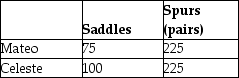 Mateo and Celeste produce custom saddles and spurs.Table 7-3 lists the number of saddles and pairs of spurs Mateo and Celeste can each produce in one month.
-Refer to Table 7-3.Select the statement that accurately interprets the data in the table.
Mateo and Celeste produce custom saddles and spurs.Table 7-3 lists the number of saddles and pairs of spurs Mateo and Celeste can each produce in one month.
-Refer to Table 7-3.Select the statement that accurately interprets the data in the table. (Multiple Choice)
4.7/5 (72)
(72) Figure 7-3 Since 1953 the United States has imposed a quota to limit the imports of peanuts.Figure 7-3 illustrates the impact of the quota.
-Refer to Figure 7-3.If there was no quota,how many pounds of peanuts would domestic producers supply?
Since 1953 the United States has imposed a quota to limit the imports of peanuts.Figure 7-3 illustrates the impact of the quota.
-Refer to Figure 7-3.If there was no quota,how many pounds of peanuts would domestic producers supply? (Multiple Choice)
4.8/5 (76)
(76) In the real world we don't observe countries completely specializing in the production of goods for which they have a comparative advantage.All of the following are reasons for this except
(Multiple Choice)
4.9/5 (76)
(76) Figure 7-3 Since 1953 the United States has imposed a quota to limit the imports of peanuts.Figure 7-3 illustrates the impact of the quota.
-Refer to Figure 7-3.If there was no quota,how many pounds of peanuts would be imported?
Since 1953 the United States has imposed a quota to limit the imports of peanuts.Figure 7-3 illustrates the impact of the quota.
-Refer to Figure 7-3.If there was no quota,how many pounds of peanuts would be imported? (Multiple Choice)
4.7/5 (78)
(78) Table 7-3
Mateo and Celeste produce custom saddles and spurs.Table 7-3 lists the number of saddles and pairs of spurs Mateo and Celeste can each produce in one month.
-Refer to Table 7-3.Select the statement that accurately interprets the data in the table.
Mateo and Celeste produce custom saddles and spurs.Table 7-3 lists the number of saddles and pairs of spurs Mateo and Celeste can each produce in one month.
-Refer to Table 7-3.Select the statement that accurately interprets the data in the table. (Multiple Choice)
4.8/5 (74)
(74) If a country has a comparative advantage in producing a product,it must also have an absolute advantage in producing that product.
(True/False)
4.9/5 (90)
(90) Trade that is within a country or between countries is based on the principle of
(Multiple Choice)
4.8/5 (75)
(75) Assume that Australia has a comparative advantage in producing surfboards and New Zealand imports surfboards from Australia.We can conclude that
(Multiple Choice)
4.8/5 (72)
(72) At the time policymakers debated the Trans-Pacific Partnership,the United States imposed ________ on the value of imported shoes and shoe parts.
(Multiple Choice)
4.9/5 (68)
(68) Figure 7-3 Since 1953 the United States has imposed a quota to limit the imports of peanuts.Figure 7-3 illustrates the impact of the quota.
-Refer to Figure 7-3.What is the reduction in value of consumer surplus after the imposition of the quota?
Since 1953 the United States has imposed a quota to limit the imports of peanuts.Figure 7-3 illustrates the impact of the quota.
-Refer to Figure 7-3.What is the reduction in value of consumer surplus after the imposition of the quota? (Multiple Choice)
4.9/5 (70)
(70) If Brazil has a comparative advantage relative to Cuba in the production of sugar cane,then
(Multiple Choice)
4.9/5 (81)
(81) Figure 7-2  Suppose the U.S.government imposes a $0.75 per pound tariff on coffee imports.Figure 7-2 shows the impact of this tariff.
-Refer to Figure 7-2.The tariff causes domestic consumption of coffee
Suppose the U.S.government imposes a $0.75 per pound tariff on coffee imports.Figure 7-2 shows the impact of this tariff.
-Refer to Figure 7-2.The tariff causes domestic consumption of coffee (Multiple Choice)
4.7/5 (75)
(75) Members of Congress promising to support each other's legislation is known as
(Multiple Choice)
4.9/5 (66)
(66) 
Filters
- Essay(0)
- Multiple Choice(0)
- Short Answer(0)
- True False(0)
- Matching(0)