



 Chat with AI
Exam 11: Long-Run Economic Growth: Sources and Policies

Exam 1: Economics: Foundations and Models213 Questions
Exam 2: Trade-Offs, comparative Advantage, and the Market System237 Questions
Exam 3: Where Prices Come From: the Interaction of Demand and Supply234 Questions
Exam 4: Economic Efficiency,government Price Setting,and Taxes212 Questions
Exam 5: The Economics of Health Care166 Questions
Exam 6: Firms, the Stock Market, and Corporate Governance258 Questions
Exam 7: Comparative Advantage and the Gains From International Trade188 Questions
Exam 8: Gdp: Measuring Total Production and Income261 Questions
Exam 9: Unemployment and Inflation291 Questions
Exam 10: Economic Growth, the Financial System, and Business Cycles253 Questions
Exam 11: Long-Run Economic Growth: Sources and Policies262 Questions
Exam 12: Aggregate Expenditure and Output in the Short Run299 Questions
Exam 13: Aggregate Demand and Aggregate Supply Analysis286 Questions
Exam 14: Money,banks,and the Federal Reserve System281 Questions
Exam 15: Monetary Policy275 Questions
Exam 16: Fiscal Policy306 Questions
Exam 17: Inflation,unemployment,and Federal Reserve Policy257 Questions
Exam 18: Macroeconomics in an Open Economy278 Questions
Exam 19: The International Financial System258 Questions
Select questions type


Growth in the United States from 1800 to 1900 can be characterized as
(Multiple Choice)
4.7/5  (70)
(70) Which of the following is not an explanation for the revival in the growth of productivity starting in the mid-1990s?
(Multiple Choice)
4.9/5 (73)
(73) Your friend owns a snow cone stand that he works by himself.He produces about 25 snow cones per hour.He wants to be able to produce twice as many snow cones per hour so he buys a second machine.He notices that he can only produce 10 more snow cones an hour.He jokes that he could have doubled his output with the second machine if he only had four hands.Using your knowledge of the production process,explain to your friend what you think has happened when he added more capital to his production process.
(Essay)
4.8/5 (62)
(62) Figure 11-2  -Refer to Figure 11-2.Assuming no technological change,if the United States increases capital per hour worked by $40,000 every year between 2012 and 2016,we would expect to see
 (Multiple Choice)
4.9/5 (77)
(77) Disease,poor nutrition,and substandard health care in developing nations can reduce growth in an economy by
(Multiple Choice)
4.8/5 (80)
(80) Why do some firms choose not to file for a patent and instead try to keep the results of their research a trade secret?
(Multiple Choice)
4.9/5 (83)
(83) Which of the following accurately describes economic growth and standards of living between 1,000,000 B.C.and 1300 A.D.?
(Multiple Choice)
4.8/5 (80)
(80) Figure 11-1  -Refer to Figure 11-1.Using the per-worker production function in the figure above,the largest changes in an economy's standard of living would be achieved by a movement from
 (Multiple Choice)
4.9/5 (86)
(86) One of the primary reasons that Mexico has experienced relatively low rates of economic growth is that for Mexican entrepreneurs,
(Multiple Choice)
4.8/5 (84)
(84) Table 11-4
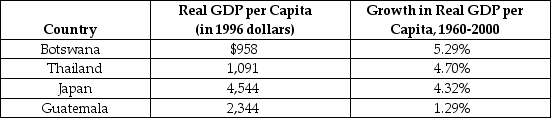 -Refer to Table 11-4.In the table above,which countries are consistent with the predictions of the economic growth model?
 (Multiple Choice)
4.8/5 (81)
(81) Economists who believe that real GDP may grow slowly because of insufficient demand for investment spending cite three main reasons for the low demand for loanable funds.Which of the following is not one of those reasons?
(Multiple Choice)
4.9/5 (79)
(79) Figure 11-3 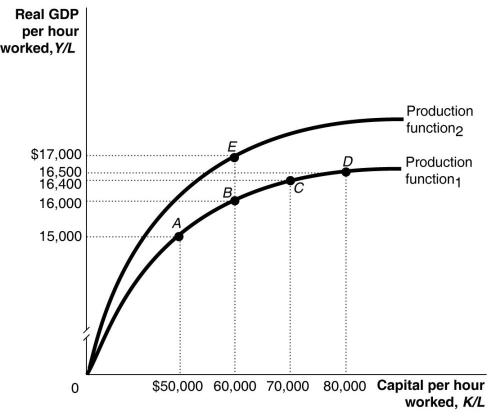 -Refer to Figure 11-3.Technological change is shown in the figure above by the movement from
 (Multiple Choice)
4.9/5 (82)
(82) Figure 11-4  -Refer to Figure 11-4.Using the per-worker production function in the figure above,the largest changes in an economy's standard of living would be achieved by a movement from
 (Multiple Choice)
5.0/5 (71)
(71) Small differences in economic growth rates result in small differences in living standards.
(True/False)
4.8/5 (80)
(80) Robert Lucas,a Nobel laureate in economics,argues that there are increasing returns to
(Multiple Choice)
4.9/5 (85)
(85) Over the last three decades in the United States,services have become a smaller fraction of GDP relative to goods.
(True/False)
4.9/5 (84)
(84) 
Filters
- Essay(0)
- Multiple Choice(0)
- Short Answer(0)
- True False(0)
- Matching(0)