



 Chat with AI
Exam 12: Aggregate Expenditure and Output in the Short Run

Exam 1: Economics: Foundations and Models213 Questions
Exam 2: Trade-Offs, comparative Advantage, and the Market System237 Questions
Exam 3: Where Prices Come From: the Interaction of Demand and Supply234 Questions
Exam 4: Economic Efficiency,government Price Setting,and Taxes212 Questions
Exam 5: The Economics of Health Care166 Questions
Exam 6: Firms, the Stock Market, and Corporate Governance258 Questions
Exam 7: Comparative Advantage and the Gains From International Trade188 Questions
Exam 8: Gdp: Measuring Total Production and Income261 Questions
Exam 9: Unemployment and Inflation291 Questions
Exam 10: Economic Growth, the Financial System, and Business Cycles253 Questions
Exam 11: Long-Run Economic Growth: Sources and Policies262 Questions
Exam 12: Aggregate Expenditure and Output in the Short Run299 Questions
Exam 13: Aggregate Demand and Aggregate Supply Analysis286 Questions
Exam 14: Money,banks,and the Federal Reserve System281 Questions
Exam 15: Monetary Policy275 Questions
Exam 16: Fiscal Policy306 Questions
Exam 17: Inflation,unemployment,and Federal Reserve Policy257 Questions
Exam 18: Macroeconomics in an Open Economy278 Questions
Exam 19: The International Financial System258 Questions
Select questions type


A rising price level decreases consumption by decreasing the real value of household wealth.
(True/False)
4.8/5  (81)
(81) Figure 12-2  -Refer to Figure 12-2.Suppose that the level of GDP associated with point K is potential GDP.If the U.S.economy is currently at point N,
 (Multiple Choice)
4.9/5 (80)
(80) If disposable income increases by $100 million,and consumption increases by $90 million,then the marginal propensity to consume is
(Multiple Choice)
4.9/5 (82)
(82) If planned investment is greater than actual investment,then aggregate expenditure is less than GDP.
(True/False)
4.7/5 (73)
(73) The ratio of the increase in equilibrium real GDP to the increase in autonomous expenditure is called the
(Multiple Choice)
4.9/5 (78)
(78) Which of the following correctly describes how an increase in the price level affects consumption spending?
(Multiple Choice)
4.9/5 (88)
(88) When Jack's income increases by $1,000,he spends an additional $850 dollars.This implies that his marginal propensity to consume is 0.85.
(True/False)
4.7/5 (86)
(86) Table 12-1
 -Refer to Table 12-1.Using the table above,compute aggregate expenditure and identify the macroeconomic equilibrium.
 (Essay)
4.9/5 (91)
(91) If planned aggregate expenditure is less than real GDP,some firms will experience unplanned increases in inventories.
(True/False)
4.9/5 (70)
(70) Table 12-15
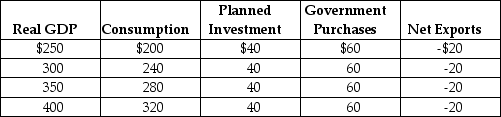 -Refer to Table 12-15.Using the table above,answer the following questions.The numbers in the table are in billions of dollars.
a.What is the equilibrium level of real GDP?
b.What is the MPC?
c.If investment spending declines by $10 billion,what will happen to equilibrium GDP?
-Refer to Table 12-15.Using the table above,answer the following questions.The numbers in the table are in billions of dollars.
a.What is the equilibrium level of real GDP?
b.What is the MPC?
c.If investment spending declines by $10 billion,what will happen to equilibrium GDP? (Essay)
5.0/5 (81)
(81) C = 2,800 + 0.9Y
I = 750
G = 1,200
NX = 150
Given the equations for C,I,G,and NX above,what is the equilibrium level of GDP (Y)?
(Essay)
4.7/5 (78)
(78) How does an increase in government spending affect the aggregate expenditure line?
(Multiple Choice)
4.9/5 (83)
(83) In the aggregate expenditure model,________ has both an autonomous component and an induced component.
(Multiple Choice)
4.8/5 (92)
(92) ________ usually increase(s)when the U.S.economy is in a recession and decrease(s)when the U.S.economy is expanding.
(Multiple Choice)
4.8/5 (85)
(85) An increase in the price level results in a(n)________ in household consumption spending and a(n)________ in investment spending.
(Multiple Choice)
4.8/5 (69)
(69) Figure 12-2
-Refer to Figure 12-2.Suppose that the level of GDP associated with point N is potential GDP.If the U.S.economy is currently at point K,
-Refer to Figure 12-2.Suppose that the level of GDP associated with point N is potential GDP.If the U.S.economy is currently at point K, (Multiple Choice)
4.9/5 (69)
(69) All of the following are true statements about the multiplier except
(Multiple Choice)
4.7/5 (78)
(78) Actual investment spending includes spending by consumers on
(Multiple Choice)
4.9/5 (83)
(83) 
Filters
- Essay(0)
- Multiple Choice(0)
- Short Answer(0)
- True False(0)
- Matching(0)