



 Chat with AI
Exam 16: Fiscal Policy

Exam 1: Economics: Foundations and Models213 Questions
Exam 2: Trade-Offs, comparative Advantage, and the Market System237 Questions
Exam 3: Where Prices Come From: the Interaction of Demand and Supply234 Questions
Exam 4: Economic Efficiency,government Price Setting,and Taxes212 Questions
Exam 5: The Economics of Health Care166 Questions
Exam 6: Firms, the Stock Market, and Corporate Governance258 Questions
Exam 7: Comparative Advantage and the Gains From International Trade188 Questions
Exam 8: Gdp: Measuring Total Production and Income261 Questions
Exam 9: Unemployment and Inflation291 Questions
Exam 10: Economic Growth, the Financial System, and Business Cycles253 Questions
Exam 11: Long-Run Economic Growth: Sources and Policies262 Questions
Exam 12: Aggregate Expenditure and Output in the Short Run299 Questions
Exam 13: Aggregate Demand and Aggregate Supply Analysis286 Questions
Exam 14: Money,banks,and the Federal Reserve System281 Questions
Exam 15: Monetary Policy275 Questions
Exam 16: Fiscal Policy306 Questions
Exam 17: Inflation,unemployment,and Federal Reserve Policy257 Questions
Exam 18: Macroeconomics in an Open Economy278 Questions
Exam 19: The International Financial System258 Questions
Select questions type


If the economy is growing beyond potential real GDP,which of the following would be an appropriate fiscal policy to bring the economy back to long-run aggregate supply? An increase in
(Multiple Choice)
4.8/5  (74)
(74) Figure 16-9 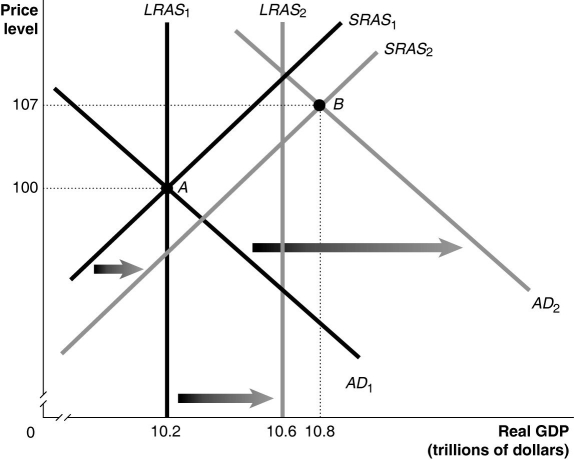 -To combat inflation,Congress and the president should
 (Multiple Choice)
4.9/5 (76)
(76) If the federal budget has an actual budget deficit of $100 billion and a cyclically adjusted budget deficit of $75 billion,then the economy
(Multiple Choice)
4.8/5 (88)
(88) Increases in government spending result in ________ in the short run,and permanent increases in government spending result in ________ in the long run.
(Multiple Choice)
4.9/5 (76)
(76) From an initial long-run equilibrium,if aggregate demand grows faster than long-run and short-run aggregate supply,then Congress and the president would most likely
(Multiple Choice)
4.8/5 (70)
(70) An increase in the tax wedge associated with a given economic activity will decrease the level of that activity.
(True/False)
4.9/5 (83)
(83) Table 16-6
 -Refer to Table 16-6.Suppose the economy is in the state described by the table above.What problem will occur in the economy if no policy is pursued? What fiscal policy tools could be used to combat the problem? Draw a dynamic aggregate demand and aggregate supply diagram to illustrate the appropriate fiscal policy to use in this situation.
 (Essay)
4.9/5 (74)
(74) Explain why the tax multiplier is different from the government purchases multiplier,in both sign and relative magnitude.
(Essay)
4.9/5 (79)
(79) Historically,the largest U.S.federal budget deficits as a percentage of GDP in the 20th century occurred during
(Multiple Choice)
4.8/5 (87)
(87) Table 16-5
 -Use the dynamic aggregate demand and aggregate supply model and start with Year 1 in a long-run macroeconomic equilibrium.For Year 2,graph aggregate demand,long-run aggregate supply,and short-run aggregate supply such that the condition of the economy will induce the president and Congress to conduct expansionary fiscal policy.Briefly explain the condition of the economy and what the president and Congress are attempting to do.
 (Essay)
4.9/5 (74)
(74) A law requiring the government to balance its budget in each year would serve as an automatic destabilizer.
(True/False)
4.7/5 (74)
(74) An increase in government spending may expedite recovery from a recession in the short run,but in the long run this policy may
(Multiple Choice)
4.7/5 (75)
(75) The automatic budget surpluses and budget deficits that occur in the federal budget over the business cycle
(Multiple Choice)
4.9/5 (85)
(85) Before the Great Depression of the 1930s,the majority of government spending took place at the ________ and after the Great Depression the majority of government spending took place at the ________.
(Multiple Choice)
4.8/5 (75)
(75) Table 16-4
 -Refer to Table 16-4.Consider the hypothetical information in the table above for potential real GDP,real GDP,and the price level in 2016 and in 2017 if Congress and the president do not use fiscal policy.If Congress and the president use fiscal policy successfully to keep real GDP at its potential level in 2017,which of the following will be lower than if Congress and the president had taken no action?
 (Multiple Choice)
4.8/5 (79)
(79) 
Filters
- Essay(0)
- Multiple Choice(0)
- Short Answer(0)
- True False(0)
- Matching(0)