



 Chat with AI
Exam 17: Inflation,unemployment,and Federal Reserve Policy

Exam 1: Economics: Foundations and Models213 Questions
Exam 2: Trade-Offs, comparative Advantage, and the Market System237 Questions
Exam 3: Where Prices Come From: the Interaction of Demand and Supply234 Questions
Exam 4: Economic Efficiency,government Price Setting,and Taxes212 Questions
Exam 5: The Economics of Health Care166 Questions
Exam 6: Firms, the Stock Market, and Corporate Governance258 Questions
Exam 7: Comparative Advantage and the Gains From International Trade188 Questions
Exam 8: Gdp: Measuring Total Production and Income261 Questions
Exam 9: Unemployment and Inflation291 Questions
Exam 10: Economic Growth, the Financial System, and Business Cycles253 Questions
Exam 11: Long-Run Economic Growth: Sources and Policies262 Questions
Exam 12: Aggregate Expenditure and Output in the Short Run299 Questions
Exam 13: Aggregate Demand and Aggregate Supply Analysis286 Questions
Exam 14: Money,banks,and the Federal Reserve System281 Questions
Exam 15: Monetary Policy275 Questions
Exam 16: Fiscal Policy306 Questions
Exam 17: Inflation,unemployment,and Federal Reserve Policy257 Questions
Exam 18: Macroeconomics in an Open Economy278 Questions
Exam 19: The International Financial System258 Questions
Select questions type


Figure 17-9  -Refer to Figure 17-9.A follower of the new classical macroeconomics would argue that a contractionary monetary policy to lower inflation after a supply shock,like that pursued by Volcker in 1979,would result in a movement from
 (Multiple Choice)
4.8/5  (79)
(79) The "rational expectations" school of economists,including Robert Lucas and Thomas Sargent,argue that changes in monetary policy cannot affect unemployment rates in the short run or long run.
(True/False)
4.7/5 (78)
(78) Figure 17-9
-Refer to Figure 17-9.A follower of the new classical macroeconomics would argue that ________ like that pursued by Paul Volcker in 1979,would result in a movement from C to A.
-Refer to Figure 17-9.A follower of the new classical macroeconomics would argue that ________ like that pursued by Paul Volcker in 1979,would result in a movement from C to A. (Multiple Choice)
4.8/5 (75)
(75) How would you expect the Fed to respond to a negative supply shock in the economy?
(Essay)
4.9/5 (83)
(83) A falling price level is called ________ and a fall in the rate of inflation is called ________.
(Multiple Choice)
4.9/5 (89)
(89) The key to understanding the short-run trade-off behind the Phillips curve is that an increase in inflation will decrease unemployment if the inflation is ________ by both workers and firms.
(Multiple Choice)
4.7/5 (71)
(71) A relationship that depends on the basic behavior of consumers and firms and remains unchanged over long periods is called a ________ relationship.
(Multiple Choice)
4.9/5 (78)
(78) Figure 17-3 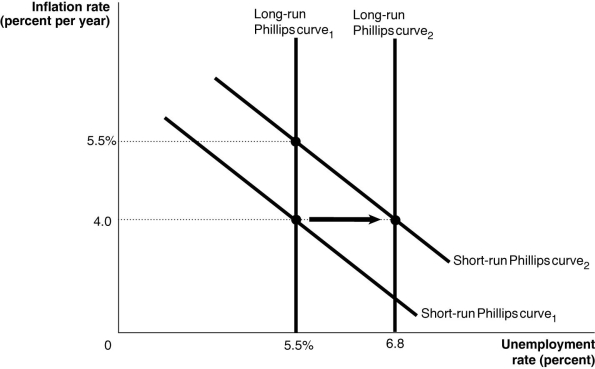 -Refer to Figure 17-3.The shifts shown in the short-run and long-run Phillips curves between period 1 and period 2 could be explained by
 (Multiple Choice)
4.9/5 (73)
(73) Use the information below to explain adjustments that move the economy to a long-run equilibrium.Assume that firms and workers have adaptive expectations.
The current unemployment rate = 7%.
The natural rate of unemployment = 5.5%.
Last year's inflation rate = 5%.
This year's inflation rate = 4%.
(Essay)
4.8/5 (84)
(84) Figure 17-2  -Refer to Figure 17-2.Suppose the Fed used expansionary policy to push short-run equilibrium to point B.If the short-run equilibrium remained at point B long enough,
 (Multiple Choice)
4.8/5 (82)
(82) If wages and prices adjust slowly,we would expect expansionary monetary policy to be
(Multiple Choice)
4.8/5 (93)
(93) If the unemployment rate in the economy is steady at 4 percent per year,how does the short-run Phillips curve predict that the inflation rate will be changing,if at all? What will happen if the unemployment rate now rises to 7 percent per year? Assume there are no changes to inflation expectations.Provide an appropriate graph to support your discussion.
(Essay)
4.9/5 (67)
(67) If the Federal Reserve attempts to continue reducing unemployment by manipulating monetary policy,which of the following would you expect to see?
(Multiple Choice)
4.9/5 (72)
(72) Suppose the current inflation rate and the expected inflation rate are both 3 percent.The current unemployment rate and the natural rate of unemployment are both 4 percent.Use a Phillips curve graph to show the effect on the economy of a severe supply shock.If the Federal Reserve keeps monetary policy unchanged,what will eventually happen to the unemployment rate? Show this on your Phillips curve graph.
(Essay)
4.7/5 (81)
(81) In the long run,the Fed may decrease the unemployment rate only if it is willing to increase the rate of inflation.
(True/False)
4.8/5 (74)
(74) Models that focus on factors other than changes in the money supply to explain fluctuations in real GDP are called
(Multiple Choice)
4.9/5 (97)
(97) When individuals use ________ about an economic variable to make a decision,expectations are rational.
(Multiple Choice)
4.7/5 (71)
(71) 
Filters
- Essay(0)
- Multiple Choice(0)
- Short Answer(0)
- True False(0)
- Matching(0)