



 Chat with AI
Exam 19: The International Financial System

Exam 1: Economics: Foundations and Models213 Questions
Exam 2: Trade-Offs, comparative Advantage, and the Market System237 Questions
Exam 3: Where Prices Come From: the Interaction of Demand and Supply234 Questions
Exam 4: Economic Efficiency,government Price Setting,and Taxes212 Questions
Exam 5: The Economics of Health Care166 Questions
Exam 6: Firms, the Stock Market, and Corporate Governance258 Questions
Exam 7: Comparative Advantage and the Gains From International Trade188 Questions
Exam 8: Gdp: Measuring Total Production and Income261 Questions
Exam 9: Unemployment and Inflation291 Questions
Exam 10: Economic Growth, the Financial System, and Business Cycles253 Questions
Exam 11: Long-Run Economic Growth: Sources and Policies262 Questions
Exam 12: Aggregate Expenditure and Output in the Short Run299 Questions
Exam 13: Aggregate Demand and Aggregate Supply Analysis286 Questions
Exam 14: Money,banks,and the Federal Reserve System281 Questions
Exam 15: Monetary Policy275 Questions
Exam 16: Fiscal Policy306 Questions
Exam 17: Inflation,unemployment,and Federal Reserve Policy257 Questions
Exam 18: Macroeconomics in an Open Economy278 Questions
Exam 19: The International Financial System258 Questions
Select questions type


If,at the current exchange rate between the dollar and the Norwegian kroner of 5.78 kroner per dollar,the dollar is "overvalued," how do you expect demand and supply in the foreign exchange markets to respond?
(Multiple Choice)
4.9/5  (82)
(82) One reason purchasing power parity does not exactly hold is that many goods are not traded internationally.
(True/False)
4.9/5 (77)
(77) The currency adopted by most countries in Western Europe is referred to as the
(Multiple Choice)
4.8/5 (86)
(86) China began pegging its currency,the yuan,to the dollar in 1994.Because the yuan was ________ at the pegged exchange rate,the Chinese government increased its reserves of ________ as the government purchased more ________ to maintain the pegged exchange rate.
(Multiple Choice)
4.8/5 (83)
(83) Figure 19-5  -Refer to Figure 19-5.Suppose the Chinese government decides to abandon pegging the yuan to the dollar at a rate which undervalues the yuan.Using the figure above,the equilibrium exchange rate would be ________ and Chinese exports to the United States would ________ in price.
 (Multiple Choice)
4.7/5 (67)
(67) Figure 19-1 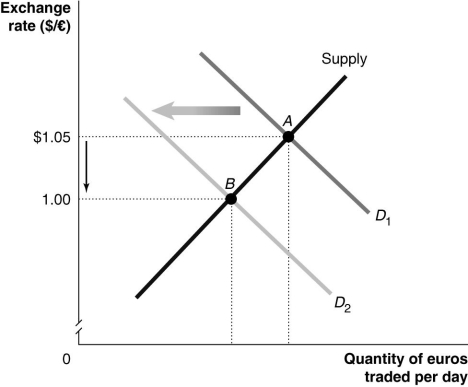 -Refer to Figure 19-1.Which of the following would cause the change depicted in the figure above?
 (Multiple Choice)
4.8/5 (81)
(81) Before 1980,U.S.investors rarely invested in foreign capital markets.
(True/False)
4.9/5 (72)
(72) A Big Mac costs $4.00 in the United States and 9.00 reals in Brazil.If the exchange rate is 2 reals per dollar,purchasing power parity predicts that
(Multiple Choice)
4.8/5 (77)
(77) Under the Bretton Woods system,U.S.dollars were redeemable for ________ only if the dollars were presented by a foreign central bank.
(Multiple Choice)
4.8/5 (78)
(78) Figure 19-5
-Refer to Figure 19-5.Suppose the pegged exchange rate is $0.11/yuan.Because of safety concerns and numerous product recalls,U.S.consumers lower their demand for Chinese products.Using the figure above,this would
-Refer to Figure 19-5.Suppose the pegged exchange rate is $0.11/yuan.Because of safety concerns and numerous product recalls,U.S.consumers lower their demand for Chinese products.Using the figure above,this would (Multiple Choice)
4.8/5 (69)
(69) The United States abandoned the ________ because the government wanted to rapidly expand the money supply in response to the Great Depression.
(Multiple Choice)
4.9/5 (84)
(84) If,at the current exchange rate between the dollar and the South African rand of 6.92 rand per dollar,the dollar is "undervalued," how do you expect demand and supply in the foreign exchange markets to respond?
(Multiple Choice)
4.8/5 (81)
(81) The ________ system of currency exchange was set up in 1944.
(Multiple Choice)
4.8/5 (71)
(71) Investors in which two countries accounted for about 25 percent of all foreign purchases of U.S.stocks and bonds in 2015?
(Multiple Choice)
4.9/5 (83)
(83) A Big Mac costs $4.79 in the United States and 9.6 zlotys in Poland.If the exchange rate is 3 zlotys per dollar,purchasing power parity predicts that
(Multiple Choice)
4.9/5 (86)
(86) By the late 1950s,dollars held by foreign central banks exceeded the official dollar value of U.S.gold reserves.
(True/False)
4.8/5 (77)
(77) In what year was the Bretton Woods system of currency exchange set up?
(Multiple Choice)
4.9/5 (87)
(87) The Bretton Woods system confronted severe problems in the 1960s,problems which included
(Multiple Choice)
4.9/5 (64)
(64) 
Filters
- Essay(0)
- Multiple Choice(0)
- Short Answer(0)
- True False(0)
- Matching(0)