



 Chat with AI
Exam 13: Retirement Savings and Deferred Compensation

Exam 1: An Introduction to Tax108 Questions
Exam 2: Tax Compliance, the Irs, and Tax Authorities98 Questions
Exam 3: Tax Planning Strategies and Related Limitations101 Questions
Exam 4: Individual Tax Overview112 Questions
Exam 5: Gross Income and Exclusions104 Questions
Exam 6: Individual Deductions92 Questions
Exam 7: Individual Income Tax Computation and Tax Credits132 Questions
Exam 8: Business Income, Deductions, and Accounting Methods78 Questions
Exam 9: Property Acquisition and Cost Recovery76 Questions
Exam 10: Property Dispositions88 Questions
Exam 11: Investments92 Questions
Exam 12: Compensation78 Questions
Exam 13: Retirement Savings and Deferred Compensation95 Questions
Exam 14: Tax Consequences of Home Ownership95 Questions
Select questions type


Kathy is 48 years of age and self-employed.During the year she reported $100,000 of revenues and $40,000 of expenses relating to her self-employment activities.If Kathy has no other retirement accounts in her name,what is the maximum amount she can contribute to an individual 401(k) ?
(Multiple Choice)
4.9/5  (80)
(80) Lisa,age 45,needed some cash so she received a $50,000 distribution from her Roth IRA.At the time of the distribution,the balance in the Roth IRA was $200,000.Lisa established the Roth IRA 10 years ago.Over the years,she has contributed $20,000 to her account.What amount of the distribution is taxable and subject to early distribution penalty?
(Multiple Choice)
4.9/5 (81)
(81) Both employers and employees may contribute to defined contribution plans.However,the amount that employees may contribute to the plan in a given year is limited by the tax law while the amount that employers may contribute is not.
(True/False)
4.8/5 (97)
(97) Sean (age 74 at end of 2012) retired five years ago.The balance in his 401(k) account on December 31,2012 was $1,700,000 and the balance in his account on December 31,2013 was $1,800,000.Using the IRS tables below,what is Sean's required minimum distribution for 2013? 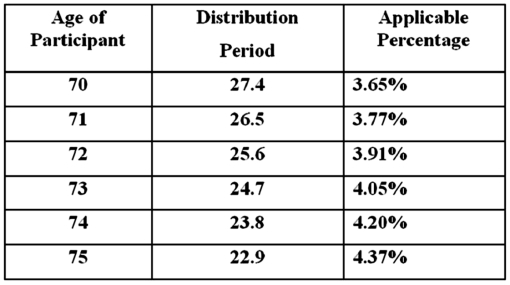
(Essay)
4.9/5 (75)
(75) An employer may contribute to an employee's traditional 401(k) account but the employer may not contribute to an employee's Roth 401(k) account.
(True/False)
4.9/5 (63)
(63) Taxpayers who participate in an employer-sponsored retirement plan are not allowed to contribute to individual retirement accounts (IRAs) .
(True/False)
4.7/5 (77)
(77) Which of the following statements regarding vesting in a defined benefit plan is correct?
(Multiple Choice)
4.7/5 (77)
(77) Dean has earned $70,000 annually for the past five years working as an architect for MWC Inc.Under MWC's defined benefit plan (which uses a 7-year graded vesting schedule) employees earn a benefit equal to 3.5% of the average of their three highest annual salaries for every full year of service with MWC.Dean has worked for five full years for MWC and his vesting percentage is 60%.What is Dean's vested benefit (or annual retirement benefit he has earned so far) ?
(Multiple Choice)
4.8/5 (69)
(69) Jacob participates in his employer's defined benefit plan.He has worked for his employer for four full years.If his employer uses a five-year cliff vesting schedule,Jacob will need to work another year in order to vest in any of his defined benefit plan retirement benefits.
(True/False)
4.9/5 (71)
(71) Shauna received a distribution from her 401(k) account this year.In which of the following situations will Shauna be subject to an early distribution penalty?
(Multiple Choice)
4.8/5 (69)
(69) Which of the following statements regarding contributions to defined contribution plans is true?
(Multiple Choice)
4.9/5 (77)
(77) Shauna received a $100,000 distribution from her 401(k) account this year.Assuming Shauna's marginal tax rate is 25%,what is the total amount of tax and penalty Shauna will be required to pay if she receives the distribution on her 59th birthday and she has not yet retired?
(Multiple Choice)
4.8/5 (82)
(82) Taxpayers never pay tax on the earnings of a traditional 401(k) account.
(True/False)
5.0/5 (76)
(76) Which of the following statements regarding traditional IRAs is true?
(Multiple Choice)
4.8/5 (82)
(82) 
Filters
- Essay(0)
- Multiple Choice(0)
- Short Answer(0)
- True False(0)
- Matching(0)