



 Chat with AI
Exam 17: Monopolistic Competition

Exam 1: Getting Started347 Questions
Exam 2: The U.S.and Global Economies211 Questions
Exam 3: The Economic Problem283 Questions
Exam 4: Demand and Supply334 Questions
Exam 5: Elasticities of Demand and Supply342 Questions
Exam 6: Efficiency and Fairness of Markets364 Questions
Exam 7: Government Actions in Markets248 Questions
Exam 8: Taxes270 Questions
Exam 9: Global Markets in Action281 Questions
Exam 10: Externalities301 Questions
Exam 11: Public Goods and Common Resources180 Questions
Exam 12: Markets with Private Information103 Questions
Exam 13: Consumer Choice and Demand295 Questions
Exam 14: Production and Cost274 Questions
Exam 15: Perfect Competition285 Questions
Exam 16: Monopoly384 Questions
Exam 17: Monopolistic Competition221 Questions
Exam 18: Oligopoly228 Questions
Exam 19: Markets for Factors of Production188 Questions
Exam 20: Economic Inequality164 Questions
Select questions type


The primary reason why monopolistically competitive firms cannot make an economic profit in the long run is because
(Multiple Choice)
4.9/5  (74)
(74) 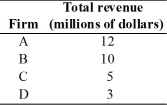 -An industry's total revenue is $100 million.The above table shows the total revenue of the four largest firms in an industry.
a.Calculate this industry's four-firm concentration ratio.
b.Is this industry competitive?
c.What market type does it most likely represent?
-An industry's total revenue is $100 million.The above table shows the total revenue of the four largest firms in an industry.
a.Calculate this industry's four-firm concentration ratio.
b.Is this industry competitive?
c.What market type does it most likely represent? (Essay)
4.9/5 (86)
(86) Which market structure is characterized by the following characteristics?
i.a large number of firms compete
ii.each firm produces a differentiated product
iii.firms are free to enter and exit
(Multiple Choice)
4.9/5 (79)
(79) The absence of barriers to entry in monopolistic competition means that in the long run firms
(Multiple Choice)
4.8/5 (85)
(85) Which of the following is true about monopolistic competition but false about perfect competition?
(Multiple Choice)
4.8/5 (99)
(99) The Herfindahl-Hirschman Index is used as a guideline to determine if a market is competitive or concentrated.Calculate the index value for each market described below.
a.100 firms,each of which produces 1 per cent of market output
b.50 firms,each of which produces 2 per cent of market output
c.25 firms,each of which produces 4 per cent of market output
d.20 firms,each of which produces 5 per cent of market output
e.10 firms,each of which produces 10 per cent of market output
f.5 firms,each of which produces 20 per cent of market output
g.2 firms,each of which produces 50 per cent of market output
(Essay)
4.7/5 (73)
(73) The four largest firms in an industry account for the following value of industry revenues: 12 percent,8 percent,5 percent and 4 percent.Calculate the four-firm concentration ratio.Would this industry be regarded as competitive or concentrated?
(Essay)
4.7/5 (73)
(73) 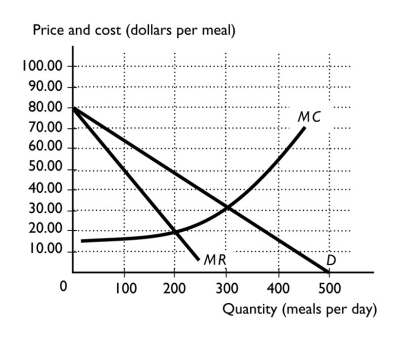 -The above figure shows a restaurant engaged in monopolistic competition with other restaurants.The equilibrium price at this restaurant is ________ per meal.
 (Multiple Choice)
4.8/5 (68)
(68) Even though monopolistic competition results in inefficiency,it does have which of the following benefits for society?
(Multiple Choice)
4.7/5 (82)
(82) For a firm in monopolistic competition to undertake product development,the marginal cost of the development must be ________ the marginal benefit of the development to consumers.
(Multiple Choice)
4.9/5 (67)
(67) 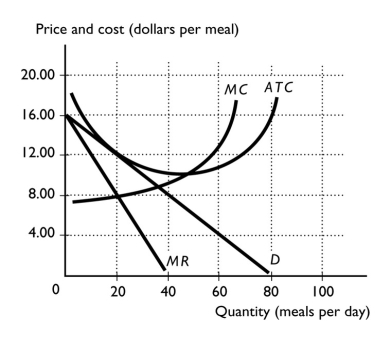 -The above figure definitely shows
A firm in monopolistic competition has ________ demand curve.
(Multiple Choice)
5.0/5 (82)
(82) Which of the following is NOT a characteristic of monopolistic competition?
(Multiple Choice)
4.8/5 (73)
(73) What is the Herfindahl-Hirschman Index if the four firms in an industry account have market shares of 62 percent,15 percent,15 percent,and 8 percent?
(Multiple Choice)
4.7/5 (77)
(77) Firms in monopolistic competition have demand curves that are
(Multiple Choice)
4.9/5 (78)
(78) Why are firms in monopolistic competition unable to make an economic profit in the long run?
(Essay)
4.9/5 (94)
(94) 
Filters
- Essay(0)
- Multiple Choice(0)
- Short Answer(0)
- True False(0)
- Matching(0)