



 Chat with AI
Exam 1: The Scope and Method of Economics

Exam 1: The Scope and Method of Economics238 Questions
Exam 2: The Economic Problem: Scarcity and Choice220 Questions
Exam 3: Demand, Supply, and Market Equilibrium298 Questions
Exam 4: Demand and Supply Applications173 Questions
Exam 5: Introduction to Macroeconomics241 Questions
Exam 6: Measuring National Output and National Income292 Questions
Exam 7: Unemployment, Inflation, and Long-Run Growth297 Questions
Exam 8: Aggregate Expenditure and Equilibrium Output355 Questions
Exam 9: The Government and Fiscal Policy362 Questions
Exam 10: Money, the Federal Reserve, and the Interest Rate358 Questions
Exam 11: The Determination of Aggregate Output, the Price Level, and the Interest Rate243 Questions
Exam 12: Policy Effects and Cost Shocks in the Asad Model200 Questions
Exam 13: The Labor Market in the Macroeconomy287 Questions
Exam 14: Financial Crises, Stabilization, and Deficits260 Questions
Exam 15: Household and Firm Behavior in the Macroeconomy: a Further Look364 Questions
Exam 16: Long-Run Growth196 Questions
Exam 17: Alternative Views in Macroeconomics294 Questions
Exam 18: International Trade, Comparative Advantage, and Protectionism301 Questions
Exam 19: Open-Economy Macroeconomics: the Balance of Payments and Exchange Rates308 Questions
Exam 20: Economic Growth in Developing Economies133 Questions
Exam 21: Critical Thinking About Research105 Questions
Select questions type


The mistake of inferring causality from two events happening one after the other is called
(Multiple Choice)
4.9/5  (86)
(86) Refer to the information provided in Figure 1.7 below to answer the questions that follow. 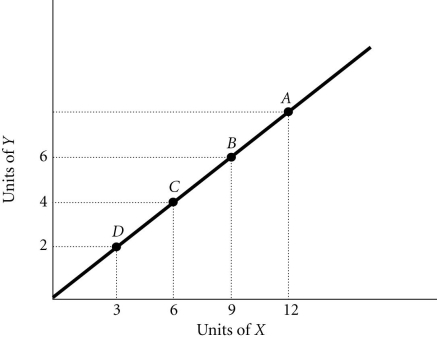 Figure 1.7
-Refer to Figure 1.7. At Point A, what is the value of Y?
Figure 1.7
-Refer to Figure 1.7. At Point A, what is the value of Y? (Multiple Choice)
4.8/5 (73)
(73) Refer to the information provided in Figure 1.4 below to answer the questions that follow. 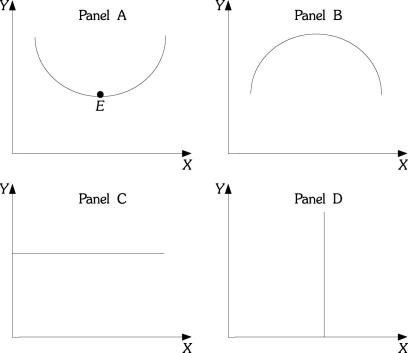 Figure 1.4
-Refer to Figure 1.4. At Point E in Panel A, the slope is
Figure 1.4
-Refer to Figure 1.4. At Point E in Panel A, the slope is (Multiple Choice)
4.8/5 (73)
(73) The principle that irrelevant detail should not be included in a model is known as
(Multiple Choice)
4.8/5 (83)
(83) As the variable on the Y-axis falls the variable on the X-axis falls. The relationship between X and Y is said to be positive.
(True/False)
4.9/5 (88)
(88) Refer to the information provided in Figure 1.1 below to answer the questions that follow.  Figure 1.1
-Refer to Figure 1.1. There is ________ relationship between the daily temperature and the number of gallons of ice cream purchased.
Figure 1.1
-Refer to Figure 1.1. There is ________ relationship between the daily temperature and the number of gallons of ice cream purchased. (Multiple Choice)
4.8/5 (93)
(93) The reasons to study economics include which of the following?
(Multiple Choice)
4.8/5 (81)
(81) The rise of the modern factory system in England during the late eighteenth and early nineteenth centuries is known as the
(Multiple Choice)
4.8/5 (87)
(87) Refer to the information provided in Figure 1.4 below to answer the questions that follow. Figure 1.4
-Refer to Figure 1.4. Which of the Panels shows a curve or line that has a slope that is negative and then positive?
Figure 1.4
-Refer to Figure 1.4. Which of the Panels shows a curve or line that has a slope that is negative and then positive? (Multiple Choice)
4.8/5 (79)
(79) That which we forgo, or give up, when we make a choice or decision is called
(Multiple Choice)
4.9/5 (73)
(73) Redistribution of income from the rich to the poor is achieved from a tax system that requires taxes to rise with income. Which of the following criteria best explains the goal of this tax system?
(Multiple Choice)
4.9/5 (81)
(81) Refer to the information provided in Figure 1.7 below to answer the questions that follow. Figure 1.7
-If the slope of a straight line is 6 and if Y (the variable on the vertical axis) decreases by 60, then X (the variable on the horizontal axis)
Figure 1.7
-If the slope of a straight line is 6 and if Y (the variable on the vertical axis) decreases by 60, then X (the variable on the horizontal axis) (Multiple Choice)
4.9/5 (66)
(66) You have noticed that there is an increase in the number of homeless people in your city. At the same time you observe that there are also a number of vacant apartments. You believe that the government could reduce the number of homeless people if landlords were required to rent their apartments for less than they are currently charging. This policy recommendation would be motivated by concerns over
(Multiple Choice)
4.9/5 (87)
(87) Debbie observes that leaves fall from trees before the fist day of winter, and concludes that the falling leaves cause winter to begin. This is an example of
(Multiple Choice)
4.8/5 (84)
(84) The collection and use of data to test economic theories is called empirical economics.
(True/False)
4.7/5 (81)
(81) The statement "the unemployment rate is 5.1%" is an example of a
(Multiple Choice)
5.0/5 (75)
(75) The amount of exercise that one gets is an important factor in the determination of his general state of health. This is best described as
(Multiple Choice)
4.9/5 (73)
(73) 
Filters
- Essay(0)
- Multiple Choice(0)
- Short Answer(0)
- True False(0)
- Matching(0)