



 Chat with AI
Exam 10: Money, the Federal Reserve, and the Interest Rate

Exam 1: The Scope and Method of Economics238 Questions
Exam 2: The Economic Problem: Scarcity and Choice220 Questions
Exam 3: Demand, Supply, and Market Equilibrium298 Questions
Exam 4: Demand and Supply Applications173 Questions
Exam 5: Introduction to Macroeconomics241 Questions
Exam 6: Measuring National Output and National Income292 Questions
Exam 7: Unemployment, Inflation, and Long-Run Growth297 Questions
Exam 8: Aggregate Expenditure and Equilibrium Output355 Questions
Exam 9: The Government and Fiscal Policy362 Questions
Exam 10: Money, the Federal Reserve, and the Interest Rate358 Questions
Exam 11: The Determination of Aggregate Output, the Price Level, and the Interest Rate243 Questions
Exam 12: Policy Effects and Cost Shocks in the Asad Model200 Questions
Exam 13: The Labor Market in the Macroeconomy287 Questions
Exam 14: Financial Crises, Stabilization, and Deficits260 Questions
Exam 15: Household and Firm Behavior in the Macroeconomy: a Further Look364 Questions
Exam 16: Long-Run Growth196 Questions
Exam 17: Alternative Views in Macroeconomics294 Questions
Exam 18: International Trade, Comparative Advantage, and Protectionism301 Questions
Exam 19: Open-Economy Macroeconomics: the Balance of Payments and Exchange Rates308 Questions
Exam 20: Economic Growth in Developing Economies133 Questions
Exam 21: Critical Thinking About Research105 Questions
Select questions type


The Bank of Arugula has $9 million in deposits and $900,000 in reserves. If the required reserve ratio is 10%, excess reserves are equal to
(Multiple Choice)
4.9/5  (88)
(88) Refer to the information provided in Figure 10.1 below to answer the questions that follow.  Figure 10.1
-Refer to Figure 10.1. A movement from Point B to Point A can be caused by
Figure 10.1
-Refer to Figure 10.1. A movement from Point B to Point A can be caused by (Multiple Choice)
4.8/5 (73)
(73) Assume that all commercial banks are loaned up. Total deposits in the banking system are $800 million. The required reserve ratio is decreased. The money supply will
(Multiple Choice)
5.0/5 (80)
(80) The rate that the least risky firms pay on bonds that they issue is the
(Multiple Choice)
4.8/5 (82)
(82) The property that makes money a good medium of exchange and a good store of value is the
(Multiple Choice)
4.8/5 (85)
(85) Assume the one-year interest rate on a bond is 8% and the expected one-year rate a year from now is 12%. According to the expectations theory of the term structure of interest rates, the two-year rate will be
(Multiple Choice)
4.9/5 (79)
(79) Refer to the information provided in Table 10.8 below to answer the questions that follow.
Table 10.8 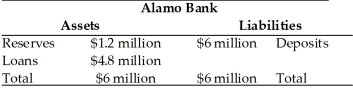 -Refer to Table 10.8. If the required reserve ratio were changed to 10% and Alamo Bank continues to hold $1,200,000 in reserves, its excess reserves will be
 (Multiple Choice)
4.9/5 (78)
(78) Jacob makes excellent tamales and Amanda is very good at mowing lawns. Amanda agrees to mow Jacob's lawn, if he makes her a dozen tamales. This is an example of
(Multiple Choice)
4.8/5 (81)
(81) Refer to the information provided in Figure 10.1 below to answer the questions that follow. Figure 10.1
-Refer to Figure 10.1. A movement from Point A to Point D can be caused by
Figure 10.1
-Refer to Figure 10.1. A movement from Point A to Point D can be caused by (Multiple Choice)
4.8/5 (81)
(81) By influencing the current one-year rate and by affecting people's expectations of future short-term rates, the Fed can
(Multiple Choice)
4.8/5 (81)
(81) If the interest rate on a 2-year security was higher than the average expected interest rate on consecutive 1-year securities, people would be indifferent as to which security they held.
(True/False)
4.7/5 (86)
(86) Refer to the information provided in Figure 10.1 below to answer the questions that follow. Figure 10.1
-Refer to Figure 10.1. A movement from Point D to Point E can be caused by
Figure 10.1
-Refer to Figure 10.1. A movement from Point D to Point E can be caused by (Multiple Choice)
4.8/5 (74)
(74) Which of the following factors causes the barter system to be inefficient?
(Multiple Choice)
4.8/5 (78)
(78) 
Filters
- Essay(0)
- Multiple Choice(0)
- Short Answer(0)
- True False(0)
- Matching(0)