



 Chat with AI
Exam 17: Alternative Views in Macroeconomics

Exam 1: The Scope and Method of Economics238 Questions
Exam 2: The Economic Problem: Scarcity and Choice220 Questions
Exam 3: Demand, Supply, and Market Equilibrium298 Questions
Exam 4: Demand and Supply Applications173 Questions
Exam 5: Introduction to Macroeconomics241 Questions
Exam 6: Measuring National Output and National Income292 Questions
Exam 7: Unemployment, Inflation, and Long-Run Growth297 Questions
Exam 8: Aggregate Expenditure and Equilibrium Output355 Questions
Exam 9: The Government and Fiscal Policy362 Questions
Exam 10: Money, the Federal Reserve, and the Interest Rate358 Questions
Exam 11: The Determination of Aggregate Output, the Price Level, and the Interest Rate243 Questions
Exam 12: Policy Effects and Cost Shocks in the Asad Model200 Questions
Exam 13: The Labor Market in the Macroeconomy287 Questions
Exam 14: Financial Crises, Stabilization, and Deficits260 Questions
Exam 15: Household and Firm Behavior in the Macroeconomy: a Further Look364 Questions
Exam 16: Long-Run Growth196 Questions
Exam 17: Alternative Views in Macroeconomics294 Questions
Exam 18: International Trade, Comparative Advantage, and Protectionism301 Questions
Exam 19: Open-Economy Macroeconomics: the Balance of Payments and Exchange Rates308 Questions
Exam 20: Economic Growth in Developing Economies133 Questions
Exam 21: Critical Thinking About Research105 Questions
Select questions type


Refer to the information provided in Figure 17.2 below to answer the questions that follow. 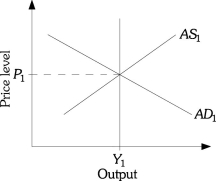 Figure 17.2
-Refer to Figure 17.2. According to the new classical economists, under rational expectations an expected increase in government spending would
Figure 17.2
-Refer to Figure 17.2. According to the new classical economists, under rational expectations an expected increase in government spending would (Multiple Choice)
4.8/5  (85)
(85) If income is $30 billion, the price level is 3, and the stock of money is $18 billion, what is the velocity of money?
(Multiple Choice)
4.9/5 (78)
(78) The Lucas supply model, in combination with the assumption that expectations are rational, leads to the conclusion that
(Multiple Choice)
4.9/5 (76)
(76) Many economists challenged the idea of passive government involvement in the economy following the inflation of the 1970s and early 1980s, and the recessions of 1974-1975 and 1980-1982.
(True/False)
4.9/5 (68)
(68) According to supply-side economists, as tax rates are reduced, labor supply should increase. This implies that
(Multiple Choice)
4.8/5 (75)
(75) Refer to the information provided in Figure 17.1 below to answer the questions that follow. 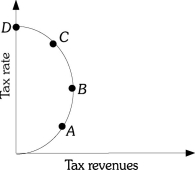 Figure 17.1
-Refer to Figure 17.1. The tax rate that will ________ is associated with Point B.
Figure 17.1
-Refer to Figure 17.1. The tax rate that will ________ is associated with Point B. (Multiple Choice)
4.8/5 (87)
(87) Refer to the information provided in Figure 17.2 below to answer the questions that follow. Figure 17.2
-Refer to Figure 17.2. According to the new classical economists, under rational expectations an expected decrease in government spending would
Figure 17.2
-Refer to Figure 17.2. According to the new classical economists, under rational expectations an expected decrease in government spending would (Multiple Choice)
4.9/5 (81)
(81) Refer to the information provided in Figure 17.1 below to answer the questions that follow. Figure 17.1
-Refer to Figure 17.1. A cut in tax rates will decrease tax revenue if the economy moves from Point
Figure 17.1
-Refer to Figure 17.1. A cut in tax rates will decrease tax revenue if the economy moves from Point (Multiple Choice)
4.8/5 (66)
(66) If nominal GDP is $600 billion and the money supply is $200 billion, the velocity of money is
(Multiple Choice)
4.7/5 (79)
(79) If tax rates increased, giving people a decreased incentive to work and businesses a decreased incentive to invest
(Multiple Choice)
4.9/5 (81)
(81) If the demand for money depends on the interest rate, then a ________ in the money supply will increase nominal GDP by ________.
(Multiple Choice)
4.8/5 (90)
(90) Despite the cut in taxes during the 1980s, federal receipts rose all but one year during that decade.
(True/False)
4.8/5 (83)
(83) Refer to the information provided in Figure 17.1 below to answer the questions that follow. Figure 17.1
-Refer to Figure 17.1. At Point ________, any change in tax rates will decrease tax revenue.
Figure 17.1
-Refer to Figure 17.1. At Point ________, any change in tax rates will decrease tax revenue. (Multiple Choice)
4.8/5 (82)
(82) If firms have ________ and if they set prices and wages on this basis, then prices and wages will, on average, be set at market-clearing levels.
(Multiple Choice)
4.9/5 (73)
(73) The rational-expectations hypothesis suggests that errors in forecasting future inflation rates are due to
(Multiple Choice)
4.8/5 (80)
(80) Suppose that the stock of money is $250 billion and nominal GDP is $2,000 billion. The velocity of money is
(Multiple Choice)
4.9/5 (78)
(78) The Lucas supply function, in combination with the assumption that expectations are rational, implies that if a monetary policy change is announced to the public,
(Multiple Choice)
4.9/5 (89)
(89) According to the rational expectations theory, if all firms have rational expectations and wages and prices are flexible, disequilibrium in a market
(Multiple Choice)
4.8/5 (76)
(76) 
Filters
- Essay(0)
- Multiple Choice(0)
- Short Answer(0)
- True False(0)
- Matching(0)