



 Chat with AI
Exam 8: Aggregate Expenditure and Equilibrium Output

Exam 1: The Scope and Method of Economics65 Questions
Exam 2: The Economic Problem: Scarcity and Choice107 Questions
Exam 3: Demand, Supply, and Market Equilibrium86 Questions
Exam 4: Demand and Supply Applications37 Questions
Exam 5: Introduction to Macroeconomics64 Questions
Exam 6: Measuring National Output and National Income84 Questions
Exam 7: Unemployment, Inflation, and Long-Run Growth81 Questions
Exam 8: Aggregate Expenditure and Equilibrium Output58 Questions
Exam 9: The Government and Fiscal Policy71 Questions
Exam 10: The Money Supply and the Federal Reserve System96 Questions
Exam 11: Money Demand and the Equilibrium Interest Rate96 Questions
Exam 12: The Determination of Aggregate Output, the Price Level, and the Interest Rate100 Questions
Exam 13: Policy Effects and Costs Shocks in the Asad Model89 Questions
Exam 14: The Labor Market in the Macroeconomy111 Questions
Exam 15: Financial Crises, Stabilization, and Deficits102 Questions
Exam 16: Household and Firm Behavior in the Macroeconomy: a Further Look92 Questions
Exam 17: Long-Run Growth59 Questions
Exam 18: Alternative Views in Macroeconomics88 Questions
Exam 19: International Trade, Comparative Advantage, and Protectionism63 Questions
Exam 20: Open-Economy Macroeconomics: the Balance of Payments and Exchange Rates105 Questions
Exam 21: Economic Growth in Developing and Transitional Economies48 Questions
Select questions type


Fill in the consumption table below assuming that the marginal propensity to consume is constant. In addition, write the algebraic equation for the consumption function.
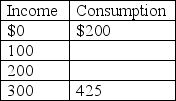
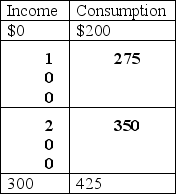
(Essay)
4.8/5  (77)
(77) 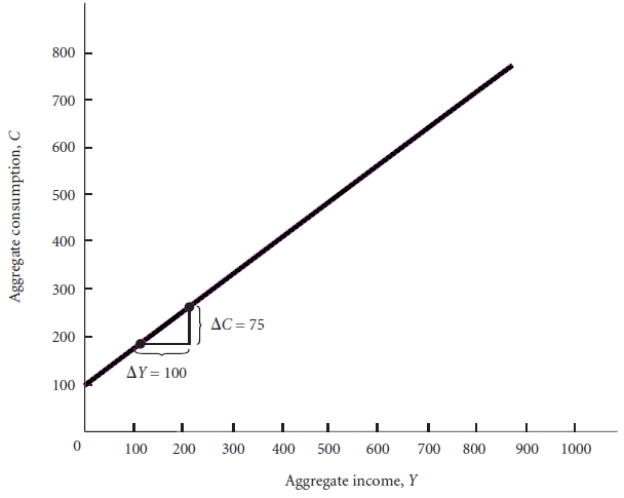 Figure 23.1
-Using Figure 23.1 derive the equation for this saving function.
Figure 23.1
-Using Figure 23.1 derive the equation for this saving function. (Essay)
4.8/5 (73)
(73) Suppose an economy is initially in equilibrium at $800 billion and investment increases by $10 billion. This causes the economy to expand to $1200 billion. Calculate the value of the multiplier.
(Essay)
4.9/5 (73)
(73) Explain any differences between actual investment and planned investment. Also, is it possible for actual investment to be greater than planned investment? If so, explain.
(Essay)
4.8/5 (80)
(80) Assume the saving function for an economy is S = - 200 + .2Y. Derive the consumption function from this information and show your work.
(Essay)
4.9/5 (85)
(85) Draw a graph of the consumption function and explain what the vertical intercept means and the slope. Make sure to label both axes.
(Essay)
4.8/5 (78)
(78) Algebraically derive the value of the multiplier assuming the basic form of the consumption function as C = a + bY where "a" is consumption where income is zero and "b" is the marginal propensity to consume. You may assume a two-sector private economy.
(Essay)
4.9/5 (83)
(83) 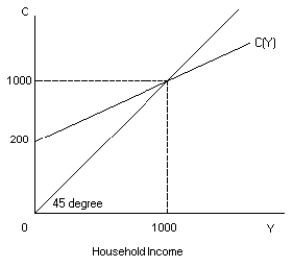 -Draw a consumption table where autonomous consumption is $200 and the marginal propensity to consume is .8. Make sure to start with an income level of $0 and increase by $100 each time up to an income level of $400. Without completing the table any further determine the level of income where consumption and income are equal. Prove this algebraically.
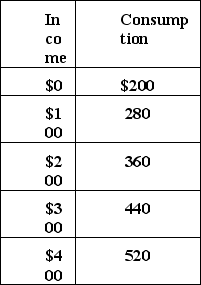
-Draw a consumption table where autonomous consumption is $200 and the marginal propensity to consume is .8. Make sure to start with an income level of $0 and increase by $100 each time up to an income level of $400. Without completing the table any further determine the level of income where consumption and income are equal. Prove this algebraically.
(Essay)
4.9/5 (87)
(87) Compare and contrast the MPC and the MPS. Also explain what these two figures must always add up to.
(Essay)
4.9/5 (76)
(76) Suppose there is an economy in which aggregate expenditure is greater than aggregate output by $30 billion. In addition, firms react by increasing planned investment by $30 billion. Explain why this does not restore equilibrium.
(Essay)
4.9/5 (81)
(81) Discuss some of the factors that would cause the actual multiplier to be different from 1/(1 - MPC).
(Essay)
4.8/5 (67)
(67) In 1995 the Apex television manufacturing company planned to invest $1,100,000 by building a brand new factory wing at a cost of $1,000,000 and increasing its inventories by $100,000 worth of television sets. However, by the end of the year the actual amount of investment for the company was $1,200,000. What could explain this apparent difference between the company's planned investment and actual investment?
(Essay)
4.8/5 (87)
(87) Assume a two sector economy where C = $100 + .9Y and I = $50. Calculate the equilibrium level of output for this hypothetical economy. What would the level of consumption be if the economy were operating at 1400? What would be the amount of unplanned investment at this level? In which direction would you expect the economy to move to at $1400 and why?
(Essay)
4.9/5 (71)
(71) In the simple Keynesian model an increase in consumer spending will increase investment, and a decrease in consumer spending will decrease investment. Critically evaluate this theory.
(Essay)
4.9/5 (82)
(82) Assume consumption is represented by the following: C = 400 + .5Y. Also assume that planned investment (I) equals 100.
(Essay)
4.9/5 (67)
(67) What is the relationship between consumption and the following economic variables: household income, wealth, household's expectations about the future, and interest rates?
(Essay)
4.7/5 (75)
(75) Assume planned aggregate expenditure exceeds aggregate output (income). Explain what will happen to unplanned inventories and the adjustment process towards equilibrium output.
(Essay)
4.8/5 (72)
(72) 
Filters
- Essay(0)
- Multiple Choice(0)
- Short Answer(0)
- True False(0)
- Matching(0)