



 Chat with AI
Exam 7: Unemployment, Inflation, and Long-Run Growth

Exam 1: The Scope and Method of Economics65 Questions
Exam 2: The Economic Problem: Scarcity and Choice107 Questions
Exam 3: Demand, Supply, and Market Equilibrium86 Questions
Exam 4: Demand and Supply Applications37 Questions
Exam 5: Introduction to Macroeconomics64 Questions
Exam 6: Measuring National Output and National Income84 Questions
Exam 7: Unemployment, Inflation, and Long-Run Growth81 Questions
Exam 8: Aggregate Expenditure and Equilibrium Output58 Questions
Exam 9: The Government and Fiscal Policy71 Questions
Exam 10: The Money Supply and the Federal Reserve System96 Questions
Exam 11: Money Demand and the Equilibrium Interest Rate96 Questions
Exam 12: The Determination of Aggregate Output, the Price Level, and the Interest Rate100 Questions
Exam 13: Policy Effects and Costs Shocks in the Asad Model89 Questions
Exam 14: The Labor Market in the Macroeconomy111 Questions
Exam 15: Financial Crises, Stabilization, and Deficits102 Questions
Exam 16: Household and Firm Behavior in the Macroeconomy: a Further Look92 Questions
Exam 17: Long-Run Growth59 Questions
Exam 18: Alternative Views in Macroeconomics88 Questions
Exam 19: International Trade, Comparative Advantage, and Protectionism63 Questions
Exam 20: Open-Economy Macroeconomics: the Balance of Payments and Exchange Rates105 Questions
Exam 21: Economic Growth in Developing and Transitional Economies48 Questions
Select questions type


Some countries use claims for unemployment compensation as the method for calculating the unemployment rate. This of course is not the case in the United States. Can you think of any reason why this method might not be an accurate portrayal of the true unemployment rate?
(Essay)
4.9/5  (68)
(68) What is the natural rate of unemployment and the current consensus estimate of economists?
(Essay)
4.7/5 (71)
(71) 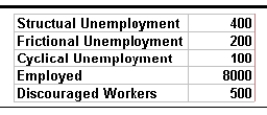 Table 7-1
-Using Table 7.1 above, calculate the unemployment rate.
Explain how and why the unemployment rate may actually rise during an economic recovery.
(Essay)
4.9/5 (78)
(78) Suppose there are 10 million unemployed out of a labor force of 100 million. This means an unemployment rate of 10/100 = .10, or 10 percent. Recalculate the unemployment rate if 1 million of these 10 million unemployed workers stop looking for work.
(Essay)
4.8/5 (85)
(85) Explain how it might be possible for the unemployment rate to decline even though the number of unemployed is growing.
(Essay)
4.8/5 (73)
(73) You are an employee of the Bureau of Labor Statistics involved in the monthly survey of households used to estimate the unemployment rate. In each of the following cases, classify the individual as frictionally, structurally, or cyclically unemployed. Explain your classification.
(a) There has been a general economic slow down. Because of weak demand, Andy Capp has lost his portering job at the docks.
(b) Phil McCafferty, a newly qualified dental school graduate, is looking for a place to set up practice.
(c) Coal miner Ned Ludd is thrown out of work by the introduction of a more mechanized production process.
(d) Latosha Hogan, a computer programmer with a large bank, quit her job two months ago in search of a better-paid programming position. She is still looking.
(Essay)
4.9/5 (68)
(68) Assume that the CPI for year 3 is 120 and the CPI for year 4 is 130. Compute the inflation rate for year 4.
(Essay)
4.9/5 (88)
(88) For the United States, explain why the amount of output that each worker can produce per hour has risen in the last half century.
(Essay)
4.9/5 (84)
(84) Explain the three different types of unemployment. Give an example of each type. Given what you have learned about the different types of unemployment, suggest three policies that could be used to reduce unemployment, one for each type of unemployment.
(Essay)
4.9/5 (80)
(80) Table 7.2
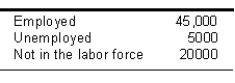 -Using Table 7.2 calculate the unemployment rate and show your work.
 (Essay)
4.9/5 (76)
(76) Assume the number of people employed is 100,000 and the labor force is 500,000. Calculate the unemployment rate based on this information.
(Essay)
4.8/5 (84)
(84) If the national unemployment rate is 7%, does every region in the country have a 7% unemployment rate? Explain.
(Essay)
4.8/5 (79)
(79) Explain why it might be a fruitless endeavor for the government to attempt to reduce frictional unemployment.
(Essay)
4.9/5 (94)
(94) Explain how inflation might actually provide an incentive for the government to spend more and take on more debt?
(Essay)
5.0/5 (76)
(76) Suppose there are 10 million unemployed out of a labor force of 100 million. This means an unemployment rate of 10/100 = .10, or 10 percent. Recalcuate the unemployment rate if 1 million previously discouraged workers re-enter the workforce and start looking for work but don't immediately find employment.
(Essay)
4.8/5 (67)
(67) 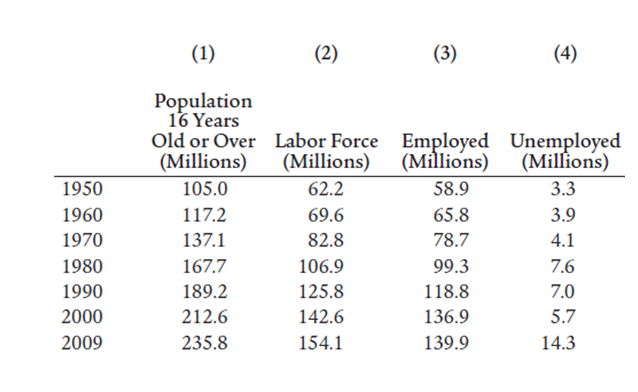 Figure 22.1
-Using Figure 22.1 calcuulate the unemployment rate in each of the years between 1950 and 2009.
Figure 22.1
-Using Figure 22.1 calcuulate the unemployment rate in each of the years between 1950 and 2009.
(Essay)
5.0/5 (68)
(68) 
Filters
- Essay(0)
- Multiple Choice(0)
- Short Answer(0)
- True False(0)
- Matching(0)