



 Chat with AI
Exam 2: Transmission Genetics

Exam 1: The Molecular Basis of Heredity, Variation, and Evolution53 Questions
Exam 2: Transmission Genetics55 Questions
Exam 3: Cell Division and Chromosome Heredity69 Questions
Exam 4: Gene Interaction56 Questions
Exam 5: Genetic Linkage and Mapping in Eukaryotes61 Questions
Exam 6: Genetic Analysis and Mapping in Bacteria and Bacteriophages51 Questions
Exam 7: Dna Structure and Replication57 Questions
Exam 8: Molecular Biology and Transcription and Rna Processing55 Questions
Exam 9: The Molecular Biology of Translation55 Questions
Exam 10: The Integration of Genetic Approaches: Understanding Sickle Cell Disease48 Questions
Exam 11: Chromosome Structure50 Questions
Exam 12: Gene Mutation, Dna Repair, and Homologous Recombination52 Questions
Exam 13: Chromosome Aberrations and Transposition54 Questions
Exam 14: Regulation of Gene Expression in Bacteria and Bacteriophages54 Questions
Exam 15: Regulation of Gene Expression in Eukaryotes56 Questions
Exam 16: Forward Genetics and Recombinant Dna Technology44 Questions
Exam 17: Applications of Recombinant Dna Technology and Reverse Genetics48 Questions
Exam 18: Genomics: Genetics From a Whole-Genome Perspective54 Questions
Exam 19: Cytoplasmic Inheritance and the Evolution of Organelle Genomes52 Questions
Exam 20: Developmental Genetics57 Questions
Exam 21: Genetic Analysis of Quantitative Traits47 Questions
Exam 22: Population Genetics and Evolution47 Questions
Select questions type


A cross between a short pea plant and a tall pea plant results in a 1:1 genotypic and phenotypic ratio in the offspring. What are the genotypes of the parent plants?
(Essay)
5.0/5  (86)
(86) In the accompanying figure, the chance that individual III-2 is a heterozygous carrier is __________. 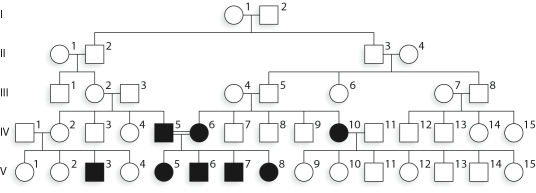
(Multiple Choice)
5.0/5 (77)
(77) A normal distribution curve contains all the possible experimental outcomes in graph form. The tall central segment of the curve represents the outcomes with the highest probability of occurrence. The average outcome, represented by the center of the data distribution, is known as what?
(Short Answer)
4.8/5 (78)
(78) The law of segregation would predict that the F2 progeny of F1 heterozygous plants will exhibit a __________.
(Multiple Choice)
4.9/5 (75)
(75) Mendel performed many types of crosses, including those in which the same genotypes are crossed but the sexes of the parents are switched. These are known as __________.
(Multiple Choice)
4.7/5 (88)
(88) The law of independent assortment would predict that the F2 progeny of F1 heterozygous plants will exhibit a __________.
(Multiple Choice)
4.8/5 (88)
(88) What is the probability of rolling two six-sided dice and obtaining at least one 3?
(Essay)
4.9/5 (75)
(75) What type of cross would be used to illustrate Mendel's law of independent assortment?
(Short Answer)
5.0/5 (85)
(85) The P value is a quantitative expression of the probability that the results of another experiment of the same size and structure will deviate from expected results as much as or more than by chance. The greater the difference between observed and expected results of an experiment, __________.
(Multiple Choice)
4.7/5 (78)
(78) What is the probability of rolling one six-sided die and obtaining any number but 6?
(Short Answer)
4.9/5 (73)
(73) What is the probability of rolling one six-sided die and obtaining a 1 or a 2?
(Short Answer)
4.7/5 (86)
(86) In rabbits, long hair and black fur are produced by the dominant alleles L and B, which assort independently. The genotype ll produces short hair and the genotype bb produces white fur. A cross between a male with short, black fur and a female with long, white fur produces four offspring with short, black fur, four offspring with long, white fur, four offspring with short, white fur, and four offspring with long, black fur. What are the genotypes of the parents?
(Multiple Choice)
4.9/5 (69)
(69) Describe the blending theory of heredity and how Mendel's results help to reject this theory.
(Essay)
4.8/5 (86)
(86) In peas, the yellow allele is dominant over the green allele. A plant with yellow peas was crossed to a plant with green peas. The resulting plants were 50% yellow and 50% green. What is the genotype of the parents in this cross?
(Multiple Choice)
4.8/5 (76)
(76) Assuming independent assortment, what phenotypic ratio would you expect to see if an individual with the genotype RrGg is self-crossed?
(Multiple Choice)
4.8/5 (92)
(92) Crosses in which F1 plants heterozygous for a given allele are crossed to generate a 3:1 phenotypic ratio in the F2 generation are known as __________.
(Multiple Choice)
4.9/5 (77)
(77) In 1997, a gene called Le was discovered by two research groups led by David Martin and Diane Lester. Allelic variation in the Le gene, which controls elongation of the plant stem between branches, is responsible for which trait in peas?
(Multiple Choice)
5.0/5 (91)
(91) In a cross between individuals who are both heterozygous (carriers)for a recessive disease such as albinism, you would like to determine the risk of one or more children to inherit the recessive phenotype. Which of the rules of probability can be used to calculate the probability of a particular combination of events that each have two alternative outcomes?
(Short Answer)
4.9/5 (62)
(62) What is the probability of rolling two six-sided dice and obtaining an odd number on at least one die?
(Essay)
4.9/5 (77)
(77) The statistical interpretation of a χ2 value is determined by identifying the P value for each experiment, and the P value is dependent on the number of degrees of freedom (df)in the experiment being examined. For a coin flip experiment, the df value is equal to 1. You perform an experiment to determine how many times out of 100 die rolls that you roll a "1" in a single roll. What would the df value be equal to?
(Multiple Choice)
4.9/5 (89)
(89) 
Filters
- Essay(0)
- Multiple Choice(0)
- Short Answer(0)
- True False(0)
- Matching(0)