



 Chat with AI
Exam 1: Accounting: Information for Decision Making

Exam 1: Accounting: Information for Decision Making118 Questions
Exam 2: Basic Financial Statements142 Questions
Exam 3: The Accounting Cycle: Capturing Economic Events150 Questions
Exam 4: The Accounting Cycle: Accruals and Deferrals131 Questions
Exam 5: The Accounting Cycle: Reporting Financial Results126 Questions
Exam 6: Merchandising Activities121 Questions
Exam 7: Financial Assets206 Questions
Exam 8: Inventories and the Cost of Goods Sold147 Questions
Exam 9: Plant and Intangible Assets147 Questions
Exam 10: Liabilities197 Questions
Exam 11: Stockholders Equity: Paid-In Capital148 Questions
Exam 12: Income and Changes in Retained Earnings133 Questions
Exam 13: Statement of Cash Flows163 Questions
Exam 14: Financial Statement Analysis146 Questions
Exam 15: Global Business and Accounting82 Questions
Exam 16: Management Accounting112 Questions
Exam 17: Job Order Cost Systems and Overhead Allocations103 Questions
Exam 18: Process Costing83 Questions
Exam 19: Costing and the Value Chain70 Questions
Exam 20: Cost-Volume-Profit Analysis121 Questions
Exam 21: Incremental Analysis97 Questions
Exam 22: Responsibility Accounting and Transfer Pricing88 Questions
Exam 23: Operational Budgeting93 Questions
Exam 24: Standard Cost Systems110 Questions
Exam 25: Rewarding Business Performance69 Questions
Exam 26: Capital Budgeting99 Questions
Exam 27: the Time Value of Money: Future Amounts and Present Values49 Questions
Exam 28: Forms of Business Organization51 Questions
Select questions type


The work of accountants practicing in public accounting may best be described as:
(Multiple Choice)
4.7/5  (83)
(83) The body created by the Sarbanes Oxley Act and charged with oversight of the accounting profession is the:
(Multiple Choice)
4.9/5 (69)
(69) Which of the following is not an important factor in ensuring the integrity of accounting information?
(Multiple Choice)
4.8/5 (80)
(80) Management accounting refers to the preparation and use of accounting information designed to meet the needs of decision makers outside the business organization.
(True/False)
4.8/5 (70)
(70) The general purpose financial statements prepared annually by a corporation would not include the:
(Multiple Choice)
5.0/5 (84)
(84) The FASB takes on a responsibility to do the following,except:
(Multiple Choice)
4.9/5 (81)
(81) The Securities and Exchange Commission is instrumental in the development of financial accounting standards.
(True/False)
4.8/5 (73)
(73) Which of the following is not a basic function of an accounting system?
(Multiple Choice)
4.9/5 (91)
(91) The Code of Ethics of the AICPA calls for a member in public practice to be independent in fact and appearance when providing auditing services.
(True/False)
4.8/5 (76)
(76) All of the following are characteristics of management accounting,except:
(Multiple Choice)
4.9/5 (78)
(78) Accounting Terminology
Listed below are 8 accounting terms. 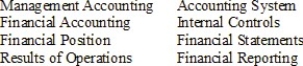 Each of the following statements may (or may not)describe one of these terms.In the space provided,indicate the accounting term described or answer "None" if the statement does not accurately describe any of the terms.
(A. )Information describing the financial resources,obligations,and activities of an economic entity.
(B. )An entity's financial resources and obligations at a point in time.
(C. )Accounting information intended specifically to assist company's management.
(D. )The personnel,procedures,and technology used by an organization to develop accounting information and to communicate this information to decision makers.
(E. )An entity's financial activities during the year.
(F. )Measures used by an organization to guard against errors,waste,and fraud and to assure the reliability of accounting information.
(G. )A plan of financial operations for some future period.
(H. )A written assertion identifying,measuring,and communicating financial information about an economic entity.
Each of the following statements may (or may not)describe one of these terms.In the space provided,indicate the accounting term described or answer "None" if the statement does not accurately describe any of the terms.
(A. )Information describing the financial resources,obligations,and activities of an economic entity.
(B. )An entity's financial resources and obligations at a point in time.
(C. )Accounting information intended specifically to assist company's management.
(D. )The personnel,procedures,and technology used by an organization to develop accounting information and to communicate this information to decision makers.
(E. )An entity's financial activities during the year.
(F. )Measures used by an organization to guard against errors,waste,and fraud and to assure the reliability of accounting information.
(G. )A plan of financial operations for some future period.
(H. )A written assertion identifying,measuring,and communicating financial information about an economic entity. (Essay)
4.9/5 (87)
(87) Although accounting information is used by a wide variety of external parties,financial reporting is primarily directed toward the informational needs of:
(Multiple Choice)
4.8/5 (85)
(85) AICPA Code of Professional Conduct
State and discuss the six articles of the AICPA Code of Professional Conduct that guide members in performing their professional responsibilities.
(Essay)
4.9/5 (74)
(74) One purpose of generally accepted accounting principles is to make accounting information prepared by different companies more comparable.
(True/False)
4.9/5 (91)
(91) Which of the following is not a user of internal accounting information?
(Multiple Choice)
4.9/5 (90)
(90) 
Filters
- Essay(0)
- Multiple Choice(0)
- Short Answer(0)
- True False(0)
- Matching(0)