



 Chat with AI
Exam 11: Investment Decision Criteria

Exam 1: Getting Started-Principles of Finance90 Questions
Exam 2: Firms and the Financial Market50 Questions
Exam 3: Understanding Financial Statements, Taxes, and Cash Flows80 Questions
Exam 4: Financial Analysis-Sizing up Firm Performance130 Questions
Exam 5: Time Value of Money-The Basics93 Questions
Exam 6: The Time Value of Money-Annuities and Other Topics121 Questions
Exam 7: An Introduction to Risk and Return-History of Financial Market Returns56 Questions
Exam 8: Risk and Return-Capital Market Theory102 Questions
Exam 9: Debt Valuation and Interest Rates125 Questions
Exam 10: Stock Valuation101 Questions
Exam 11: Investment Decision Criteria117 Questions
Exam 12: Analyzing Project Cash Flows123 Questions
Exam 13: Risk Analysis and Project Evaluation116 Questions
Exam 14: The Cost of Capital140 Questions
Exam 15: Capital Structure Policy116 Questions
Exam 16: Dividend Policy130 Questions
Exam 17: Financial Forecasting and Planning119 Questions
Exam 18: Working Capital Management150 Questions
Exam 19: International Business Finance122 Questions
Exam 20: Corporate Risk Management133 Questions
Select questions type


Project Ell requires an initial investment of $50,000 and the produces annual cash flows of $30,000, $25,000, and $15,000. Project Ess requires an initial investment of $60,000 and then produces annual cash flows of $25,000 per year for the next ten years. The company ranks projects by their payback periods.
(Multiple Choice)
4.9/5  (85)
(85) Central Mass Ambulance Service can purchase a new ambulance for $200,000 that will provide an annual net cash flow of $50,000 per year for five years. The salvage value of the ambulance will be $25,000. Assume the ambulance is sold at the end of year 5. Calculate the NPV of the ambulance if the required rate of return is 9%. (Round your answer to the nearest $1.)
(Multiple Choice)
4.7/5 (92)
(92) You have been asked to analyze a capital investment proposal. The project's cost is $2,775,000. Cash inflows are projected to be $925,000 in Year 1; $1,000,000 in Year 2; $1,000,000 in Year 3; $1,000,000 in Year 4; and $1,225,000 in Year 5. Assume that your firm discounts capital projects at 15.5%. What is the project's NPV?
(Multiple Choice)
4.9/5 (85)
(85) A machine has a cost of $5,375,000. It will produce cash inflows of $1,825,000 (Year 1); $1,775,000 (Year 2); $1,630,000 (Year 3); $1,585,000 (Year 4); and $1,650,000 (Year 5). At a discount rate of 16.25%, what is the NPV?
(Multiple Choice)
5.0/5 (78)
(78) ABC Service can purchase a new assembler for $15,052 that will provide an annual net cash flow of $6,000 per year for five years. Calculate the NPV of the assembler if the required rate of return is 12%. (Round your answer to the nearest $1.)
(Multiple Choice)
4.7/5 (73)
(73) When several sign reversals in the cash flow stream occur, the IRR equation can have more than one positive IRR.
(True/False)
4.7/5 (79)
(79) According to the modified internal rate of return (MIRR) technique, when a project's MIRR is greater than its cost of capital, the project should be accepted.
(True/False)
4.7/5 (86)
(86) Black Friday Inc. has estimated the following cash flows for a project it is considering:
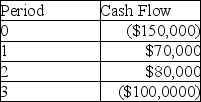 a. What is the payback period for this project?
b. What is the obvious problem with using the payback method in this case?
a. What is the payback period for this project?
b. What is the obvious problem with using the payback method in this case? (Essay)
4.7/5 (82)
(82) Project January has a NPV of $50,000, project December has a NPV of $40,000. Which of the following circumstances could make it possible to choose December over January?
(Multiple Choice)
4.8/5 (73)
(73) Mass Waste Disposal Inc. is considering the construction f a facility at a cost of $20 million. The project will produce positive cash flows of $7 million per year for the next 4 years but the 5th and final year will have a net negative cash flow of $5 million. If the discount rate is 10%, the MIRR of this project is ________ and the project should be ________.
(Multiple Choice)
5.0/5 (81)
(81) Which of the following would be considered a capital budgeting decision?
(Multiple Choice)
4.8/5 (83)
(83) Warchester Inc. is considering the purchase of copying equipment that will require an initial investment of $15,000 and $4,000 per year in annual operating costs over the equipment's estimated useful life of 5 years. The company will use a discount rate of 8.5%. What is the equivalent annual cost?
(Multiple Choice)
4.9/5 (77)
(77) Which of the following is the correct equation to solve for the NPV of the project that has an initial outlay of $30,000, followed by three years of $20,000 in incremental cash inflow? Assume a discount rate of 10%.
(Multiple Choice)
4.8/5 (75)
(75) Aroma Candles, Inc. is evaluating a project with the following cash flows. Calculate the IRR of the project. (Round to the nearest whole percentage.) Year Cash Flows
0 ($120,000)
1 $30,000
2 $70,000
3 $90,000
(Multiple Choice)
4.8/5 (73)
(73) The internal rate of return (IRR) will increase as the required rate of return of a project is increased.
(True/False)
5.0/5 (93)
(93) We compute the profitability index of a capital-budgeting proposal by
(Multiple Choice)
4.9/5 (74)
(74) Suppose you determine that the NPV of a project is $1,525,855. What does that mean?
(Multiple Choice)
4.9/5 (80)
(80) You are considering investing in a project with the following year-end after-tax cash flows: Year 1: $5,000
Year 2: $3,200
Year 3: $7,800
If the initial outlay for the project is $12,113, compute the project's IRR.
(Multiple Choice)
5.0/5 (78)
(78) The Seattle Corporation has been presented with an investment opportunity which will yield cash flows of $30,000 per year in Years 1 through 4, $35,000 per year in Years 5 through 9, and $40,000 in Year 10. This investment will cost the firm $100,000 today, and the firm's cost of capital is 10%. Assume cash flows occur evenly during the year. The discounted payback period is
(Multiple Choice)
4.9/5 (75)
(75) 
Filters
- Essay(0)
- Multiple Choice(0)
- Short Answer(0)
- True False(0)
- Matching(0)