



 Chat with AI
Exam 15: Capital Structure Policy

Exam 1: Getting Started-Principles of Finance90 Questions
Exam 2: Firms and the Financial Market50 Questions
Exam 3: Understanding Financial Statements, Taxes, and Cash Flows80 Questions
Exam 4: Financial Analysis-Sizing up Firm Performance130 Questions
Exam 5: Time Value of Money-The Basics93 Questions
Exam 6: The Time Value of Money-Annuities and Other Topics121 Questions
Exam 7: An Introduction to Risk and Return-History of Financial Market Returns56 Questions
Exam 8: Risk and Return-Capital Market Theory102 Questions
Exam 9: Debt Valuation and Interest Rates125 Questions
Exam 10: Stock Valuation101 Questions
Exam 11: Investment Decision Criteria117 Questions
Exam 12: Analyzing Project Cash Flows123 Questions
Exam 13: Risk Analysis and Project Evaluation116 Questions
Exam 14: The Cost of Capital140 Questions
Exam 15: Capital Structure Policy116 Questions
Exam 16: Dividend Policy130 Questions
Exam 17: Financial Forecasting and Planning119 Questions
Exam 18: Working Capital Management150 Questions
Exam 19: International Business Finance122 Questions
Exam 20: Corporate Risk Management133 Questions
Select questions type


The MAX Corporation is planning a $4 million expansion this year. The expansion can be financed by issuing either common stock or bonds. The new common stock can be sold for $60 per share. The bonds can be issued with a 12% coupon rate. The firm's existing shares of preferred stock pay dividends of $2.00 per share. The company's combined state and federal corporate income tax rate is 46%. The company's balance sheet prior to expansion is as follows:
MAX Corporation
Current assets $ 2,000,000
Fixed assets 8,000,000
Total assets $10,000,000
Current liabilities $ 1,500,000
Bonds:
(8%, $1,000 par value) 1,000,000
(10%, $1,000 par value) 4,000,000
Preferred stock:
($100 par value) 500,000
Common stock:
($2 par value) 700,000
Retained earnings 2,300,000
Total liabilities and equity $10,000,000
a. Calculate the indifference level of EBIT between the two plans.
b. If EBIT is expected to be $3 million, which plan will result in higher EPS?
(Essay)
5.0/5  (92)
(92) Capital leasing is mutually advantageous to lessor and lessee when
(Multiple Choice)
4.8/5 (84)
(84) Under what conditions are shareholders likely to incur agency costs when managers make capital budgeting decisions?
(Essay)
4.9/5 (84)
(84) Which of the following is consistent with the Tradeoff theory of capital structure?
(Multiple Choice)
4.8/5 (75)
(75) Farar, Inc. projects operating income of $4 million next year. The firm's income tax rate is 40%. Farar presently has 750,000 shares of common stock, no preferred stock, and no debt. The firm is considering the issuance of $6 million of 10% bonds to finance a new product that is not expected to generate an increase in income for two years. If Farar issues the bonds this year, what will projected EPS be next year?
(Multiple Choice)
4.9/5 (75)
(75) High coverage ratios, compared with a standard, imply unused debt capacity.
(True/False)
5.0/5 (79)
(79) Capital leasing arrangements are most likely to be mutually beneficial to lessor and lessee when the lessor is taxed at a higher rate and can issue debt at a lower rate than the lessee.
(True/False)
4.8/5 (85)
(85) How does the text distinguish between firm's financial structure and its capital structure?
(Multiple Choice)
4.9/5 (76)
(76) Babbit Corp has a debt ratio (debt to assets) of 40%. Management is wondering if its current capital structure is too conservative. Babbit Corp's present EBIT is $4.5 million, and profits available to common shareholders are $2,851,200, with 480,000 shares of common stock outstanding. If the firm were to instead have a debt ratio of 60%, additional interest expense would cause profits available to stockholders to decline to $2,791,800, but only 384,000 common shares would be outstanding. What is the difference in EPS at a debt ratio of 60% versus 40%?
(Multiple Choice)
4.9/5 (83)
(83) There is abundant evidence that most companies operate at or near their optimal capital structures.
(True/False)
4.9/5 (75)
(75) Debt ratios and debt to enterprise value ratios differ widely from one industry to another.
(True/False)
4.8/5 (81)
(81) The tax shield on interest is calculated by multiplying the interest rate paid on debt by the principal amount of the debt and the firm's marginal tax rate.
(True/False)
4.7/5 (83)
(83) Adams Inc. expects EBIT of $50 million if there is a recession, $100 million if the economy is normal, and $150 million if the economy expands. Bellingham Inc. also expects EBIT of $50 million if there is a recession, $100 million if the economy is normal, and $150 million if the economy expands. Adams is financed entirely with equity while Bellingham is financed 50% with debt at 10%. Adams has $200 million in equity; Bellingham is financed with $100 million of debt and $100 million of equity. The tax rate is 30%. Both firms pay out all available earnings as dividends. If there is a recession, compare dividends and total distributions to investors for each company.
(Essay)
5.0/5 (62)
(62) Merrimac Brewing company's total assets equal $18 million. The book value of Merrimac's equity is $6 million. Excess cash is $200,000. The market value of Merrimac's equity is $10 million. It's Debt to Enterprise Value ratio is .5. What is Merrimac's Debt Ratio?
(Multiple Choice)
4.8/5 (77)
(77) Bipolar Beverages total assets equal $360 million. The book value of Bipolar's equity is $180 million. The market value of Bipolar's equity is $ 250 million. The book value of the company's interest bearing debt is $120 million. Compute Bipolar's Debt Ratio and Debt to Value Ratio.
(Essay)
4.9/5 (72)
(72) Cornucopia's liabilities and equity are shown below: 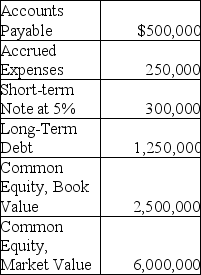 Cornucopia's debt to enterprise value ratio is ________. Excess cash is negligible.
 (Multiple Choice)
4.9/5 (62)
(62) The Modigliani and Miller Capital Structure Theorem suggests that the cost of equity decreases as financial leverage increases.
(True/False)
4.8/5 (87)
(87) Cheshire Corporation is now financed 100% with equity. The cost of equity is 15%. Cheshire is considering a proposal to borrow enough money at 7% to buy back half of its common stock. It would then be financed 50% with debt and 50% with equity. Assume that this does not affect the cost of equity. Cheshire's tax rate is 40%. What is Cheshire's cost of capital without and with the stock repurchase?
(Essay)
4.9/5 (92)
(92) 
Filters
- Essay(0)
- Multiple Choice(0)
- Short Answer(0)
- True False(0)
- Matching(0)