



 Chat with AI
Exam 16: Investment Decision Applications


LD Winery expects a demand of 10 000 bottles per year for a special purpose wine for six years. Net return per unit is $6.10. To produce the wine, LD must buy equipment costing $200 000 with a life of six years and a salvage value of $10 000 after six years. The company estimates that repair costs will be $8000 per year during Years 2 to 6. Should LD invest in the equipment if it requires a return of 16% on its investment?

 (81)
 Verified
Inflows: PMT = $10 000(6.10) = $61 000; P/Y = C/Y = 1; I/Y = 16%; n = 6
PVIN = 61000  = 224 769
PVOUT = 200 000 + 8 000  - 10 000 (
 )
 NPV = 224 769 - 222 090 = $2679
Since NPV > 0, the return on the investment is greater than 16%. LD Winery should invest in the equipment.
Replacing old equipment at an immediate cost of $75 000 and an additional outlay of $10 000 six years from now will result in savings of $3120 per quarter for 11 years. The required rate of return is 11.4% compounded annually. Use the net present value method to determine whether the company should replace old equipment or not.
(78) VerifiedOutlays: FV = $10 000; I/Y = 11.4%; P/Y = C/Y = 1; n = 6(1) = 6;
PV = 10 000  = $5232.25
PVOUT = 75 000 + 5232.25 = $80 232
Inflows: PMT = $3 120; P/Y = 4; C/Y = 1; c =  = 0.25; n = 4(11) = 44;
p =  - 1 = .0273568
PV = 3120 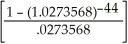 = $79 266.63 = $79 267
PVIn = $79 267
NPV = 79 267 - 80 232 = -$965 < 0, The equipment shouldn't be replaced at the current rate of return.
Tamia Industries plans to replace the outdated equipment that will cost the company $100 000.00 now and $60 000.00 six years from now. This replacement will result in revenues of $6000.00 at the end of each quarter for twelve years. At an interest rate of 9% compounded annually and using the Net Present Value criterion, should the company replace this equipment or not?
(77) VerifiedPV of $60 000 Outlay is:
FV = 60 000; n = 6(4) = 24; i = 0.09; I/Y = 9; P/Y = 4; C/Y = 1; c =  ;
PV = 60000  = 35 776.04
PVOUT = 100 000 + 35 776.04 = $135 776.04 = $135 776
Inflow is: PMT = 6000; n = 12(4) = 48
p =  - 1 = 0.0217782
PV = 6000 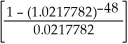 = 177 553.47
PVIn = $177 553
Programmed solution:  NPV = $177 553 - 135 776 = $41 777 > 0; Replace the equipment.
Suleiman must make a choice between two investment alternatives. Alternative 1 will provide him returns of $300 000 at the end of second year and $700 000 at the end of fifth year. Alternative 2 will provide him returns $180 000 at the end of each of the next six years. Alternative 3 will provide him returns $370 000 at the end of second, fourth and sixth years. Which alternative is preferable if money is worth 9.4%?
(83) The introduction of a new product requires an initial outlay of $610 000. The anticipated net returns from the marketing of the product are expected to be $92 300 per year for 12 years. Find the rate of return (correct to the nearest tenth of a percent).
(71) Jasmine has two investment choices. Alternative 1 requires an immediate outlay of $150 000 and offers a return of $417 000 after seven years. Alternative 2 requires an immediate outlay of $180 000 in return for which $25 000 will be received at the end of every six months for the next seven years. Alternative 3 requires an immediate outlay of $200 000 in return for which $60 000 will be received at the end of every year for the next seven years. The required rate of return on investment is 6.3% compounded semi-annually. What is Jasmine's most preferred option?
(82) Kevin needs to decide whether to buy a Honda Civic for $19 900 with a salvage price of $6500 after 5 years or lease the car for 5 years making monthly payments of $269 at the beginning of each month. If money is worth 5% compounded annually, should Kevin buy or lease?
(89) A local community church is contemplating installment of solar cells on its roof and sell the access electricity to the Ontario grid via a power purchase agreement. The project requires an initial investment of $75 000 with a residual value of $2000 after 10 years. It is estimated to yield annual net returns of $15 000 for 10 years. What is the NPV of the project given a rate of return of 7%?
(80) An obligation can be settled by making a payment of $7500.00 now and a final payment of $10 000.00 in five years. Alternatively the obligation can be settled by payments of $750.00 at the end of every three months for five years. If interest rate is 10% compounded quarterly, determine the preferred alternative.
(66) You win a lottery and have a choice of taking $200 000.00 immediately or taking payments of $8000.00 at the end of every three months for ten years. Which offer is preferable if interest is 8% compounded quarterly?
(67) A restaurant may be purchased for $250 000. Annual net income from the operation of the restaurant is expected to be $61 000 for each of the first 4 years and $30 000 for each of the next three years. After 7 years, the restaurant can be sold for $315 000. Determine the rate of return on the investment correct to the nearest tenth of a percent.
a) Use linear interpolation to find the approximate value of the rate of return.
b) Find the answer using Cash Flow and IRR.
(80) A company is looking to invest in a very risky project. They have a required rate of return of 27% compounded annually. The project has the following cash inflows: Year 1 $17500, Year 2 $15000, Year 3 $27500. It also has the following cash outflows: Immediately -$10 000, Year 1 -$15 000, Year 3 -$9500. What is the NPV?
(82) Replacing old office equipment at an immediate cost of $3000 and $4000 four years from now will result in savings of $400 semi-annually for ten years. Should the old equipment be replaced
a) at 8% compounded annually?
b) at 12% compounded annually?
(71) Assume that the net present value of a project is $74.3 million at 6%, and -$21.2 million at 9%. Use linear interpolation to compute the rate of return correct to the nearest hundredth of a percent.
(87) A once in a lifetime project requires an immediate outlay of $100 000 and $25 000 at the end of each year for 3 years. Net returns are nil for the first 3 years and $30 000 per year thereafter for fourteen years. What is the net present value of the project at 16%?
(55) An obligation can be settled by making a payment of $12 000 now and a final payment of $32 000 in 4 years. Alternatively, the obligation can be settled by payments of $2700 at the end of every three months for five years. Interest is 10% compounded quarterly.
Compute the present value of each alternative and determine the preferred alternative according to the discounted cash flow criterion.
(75) A company is considering a project that will require a cost outlay of $17 200 per year for 3 years. At the end of the project the salvage value will be $15 000. The project will yield returns of $60 000 in Year 4 and $20 000 in Year 5. There are no returns after Year 5. Alternative investments are available that will yield a return of 14.2%. Should the company undertake the project?
(73) An expenditure may be met by outlays of $1700 now and $2210 at the end of every six months for 6 years or by making monthly payments of $500 in advance for seven years. Interest is 11% compounded annually.
Compute the present value of each alternative and determine the preferred alternative according to the discounted cash flow criterion.
(77) A company has two investment choices. Alternative A requires an immediate outlay of $4000.00 and offers a return of $14 000.00 after seven years. Alternative B requires an immediate outlay of $3600.00 in return for which $500.00 will be received at the end of every six months for the next seven years. If the rate of return is 6% compounded semi-annually, determine which alternative is preferable.
(78) A special chemical development project requires an immediate outlay of $110 000 and $50 000 at the end of each year for 3 years. Net returns are nil for the first 3 years and $60 000 per year thereafter for fourteen years. What is the net present value of the project at 17%?
(75) 
Filters
- Essay(0)
- Multiple Choice(0)
- Short Answer(0)
- True False(0)
- Matching(0)