



 Chat with AI
Exam 17: Multivariate Analysis of Variance Manova

Exam 1: Why Is My Evil Lecturer Forcing Me to Learn Statistics26 Questions
Exam 2: The Spine of Statistics29 Questions
Exam 3: The Phoenix of Statistics16 Questions
Exam 4: The IBM Spss Statistics Environment27 Questions
Exam 5: Exploring Data With Graphs23 Questions
Exam 6: The Beast of Bias32 Questions
Exam 7: Non-Parametric Models21 Questions
Exam 8: Correlation19 Questions
Exam 9: Regression33 Questions
Exam 10: Comparing Two Means20 Questions
Exam 11: Moderation, Mediation and More Regression21 Questions
Exam 12: GlM 1: Comparing Several Independent Means28 Questions
Exam 13: GlM 2: Comparing Means Adjusted for Other Predictors Analysis of Covariance20 Questions
Exam 14: GlM 3: Factorial Designs30 Questions
Exam 15: GlM 4: Repeated-Measures Designs31 Questions
Exam 16: GlM 5: Mixed Designs19 Questions
Exam 17: Multivariate Analysis of Variance Manova20 Questions
Exam 18: Exploratory Factor Analysis19 Questions
Exam 19: Categorical Outcomes: Chi-Square and Loglinear Analysis19 Questions
Exam 20: Categorical Outcomes: Logistic Regression20 Questions
Exam 21: Multilevel Linear Models20 Questions
Select questions type


Which of the following sentences is false?

Free
(Multiple Choice)
4.9/5  (71)
(71) Correct Answer: Verified
B
A psychologist was interested in gauging the success of a mood manipulation during one of her experiments. She had three groups of participants who underwent different types of mood induction: disgust mood induction, negative mood induction and positive mood induction. After the mood induction, participants were asked to endorse nine statements relating to their mood (on a 5-point Likert scale from 1 = disagree to 5 = agree): (1) When you're smiling the whole world smiles with you, (2) I love the pretty flowers, (3) I could never touch a dead body, (4) I would never eat catfood, (5) If someone served me monkey brain soup I would vomit, (6) I feel fed up, (7) Bodily fluids are nasty, (8) I could not drink from a glass that I'd used to catch a spider, (9) I am a worthless piece of scum.
- What analysis should be done to see if the mood inductions had an effect on responses to these nine items?
Free
(Multiple Choice)
4.8/5 (86)
(86) Correct Answer:Verified
VerifiedC
A psychologist was interested in gauging the success of a mood manipulation during one of her experiments. She had three groups of participants who underwent different types of mood induction: disgust mood induction, negative mood induction and positive mood induction. After the mood induction, participants were asked to endorse nine statements relating to their mood (on a 5-point Likert scale from 1 = disagree to 5 = agree).
-Which statement best sums up this part of the output? 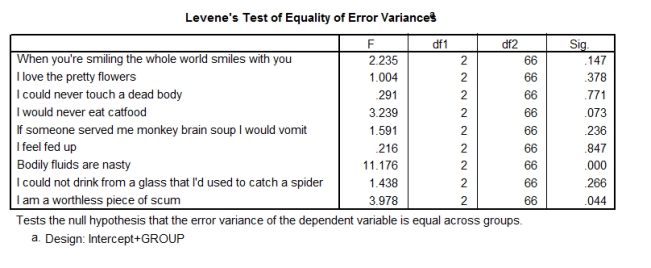
Free
(Multiple Choice)
5.0/5 (85)
(85) Correct Answer:Verified
VerifiedA
A psychologist was interested in gauging the success of a mood manipulation during one of her experiments. She had three groups of participants who underwent different types of mood induction: disgust mood induction, negative mood induction and positive mood induction. After the mood induction, participants were asked to endorse nine statements relating to their mood (on a 5-point Likert scale from 1 = disagree to 5 = agree): (1) When you're smiling the whole world smiles with you, (2) I love the pretty flowers, (3) I could never touch a dead body, (4) I would never eat catfood, (5) If someone served me monkey brain soup I would vomit, (6) I feel fed up, (7) Bodily fluids are nasty, (8) I could not drink from a glass that I'd used to catch a spider, (9) I am a worthless piece of scum.
-Part of the SPSS output is below. Which of the following statements best summarizes the output? 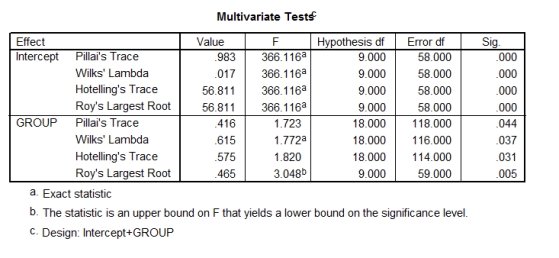
(Multiple Choice)
4.9/5 (67)
(67) A scientist was interested in the success of a newly developed sleep aid called 'Night Owl' on time taken to fall asleep and quality of sleep. She recruited 30 participants who were randomly allocated to receive either a dose of Night Owl or a placebo. The scientist measured the mean time taken for each participant to fall asleep (minutes) and the quality of their sleep (measured on a scale of 1 (poorest quality) to 10 (best possible quality)) over the course of one week.
-How could the scientist analyse her data to investigate whether participants in the Night Owl group fell asleep faster and had a better quality of sleep than those in the placebo group?
(Multiple Choice)
4.8/5 (76)
(76) A psychologist was interested in gauging the success of a mood manipulation during one of her experiments. She had three groups of participants who underwent different types of mood induction: disgust mood induction, negative mood induction and positive mood induction. After the mood induction, participants were asked to endorse nine statements relating to their mood (on a 5-point Likert scale from 1 = disagree to 5 = agree).
- A discriminant function analysis was performed on the data. The output is below. Which statement best sums up the results? Wilks' Lambda Test of Function(s) Wilks' Lambda Chi-square df Sig. 1 through 2 .615 30.128 18 .036 2 .901 6.452 8 .597 Eigenvalues
Function Eigenvalue \% of Variance Cumulative \% Canonical Correlation 1 .46 80.9 80.9 .563 2 .11 19.1 100.0 .314
a. First 2 canonical discriminant functions were used in the analysis.
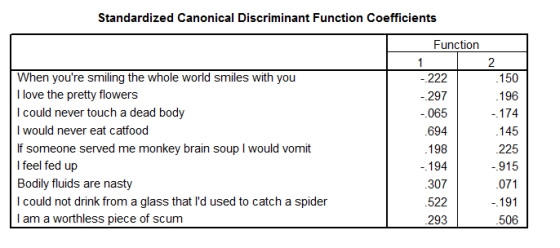
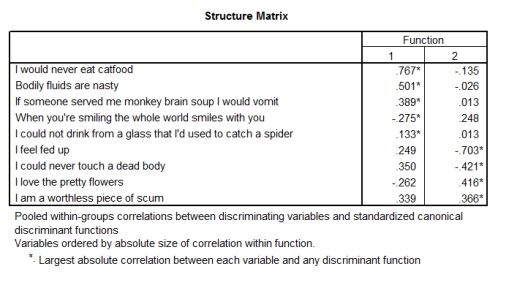
(Multiple Choice)
4.8/5 (86)
(86) A psychologist was interested in gauging the success of a mood manipulation during one of her experiments. She had three groups of participants who underwent different types of mood induction: disgust mood induction, negative mood induction and positive mood induction. After the mood induction, participants were asked to endorse nine statements relating to their mood (on a 5-point Likert scale from 1 = disagree to 5 = agree).
-Which statement best sums up this part of the output? 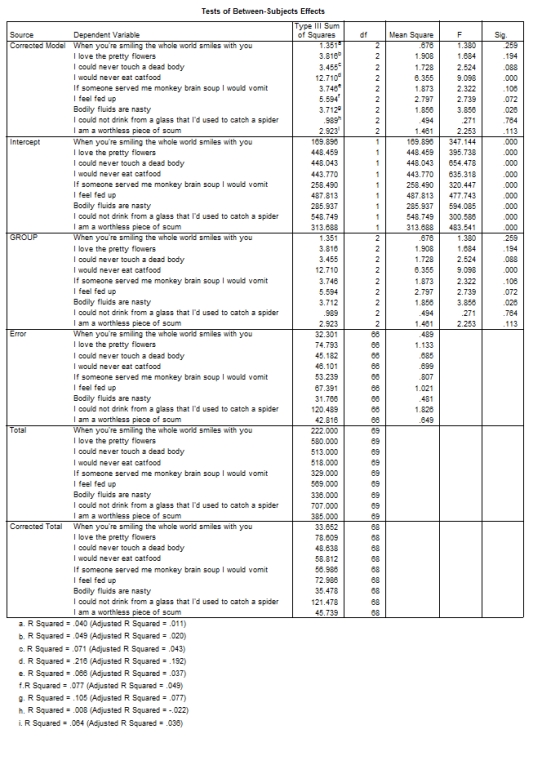
(Multiple Choice)
4.9/5 (78)
(78) A scientist was interested in the success of a newly developed sleep aid called 'Night Owl' on time taken to fall asleep and quality of sleep. She recruited 30 participants who were randomly allocated to receive either a dose of Night Owl or a placebo. The scientist measured the mean time taken for each participant to fall asleep (minutes) and the quality of their sleep (measured on a scale of 1 (poorest quality) to 10 (best possible quality)) over the course of one week.
-What does the output below show?
Box's Test of Equality
of Covariance
Matrices
Box's M .229 F .070 df1 3 df2 141120.000 Sig. .976
Tests the null hypothesis that the observed covariance matrices of the dependent variables are equal across groups.
a. Design:
Intercept + Drug Bartlett's Test of Sphericity
Likelihood Ratio .000 Approx. Chi-Square 101.046 df 2 Sig. .000
Tests the null hypothesis that the residual covariance matrix is proportional to an identity matrix.
a. Design: Intercept + Drug
(Multiple Choice)
4.8/5 (84)
(84) When you have several outcome variables, what advantage does conducting a MANOVA have over conducting several ANOVAs?
(Multiple Choice)
4.7/5 (80)
(80) A scientist was interested in the success of a newly developed sleep aid called 'Night Owl' on time taken to fall asleep and quality of sleep. She recruited 30 participants who were randomly allocated to receive either a dose of Night Owl or a placebo. The scientist measured the mean time taken for each participant to fall asleep (minutes) and the quality of their sleep (measured on a scale of 1 (poorest quality) to 10 (best possible quality)) over the course of one week.
-What can the scientist conclude from the output below?
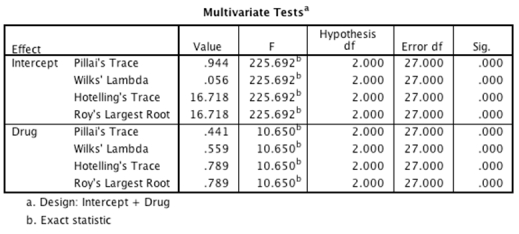
(Multiple Choice)
4.7/5 (92)
(92) When following up a significant MANOVA, what is the advantage of conducting discriminant function analysis over separate ANOVAs?
(Multiple Choice)
4.7/5 (64)
(64) If we ran Box's test prior to conducting a MANOVA and obtained a value with an associated p-value less than .05, what would this tell us?
(Multiple Choice)
4.8/5 (92)
(92) 
Filters
- Essay(0)
- Multiple Choice(0)
- Short Answer(0)
- True False(0)
- Matching(0)