



 Chat with AI
Exam 1: Accounting in Business

Exam 1: Accounting in Business240 Questions
Exam 2: Analyzing and Recording Transactions197 Questions
Exam 3: Adjusting Accounts and Preparing Financial Statements224 Questions
Exam 4: Completing the Accounting Cycle176 Questions
Exam 5: Accounting for Merchandising Operations198 Questions
Exam 6: Inventories and Cost of Sales198 Questions
Exam 7: Accounting Information Systems176 Questions
Exam 8: Cash and Internal Controls196 Questions
Exam 9: Accounting for Receivables191 Questions
Exam 10: Plant Assets, Natural Resources, and Intangibles223 Questions
Exam 11: Current Liabilities and Payroll Accounting193 Questions
Exam 12: Accounting for Partnerships139 Questions
Exam 13: Accounting for Corporations246 Questions
Exam 14: Long-Term Liabilities198 Questions
Exam 15: Investments and International Operations192 Questions
Exam 16: Reporting the Statement of Cash Flows187 Questions
Exam 17: Analysis of Financial Statements187 Questions
Exam 18: Managerial Accounting Concepts and Principles197 Questions
Exam 19: Job Order Cost Accounting164 Questions
Exam 20: Process Cost Accounting174 Questions
Exam 21: Cost Allocation and Performance Measurement170 Questions
Exam 22: Cost-Volume-Profit Analysis186 Questions
Exam 23: Master Budgets and Planning162 Questions
Exam 24: Flexible Budgets and Standard Costs174 Questions
Exam 25: Capital Budgeting and Managerial Decisions150 Questions
Exam 26: Time Value of Money60 Questions
Select questions type


On June 30 of the current year, the assets and liabilities of Phoenix, Inc. are as follows: Cash $20,500; Accounts Receivable, $7,250; Supplies, $650; Equipment, $12,000; Accounts Payable, $9,300. What is the amount of owner's equity as of July 1 of the current year?
(Multiple Choice)
4.8/5  (75)
(75) If the assets of a business increased $89,000 during a period of time and its liabilities increased $67,000 during the same period, equity in the business must have:
(Multiple Choice)
4.8/5 (83)
(83) An income statement reports on investing and financing activities.
(True/False)
4.8/5 (89)
(89) In accounting, the rule that requires that assets, services, and liabilities be recorded initially at the cash or cash-equivalent value of what was given up or of the item received is called _____________________________.
(Short Answer)
4.9/5 (69)
(69) Rent expense that is paid with cash appears on which of the following statements?
(Multiple Choice)
4.8/5 (73)
(73) The three common forms of business ownership include sole proprietorship, partnership, and non-profit.
(True/False)
5.0/5 (79)
(79) At the beginning of the year, a company had $120,000 worth of liabilities. During the year, assets increased by $160,000 and at year-end they equaled $360,000. Liabilities decreased $20,000 during the year. Calculate the beginning and ending values of equity.
(Not Answered)
This question doesn't have any answer yet
If assets are $99,000 and liabilities are $32,000, then equity equals:
(Multiple Choice)
4.8/5 (72)
(72) The accounting equation implies that: Assets + Liabilities = Equity.
(True/False)
4.9/5 (81)
(81) The financial statement that shows the beginning balance of owner's equity; the changes in equity that resulted from new investments by the owner, net income (or net loss); withdrawals; and the ending balance, is the:
(Multiple Choice)
4.9/5 (66)
(66) Annie's Attic has the following account balances for the dates given: 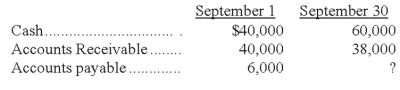 Also, its net income, for September 1 through September 30 was $20,000 and there were no investments or withdrawals by the owner. Determine the equity at both September 1 and September 30.
 (Not Answered)
This question doesn't have any answer yet
The financial statement that identifies where a company's cash came from and where it went during the period is the:
(Multiple Choice)
4.9/5 (88)
(88) The assumption that requires that a business be accounted for separately from its owners is the __________________ assumption.
(Short Answer)
4.9/5 (76)
(76) General accounting principles arise from long-used accounting practices.
(True/False)
4.8/5 (70)
(70) Identify several opportunities in accounting and its related fields.
(Essay)
4.8/5 (93)
(93) Flash has beginning equity of $257,000, net income of $51,000, withdrawals of $40,000 and investments by owners of $6,000. Its ending equity is:
(Multiple Choice)
4.8/5 (76)
(76) A sole proprietorship is a business owned by one or more persons.
(True/False)
4.8/5 (75)
(75) 
Filters
- Essay(0)
- Multiple Choice(0)
- Short Answer(0)
- True False(0)
- Matching(0)