



 Chat with AI
Exam 13: Accounting for Corporations

Exam 1: Accounting in Business240 Questions
Exam 2: Analyzing and Recording Transactions197 Questions
Exam 3: Adjusting Accounts and Preparing Financial Statements224 Questions
Exam 4: Completing the Accounting Cycle176 Questions
Exam 5: Accounting for Merchandising Operations198 Questions
Exam 6: Inventories and Cost of Sales198 Questions
Exam 7: Accounting Information Systems176 Questions
Exam 8: Cash and Internal Controls196 Questions
Exam 9: Accounting for Receivables191 Questions
Exam 10: Plant Assets, Natural Resources, and Intangibles223 Questions
Exam 11: Current Liabilities and Payroll Accounting193 Questions
Exam 12: Accounting for Partnerships139 Questions
Exam 13: Accounting for Corporations246 Questions
Exam 14: Long-Term Liabilities198 Questions
Exam 15: Investments and International Operations192 Questions
Exam 16: Reporting the Statement of Cash Flows187 Questions
Exam 17: Analysis of Financial Statements187 Questions
Exam 18: Managerial Accounting Concepts and Principles197 Questions
Exam 19: Job Order Cost Accounting164 Questions
Exam 20: Process Cost Accounting174 Questions
Exam 21: Cost Allocation and Performance Measurement170 Questions
Exam 22: Cost-Volume-Profit Analysis186 Questions
Exam 23: Master Budgets and Planning162 Questions
Exam 24: Flexible Budgets and Standard Costs174 Questions
Exam 25: Capital Budgeting and Managerial Decisions150 Questions
Exam 26: Time Value of Money60 Questions
Select questions type


Special rights often granted to preferred stock include a preference for receiving dividends and for the distribution of assets if the corporation is liquidated.
(True/False)
4.9/5  (76)
(76) The stockholders' equity section of a corporation's balance sheet follows: 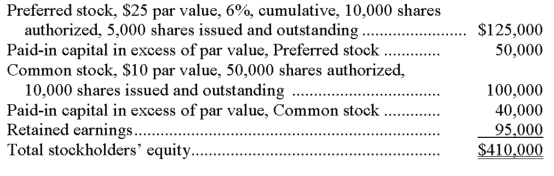 (1) Assuming that the preferred stock is not callable and no dividends are in arrears, compute the book values per preferred share and per common share.
Book value per preferred share ____________________ Book value per common share ____________________ (2) Assuming that the preferred stock has a call price of $30 per share and one year of cumulative preferred dividends is in arrears, compute the book values per preferred share and per common share
Book value per preferred share ____________________ Book value per common share ____________________
(1) Assuming that the preferred stock is not callable and no dividends are in arrears, compute the book values per preferred share and per common share.
Book value per preferred share ____________________ Book value per common share ____________________ (2) Assuming that the preferred stock has a call price of $30 per share and one year of cumulative preferred dividends is in arrears, compute the book values per preferred share and per common share
Book value per preferred share ____________________ Book value per common share ____________________ (Not Answered)
This question doesn't have any answer yet
A company is authorized to issue 50,000 shares of $50 par value, 8%, cumulative, fully participating preferred stock, and 750,000 shares of $5 par value common stock. Prepare journal entries to record the following selected transactions that occurred during the company's first year of operations: 
(Not Answered)
This question doesn't have any answer yet
Stated value stock is par stock that is assigned a value per share by the corporation's board of directors.
(True/False)
4.7/5 (87)
(87) A corporation has $1,750,000 in stockholders' equity and 350,000 weighted-average shares of common stock outstanding. Calculate the book value per common share.
(Not Answered)
This question doesn't have any answer yet
A company has a market value per share of $73.00. Its net income is $1,750,000 and the weighted-average number of shares outstanding is 350,000. The company's price-earnings ratio equals:
(Multiple Choice)
4.9/5 (85)
(85) If the dividends account is not recorded as a reduction to Retained Earnings on the date of declaration, the dividends account is closed to Retained Earnings at the end of the accounting period.
(True/False)
4.9/5 (70)
(70) A company's stock is selling for $35 per share at year-end. This current year it paid shareholders a $2.45 per share cash dividend, reported earnings per share of $12.00, and had 750,000 common shares outstanding at year-end. Calculate the company's dividend yield.
(Not Answered)
This question doesn't have any answer yet
Explain the difference between a large stock dividend and a small stock dividend. In addition, explain how to record these two types of stock dividends.
(Essay)
4.8/5 (68)
(68) A company has $100,000 of 10% noncumulative, nonparticipating, preferred stock outstanding, and $150,000 of common stock outstanding. In the company's first year of operation, no dividends were paid, but during the second year, it paid cash dividends of $25,000. Compute the dividends to be distributed to (1) preferred shares and (2) common shares.
(Not Answered)
This question doesn't have any answer yet
The only way that a shareholder can affect the management of a corporation is to get elected to the corporation's board of directors.
(True/False)
4.8/5 (72)
(72) The main limitation in using book value per share for stock valuation models is the potential difference between recorded value and market value for both assets and liabilities.
(True/False)
4.8/5 (77)
(77) On January 10, a corporation purchased 5,000 shares of its own common stock at $17.50 per share. On August 4, a total of 1,000 treasury shares were sold at $19.00 per share. These are the only treasury stock transactions ever made by the corporation. Prepare the journal entries required on January 10 and August 4.
(Not Answered)
This question doesn't have any answer yet
A company has $595,000 in total stockholders' equity. Preferred stock outstanding is valued at $150,000, and 75,000 shares of common stock are outstanding. Its book value per common share is $7.93.
($595,000 - $150,000)/75,000 shares = $5.93/share
(True/False)
5.0/5 (85)
(85) If a corporation is authorized to issue 1,000 shares of $50 common stock, it is said to have $50,000 of stock outstanding.
(True/False)
4.7/5 (81)
(81) Book value per share reflects the value per share if a company is liquidated at balance sheet amounts.
(True/False)
4.8/5 (80)
(80) ________________________ is the number of shares that a corporation's charter allows it to sell.
(Short Answer)
4.9/5 (79)
(79) 
Filters
- Essay(0)
- Multiple Choice(0)
- Short Answer(0)
- True False(0)
- Matching(0)