



 Chat with AI
Exam 20: Process Cost Accounting

Exam 1: Accounting in Business240 Questions
Exam 2: Analyzing and Recording Transactions197 Questions
Exam 3: Adjusting Accounts and Preparing Financial Statements224 Questions
Exam 4: Completing the Accounting Cycle176 Questions
Exam 5: Accounting for Merchandising Operations198 Questions
Exam 6: Inventories and Cost of Sales198 Questions
Exam 7: Accounting Information Systems176 Questions
Exam 8: Cash and Internal Controls196 Questions
Exam 9: Accounting for Receivables191 Questions
Exam 10: Plant Assets, Natural Resources, and Intangibles223 Questions
Exam 11: Current Liabilities and Payroll Accounting193 Questions
Exam 12: Accounting for Partnerships139 Questions
Exam 13: Accounting for Corporations246 Questions
Exam 14: Long-Term Liabilities198 Questions
Exam 15: Investments and International Operations192 Questions
Exam 16: Reporting the Statement of Cash Flows187 Questions
Exam 17: Analysis of Financial Statements187 Questions
Exam 18: Managerial Accounting Concepts and Principles197 Questions
Exam 19: Job Order Cost Accounting164 Questions
Exam 20: Process Cost Accounting174 Questions
Exam 21: Cost Allocation and Performance Measurement170 Questions
Exam 22: Cost-Volume-Profit Analysis186 Questions
Exam 23: Master Budgets and Planning162 Questions
Exam 24: Flexible Budgets and Standard Costs174 Questions
Exam 25: Capital Budgeting and Managerial Decisions150 Questions
Exam 26: Time Value of Money60 Questions
Select questions type


A process cost summary includes the amounts of equivalent units of production for the period.
(True/False)
4.9/5  (77)
(77) The purchase of raw materials on account in a process costing system is recorded with a:
(Multiple Choice)
4.7/5 (82)
(82) A company uses the FIFO method for inventory costing. During a period, a production department had 20,000 units in beginning goods in process inventory which were 40% complete; the department completed and transferred 165,000 units. At the end of the period, 22,000 units were in the ending goods in process inventory and are 75% complete. Compute the number of equivalent units produced by the department.
(Multiple Choice)
4.8/5 (73)
(73) Accountants use the term process cost accounting system because this system uses a number of trained individuals and computers to process the collected cost information.
(True/False)
4.9/5 (78)
(78) Refer to the following information about the Dipping Department of the Indiana Factory for the month of August. Indiana Factory uses the FIFO method of inventory costing. 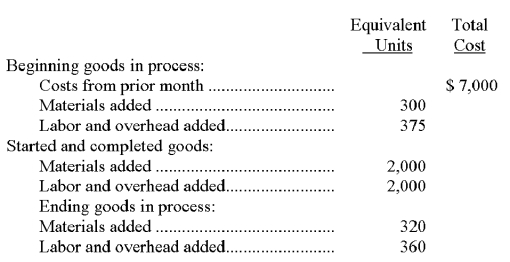 The cost per equivalent unit of materials is $10.00, and the cost per equivalent unit of labor and overhead is $22.00. Compute the cost that should be assigned all units that were completed and transferred during August.
 (Not Answered)
This question doesn't have any answer yet
In process cost accounting, materials are always classified as indirect if they are not physically incorporated into the final product.
(True/False)
4.9/5 (84)
(84) Job order manufacturing and process manufacturing are two major costing systems used in manufacturing. Briefly contrast the characteristics of these two systems.
(Essay)
4.8/5 (84)
(84) Process cost accounting systems are commonly used by companies that produce a large volume of standardized units on a continuous basis.
(True/False)
4.8/5 (88)
(88) Which of the following characteristics does not usually apply to process manufacturing systems?
(Multiple Choice)
4.9/5 (78)
(78) Embark produces mulch for landscaping use. The following information summarizes production operations for June. The journal entry to record June production activities for direct labor usage is: 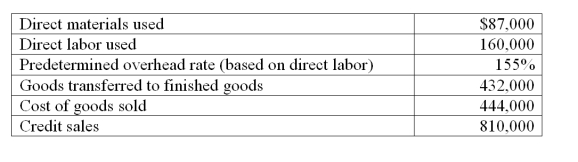
(Multiple Choice)
4.9/5 (75)
(75) In process costing, factory overhead incurred does not usually equal that applied, which yields either ____________________ or ___________________ overhead.
(Short Answer)
4.9/5 (78)
(78) An equivalent unit of production is an estimate of efforts that is used to calculate the ______________ of each production component.
(Short Answer)
4.8/5 (84)
(84) Materials and labor costs that are clearly associated with a specific process are known as _________________. Those costs that are not clearly associated with a specific process are called ______________.
(Short Answer)
4.8/5 (73)
(73) The first step in accounting for production activity in a period, ______________, is a reconciliation of the physical units started in a period with the physical units completed in that period.
(Short Answer)
4.7/5 (76)
(76) The fourth step in accounting for production activity in a period is to prepare a cost reconciliation, which reconciles _____________________ with the ___________________.
(Short Answer)
4.8/5 (80)
(80) A company that applies process costing is most frequently characterized by:
(Multiple Choice)
4.8/5 (80)
(80) During March, the production department of a process manufacturing system completed a number of units of a product and transferred them to finished goods. Of the units transferred, 25,000 were in process at the beginning of March and 110,000 were started and completed in March. March's beginning inventory units were 100% complete with respect to materials and 55% complete with respect to labor. At the end of March, 30,000 additional units were in process in the production department and were 100% complete with respect to materials and 30% complete with respect to labor. Compute the number of units transferred to finished goods.
(Multiple Choice)
5.0/5 (82)
(82) Process costing is applied to operations with repetitive production and heterogeneous products.
(True/False)
4.7/5 (74)
(74) In process costing there is never a balance remaining in Factory Overhead that needs to be closed at period end.
(True/False)
4.9/5 (70)
(70) In some circumstances, a process cost accounting system can classify wages paid to maintenance workers as direct labor costs instead of factory overhead.
(True/False)
4.9/5 (76)
(76) 
Filters
- Essay(0)
- Multiple Choice(0)
- Short Answer(0)
- True False(0)
- Matching(0)