



 Chat with AI
Exam 23: Master Budgets and Planning

Exam 1: Accounting in Business240 Questions
Exam 2: Analyzing and Recording Transactions197 Questions
Exam 3: Adjusting Accounts and Preparing Financial Statements224 Questions
Exam 4: Completing the Accounting Cycle176 Questions
Exam 5: Accounting for Merchandising Operations198 Questions
Exam 6: Inventories and Cost of Sales198 Questions
Exam 7: Accounting Information Systems176 Questions
Exam 8: Cash and Internal Controls196 Questions
Exam 9: Accounting for Receivables191 Questions
Exam 10: Plant Assets, Natural Resources, and Intangibles223 Questions
Exam 11: Current Liabilities and Payroll Accounting193 Questions
Exam 12: Accounting for Partnerships139 Questions
Exam 13: Accounting for Corporations246 Questions
Exam 14: Long-Term Liabilities198 Questions
Exam 15: Investments and International Operations192 Questions
Exam 16: Reporting the Statement of Cash Flows187 Questions
Exam 17: Analysis of Financial Statements187 Questions
Exam 18: Managerial Accounting Concepts and Principles197 Questions
Exam 19: Job Order Cost Accounting164 Questions
Exam 20: Process Cost Accounting174 Questions
Exam 21: Cost Allocation and Performance Measurement170 Questions
Exam 22: Cost-Volume-Profit Analysis186 Questions
Exam 23: Master Budgets and Planning162 Questions
Exam 24: Flexible Budgets and Standard Costs174 Questions
Exam 25: Capital Budgeting and Managerial Decisions150 Questions
Exam 26: Time Value of Money60 Questions
Select questions type


A plan that lists dollar amounts to be received from disposing of plant assets and dollar amounts to be spent on purchasing additional plant assets is called a:
(Multiple Choice)
4.7/5  (66)
(66) A manufacturing budget should include a list of equipment to be scrapped and additional equipment to be purchased if the proposed production budget is carried out.
(True/False)
5.0/5 (75)
(75) The financial budgets of a business include the cash budget, the budgeted income statement, and the budgeted balance sheet.
(True/False)
4.7/5 (84)
(84) David, Inc., is preparing its master budget for the second quarter. The following sales and production data have been forecasted:  Finished goods inventory on March 31: 120 units
Raw materials inventory on March 31: 450 pounds
Desired ending inventory each month:
Finished goods: 30% of next month's sales
Raw materials: 25% of next month's production needs
Number of pounds of raw material required per finished unit: 4 lb.
How many pounds of raw materials should be purchased in April?
Finished goods inventory on March 31: 120 units
Raw materials inventory on March 31: 450 pounds
Desired ending inventory each month:
Finished goods: 30% of next month's sales
Raw materials: 25% of next month's production needs
Number of pounds of raw material required per finished unit: 4 lb.
How many pounds of raw materials should be purchased in April? (Not Answered)
This question doesn't have any answer yet
Cambridge, Inc., is preparing its master budget for the quarter ended June 30. It sells a single product for $40 each. Sales are 60% cash and 40% on credit. All credit sales are collected in the month following the sale. At March 31, the balance in accounts receivable is $12,000, which represents the uncollected balance on March sales. Budgeted sales for the next four months follow:  The product cost is $20 per unit, and desired ending inventory is 60% of the following month's sales in units. Inventory at March 31 is 480 units. Purchases are paid 50% in the month of purchase and 50% in the following month. At March 31, the balance in accounts payable is $11,000, which represents the unpaid purchases from March. Operating expenses are paid in the month incurred and consist of:
Commissions (10% of sales)
Shipping (3% of sales)
Office salaries ($3,000 per month)
Rent ($5,000 per month)
Depreciation is $2,000 per month. Income taxes are 40%, and will be paid on July 1. There are no taxes payable at March 31. A minimum cash balance of $12,000 is required, and the beginning cash balance is $12,000. Loans are obtained at the end of any month when a cash shortage occurs. Interest is 1% per month based on the beginning of the month loan balance and is paid at each month end. If an excess balance of cash exists, loans are repaid at the end of the month. At March 31, the loan balance is $2,000. Prepare a master budget (round all dollar amounts to the nearest whole dollar) for each of the months of April, May, and June that includes the:
Sales budget
Table of cash receipts
Merchandise purchases budget
Table of cash disbursements for purchases of merchandise
Table of cash disbursements for selling and administrative expenses
Cash budget, including information on the loan balance
Budgeted income statement
The product cost is $20 per unit, and desired ending inventory is 60% of the following month's sales in units. Inventory at March 31 is 480 units. Purchases are paid 50% in the month of purchase and 50% in the following month. At March 31, the balance in accounts payable is $11,000, which represents the unpaid purchases from March. Operating expenses are paid in the month incurred and consist of:
Commissions (10% of sales)
Shipping (3% of sales)
Office salaries ($3,000 per month)
Rent ($5,000 per month)
Depreciation is $2,000 per month. Income taxes are 40%, and will be paid on July 1. There are no taxes payable at March 31. A minimum cash balance of $12,000 is required, and the beginning cash balance is $12,000. Loans are obtained at the end of any month when a cash shortage occurs. Interest is 1% per month based on the beginning of the month loan balance and is paid at each month end. If an excess balance of cash exists, loans are repaid at the end of the month. At March 31, the loan balance is $2,000. Prepare a master budget (round all dollar amounts to the nearest whole dollar) for each of the months of April, May, and June that includes the:
Sales budget
Table of cash receipts
Merchandise purchases budget
Table of cash disbursements for purchases of merchandise
Table of cash disbursements for selling and administrative expenses
Cash budget, including information on the loan balance
Budgeted income statement (Not Answered)
This question doesn't have any answer yet
The budgeted balance sheet is prepared from data contained in the previously prepared components of the master budget.
(True/False)
5.0/5 (94)
(94) A budget is a formal statement of future plans, usually expressed in monetary terms.
(True/False)
4.8/5 (79)
(79) Grafton sells a product for $700. Unit sales for May were 400 and a 3% growth in unit sales is forecasted for each month. Compute the total sales to be reported on the sales budget for month ended June 30.
(Multiple Choice)
4.8/5 (78)
(78) Grafton sells a product for $700. Unit sales for May were 400 and a 3% growth in unit sales is forecasted for each month. Grafton pays a sales manager a monthly salary of $3,000 and a commission of 2% of sales in dollars. Assume 30% of Grafton's sales are for cash. The remaining 70% are credit sales; these customers pay in the month following the sale. Compute the budgeted cash receipts for June.
(Multiple Choice)
4.7/5 (93)
(93) Sweeny Co. is preparing a cash budget for the second quarter of the coming year. The following data have been forecasted: 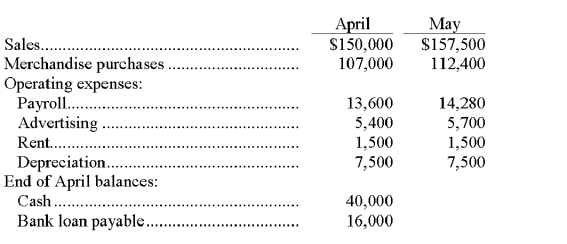 Additional data:
(1) Sales are 40% cash and 60% credit. The collection pattern for credit sales is 50% in the month following the sale and 50% in the month thereafter. Total sales in March were $125,000.
(2) Purchases are all on credit, with 40% paid in the month of purchase and the balance paid in the following month.
(3) Operating expenses are paid in the month they are incurred.
(4) A minimum cash balance of $40,000 is required at the end of each month.
(5) Loans are used to maintain the minimum cash balance. At the end of each month, interest of 1% per month is paid on the outstanding loan balance as of the beginning of the month. Repayments are made whenever excess cash is available.
Prepare the company's cash budget for May. Show the ending loan balance at May 31.
Additional data:
(1) Sales are 40% cash and 60% credit. The collection pattern for credit sales is 50% in the month following the sale and 50% in the month thereafter. Total sales in March were $125,000.
(2) Purchases are all on credit, with 40% paid in the month of purchase and the balance paid in the following month.
(3) Operating expenses are paid in the month they are incurred.
(4) A minimum cash balance of $40,000 is required at the end of each month.
(5) Loans are used to maintain the minimum cash balance. At the end of each month, interest of 1% per month is paid on the outstanding loan balance as of the beginning of the month. Repayments are made whenever excess cash is available.
Prepare the company's cash budget for May. Show the ending loan balance at May 31. (Not Answered)
This question doesn't have any answer yet
The master budget process nearly always begins with the preparation of the ___________________ and usually finishes with the preparation of the _____________________, the _______________, and the _____________________.
(Essay)
4.9/5 (80)
(80) In preparing a budgeted balance sheet, the amount for Accounts Receivable is primarily determined from:
(Multiple Choice)
4.7/5 (78)
(78) A plan that lists the types and amounts of operating expenses expected that are not included in the selling expenses budget is a:
(Multiple Choice)
4.8/5 (70)
(70) The overall coordinating activity of the budget process is the responsibility of the:
(Multiple Choice)
4.9/5 (80)
(80) Julia's Candy Co. reports the following information from its sales account and sales budget: 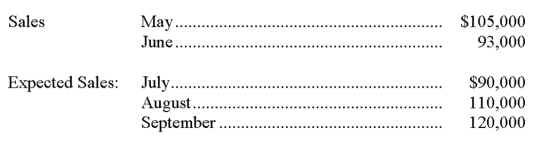 Cash sales are normally 25% of total sales and all credit sales are expected to be collected in the month following the date of sale. The total amount of cash expected to be received from customers in September is:
 (Multiple Choice)
4.8/5 (81)
(81) When preparing the cash budget, all the following should be considered except:
(Multiple Choice)
4.8/5 (84)
(84) Which of the following factors is least likely to be considered in preparing a sales budget?
(Multiple Choice)
4.8/5 (70)
(70) The sales budget for Carmel shows that 20,000 units of Product A and 22,000 units of Product B are going to be sold for prices of $10 and $12, respectively. The desired ending inventory of Product A is 20% higher than its beginning inventory of 2,000 units. The beginning inventory of Product B is 2,500 units. The desired ending inventory of B is 3,000 units. Budgeted purchases of Product A for the year would be:
(Multiple Choice)
4.8/5 (76)
(76) A quantity of merchandise or materials over the minimum needed that reduces the risk of running short is called:
(Multiple Choice)
4.7/5 (86)
(86) 
Filters
- Essay(0)
- Multiple Choice(0)
- Short Answer(0)
- True False(0)
- Matching(0)