



 Chat with AI
Exam 24: Flexible Budgets and Standard Costs

Exam 1: Accounting in Business240 Questions
Exam 2: Analyzing and Recording Transactions197 Questions
Exam 3: Adjusting Accounts and Preparing Financial Statements224 Questions
Exam 4: Completing the Accounting Cycle176 Questions
Exam 5: Accounting for Merchandising Operations198 Questions
Exam 6: Inventories and Cost of Sales198 Questions
Exam 7: Accounting Information Systems176 Questions
Exam 8: Cash and Internal Controls196 Questions
Exam 9: Accounting for Receivables191 Questions
Exam 10: Plant Assets, Natural Resources, and Intangibles223 Questions
Exam 11: Current Liabilities and Payroll Accounting193 Questions
Exam 12: Accounting for Partnerships139 Questions
Exam 13: Accounting for Corporations246 Questions
Exam 14: Long-Term Liabilities198 Questions
Exam 15: Investments and International Operations192 Questions
Exam 16: Reporting the Statement of Cash Flows187 Questions
Exam 17: Analysis of Financial Statements187 Questions
Exam 18: Managerial Accounting Concepts and Principles197 Questions
Exam 19: Job Order Cost Accounting164 Questions
Exam 20: Process Cost Accounting174 Questions
Exam 21: Cost Allocation and Performance Measurement170 Questions
Exam 22: Cost-Volume-Profit Analysis186 Questions
Exam 23: Master Budgets and Planning162 Questions
Exam 24: Flexible Budgets and Standard Costs174 Questions
Exam 25: Capital Budgeting and Managerial Decisions150 Questions
Exam 26: Time Value of Money60 Questions
Select questions type


In preparing flexible budgets, the costs that remain constant in total are _______________ costs. Those costs that change in total are _______________ costs.
(Short Answer)
4.9/5  (76)
(76) Job #305 was budgeted to require 3.5 hours of labor at $11.00 per hour. However, it was completed in 3 hours by a person who worked for $14.00 per hour. What is the total labor cost variance for Job #305?
(Not Answered)
This question doesn't have any answer yet
Tiger, Inc. has developed the following standard cost data based on 60,000 direct labor hours, which is 75% of capacity. 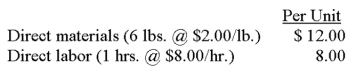 During the last period, the company operated at 80% of capacity and produced 128,000 units. Actual costs were:
 Determine the direct materials price and quantity variances and the direct labor rate and efficiency variances. Indicate whether each variance is favorable or unfavorable.
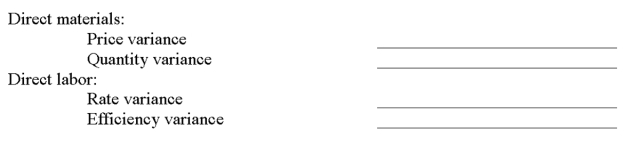
During the last period, the company operated at 80% of capacity and produced 128,000 units. Actual costs were: Determine the direct materials price and quantity variances and the direct labor rate and efficiency variances. Indicate whether each variance is favorable or unfavorable. (Not Answered)
This question doesn't have any answer yet
Kyle, Inc. has collected the following data on one of its products. The actual cost of the direct materials used is: 
(Multiple Choice)
4.9/5 (75)
(75) Standard costs can serve as a basis for evaluating actual performance.
(True/False)
4.8/5 (83)
(83) Use the following cost information to calculate the direct labor rate and efficiency variances and indicate whether they are favorable or unfavorable. 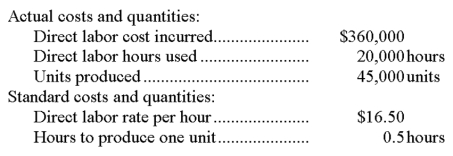
(Not Answered)
This question doesn't have any answer yet
Adams, Inc. uses the following standard to produce a single unit of its product: overhead (2 hrs. @ $3/hr.) $6. The flexible budget for overhead is $100,000 plus $1 per direct labor hour. Actual data for the month show overhead costs of $150,000, and 24,000 units produced. The overhead volume variance is:
(Multiple Choice)
4.9/5 (84)
(84) A budget performance report that includes variances can have variances caused by both price differences and quantity differences.
(True/False)
4.8/5 (90)
(90) A direct labor cost variance may be broken down into a controllable variance and a volume variance.
(True/False)
4.7/5 (77)
(77) A company's flexible budget for 36,000 units of production showed variable overhead costs of $54,000 and fixed overhead costs of $50,000. The company actually incurred total overhead costs of $95,300 while operating at a volume of 32,000 units. What is the controllable variance?
(Not Answered)
This question doesn't have any answer yet
When standard costs are used, factory overhead is assigned to products with a predetermined standard overhead rate.
(True/False)
4.9/5 (76)
(76) Montaigne Corp. has the following information about its standards and production activity for November. The volume variance is: 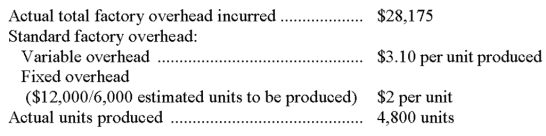
(Multiple Choice)
4.8/5 (82)
(82) A fixed budget performance report never provides useful information for evaluating variances.
(True/False)
4.9/5 (90)
(90) A company's flexible budget for 10,000 units of production reflects sales of $200,000; variable costs of $40,000; and fixed costs of $75,000. Calculate the expected level of operating income if the company produces and sells 13,000 units.
(Multiple Choice)
4.8/5 (78)
(78) Based on predicted production of 25,000 units, Best Co. anticipates $175,000 of fixed costs and $137,500 of variable costs. What are the flexible budget amounts of total costs for 20,000 and 30,000 units?
(Not Answered)
This question doesn't have any answer yet
Adams Co. uses the following standard to produce a single unit of its product: variable overhead (2 hrs. @ $3/hr.) $6. Actual data for the month show variable overhead costs of $150,000, and 24,000 units produced. The total variable overhead variance is:
(Multiple Choice)
5.0/5 (87)
(87) A company uses the following standard costs to produce a single unit of output.  During the latest month, the company purchased and used 58,000 pounds of direct materials at a price of $1.00 per pound to produce 10,000 units of output. Direct labor costs for the month totaled $56,350 based on 4,900 direct labor hours worked. Variable manufacturing overhead costs incurred totaled $15,000 and fixed manufacturing overhead incurred was $10,400. Based on this information, the direct labor rate variance for the month was:
 (Multiple Choice)
4.8/5 (84)
(84) Use the following data to find the direct labor cost variance. 
(Multiple Choice)
4.7/5 (81)
(81) Standard material, labor, and overhead costs can be obtained from standard cost tables published by the Institute of Management Accountants.
(True/False)
4.9/5 (82)
(82) 
Filters
- Essay(0)
- Multiple Choice(0)
- Short Answer(0)
- True False(0)
- Matching(0)