



 Chat with AI
Exam 14: Decision Analysis

Exam 1: Introduction to Modeling and Decision Analysis78 Questions
Exam 2: Introduction to Optimization and Linear Programming76 Questions
Exam 3: Modeling and Solving Lp Problems in a Spreadsheet93 Questions
Exam 4: Sensitivity Analysis and the Simplex Method76 Questions
Exam 5: Network Modeling92 Questions
Exam 6: Integer Linear Programming102 Questions
Exam 7: Goal Programming and Multiple Objective Optimization81 Questions
Exam 8: Nonlinear Programming Evolutionary Optimization87 Questions
Exam 9: Regression Analysis93 Questions
Exam 10: Data Mining125 Questions
Exam 11: Time Series Forecasting125 Questions
Exam 12: Introduction to Simulation Using Analytic Solver Platform85 Questions
Exam 13: Queuing Theory97 Questions
Exam 14: Decision Analysis125 Questions
Exam 15: Project Management Online82 Questions
Select questions type


Exhibit 14.8
The following questions use the information below.
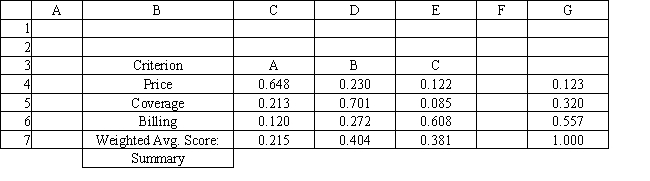
A company needs to buy a new insurance policy. They have three policies to choose from, A, B and C. The policies differ with respect to price, coverage and ease of billing. The company has developed the following AHP tables for price and summary. The other tables are not shown due to space limitations. 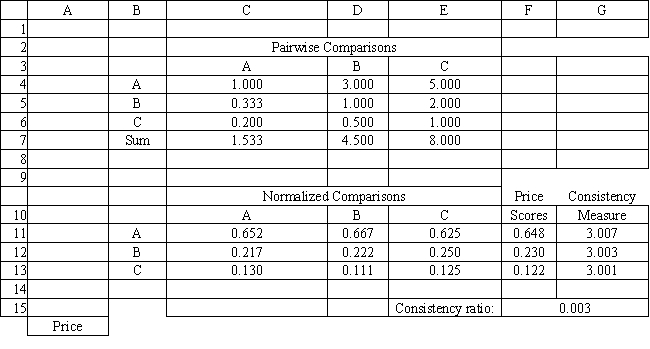
 -Expected regret is also called
 (Multiple Choice)
4.8/5  (75)
(75) Exhibit 14.5
The following questions are based on the information below.
An investor is considering 4 investments, A, B, C, D. The payoff from each investment is a function of the economic climate over the next 2 years. The economy can expand or decline. The following decision tree has been developed for the problem. The investor has estimated the probability of a declining economy at 40% and an expanding economy at 60%. 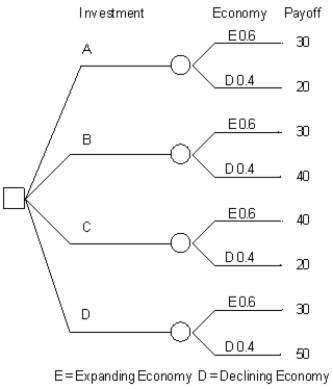 -In decision analysis, good decisions
 (Multiple Choice)
5.0/5 (83)
(83) Exhibit 14.7
The following questions use the information below.
A decision maker is faced with two alternatives. The decision maker has determined that she is indifferent between the two alternatives when p = 0.45.  -What is the formula for the exponential utility function U(x)?
 (Multiple Choice)
4.8/5 (78)
(78) Exhibit 14.8
The following questions use the information below.
A company needs to buy a new insurance policy. They have three policies to choose from, A, B and C. The policies differ with respect to price, coverage and ease of billing. The company has developed the following AHP tables for price and summary. The other tables are not shown due to space limitations. 
 -The expected monetary value criterion (EMV) is the decision-making approach used
 (Multiple Choice)
4.8/5 (73)
(73) Exhibit 14.8
The following questions use the information below.
A company needs to buy a new insurance policy. They have three policies to choose from, A, B and C. The policies differ with respect to price, coverage and ease of billing. The company has developed the following AHP tables for price and summary. The other tables are not shown due to space limitations. 
 -The decision rule which determines the maximum payoff for each alternative and then selects the alternative associated with the largest payoff is the
 (Multiple Choice)
5.0/5 (77)
(77) Exhibit 14.5
The following questions are based on the information below.
An investor is considering 4 investments, A, B, C, D. The payoff from each investment is a function of the economic climate over the next 2 years. The economy can expand or decline. The following decision tree has been developed for the problem. The investor has estimated the probability of a declining economy at 40% and an expanding economy at 60%. 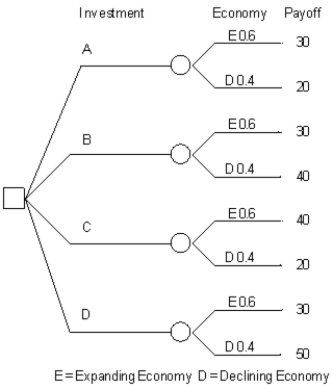 -Business decision models can be categorized as
 (Multiple Choice)
4.7/5 (91)
(91) Exhibit 14.9
The following questions are based on the information below.
An investor is considering 4 investments, W, X, Y, and Z. The payoff from each investment is a function of the economic climate over the next 2 years. The economy can expand or decline. The following payoff matrix has been developed for the investment decision problem. 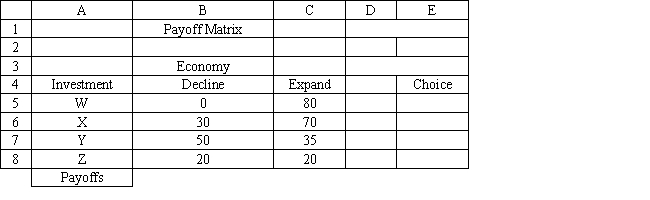 -Refer to Exhibit 14.9. What decision should be made according to the minimax regret decision rule?
 (Short Answer)
4.8/5 (79)
(79) The expected value of perfect information (EVPI) is equivalent to the minimum expected opportunity loss (EOL).
(True/False)
4.8/5 (74)
(74) Exhibit 14.13
The following questions use the information below.
A student wants to buy a new car. She has three cars to choose from, A, B and C. The cars differ with respect to price, performance and looks. The student has developed the following AHP tables for price and summary. The other tables are not shown due to space limitations. 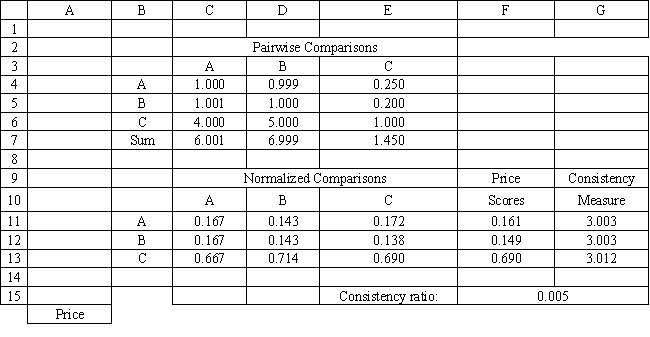
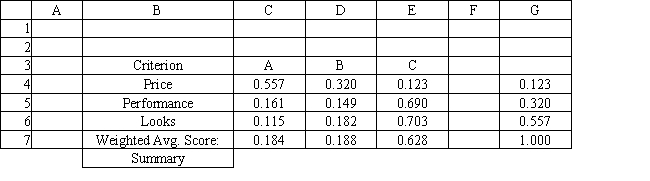 -Refer to Exhibit 14.13. What formula should go in cell G15 of the Price worksheet to compute the Consistency Ratio?
 (Short Answer)
4.8/5 (76)
(76) Exhibit 14.8
The following questions use the information below.
A company needs to buy a new insurance policy. They have three policies to choose from, A, B and C. The policies differ with respect to price, coverage and ease of billing. The company has developed the following AHP tables for price and summary. The other tables are not shown due to space limitations.
-A "risk averse" decision maker assigns the ____ relative utility to any payoff but has a(n) ____ marginal utility for increased payoffs.
-A "risk averse" decision maker assigns the ____ relative utility to any payoff but has a(n) ____ marginal utility for increased payoffs. (Multiple Choice)
5.0/5 (79)
(79) The criteria in a decision problem represent various factors that are important to the decision maker.
(True/False)
4.8/5 (80)
(80) A payoff matrix depicts ____ versus ____ with payoffs for each intersection cell.
(Multiple Choice)
4.8/5 (80)
(80) Exhibit 14.7
The following questions use the information below.
A decision maker is faced with two alternatives. The decision maker has determined that she is indifferent between the two alternatives when p = 0.45.
-Which are characteristics of decision-making under uncertainty?
-Which are characteristics of decision-making under uncertainty? (Multiple Choice)
4.9/5 (79)
(79) Exhibit 14.8
The following questions use the information below.
A company needs to buy a new insurance policy. They have three policies to choose from, A, B and C. The policies differ with respect to price, coverage and ease of billing. The company has developed the following AHP tables for price and summary. The other tables are not shown due to space limitations. 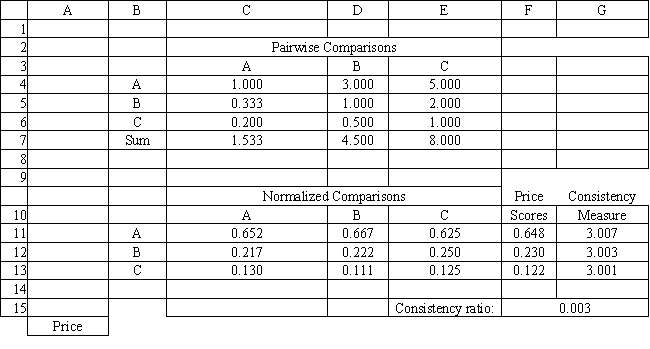
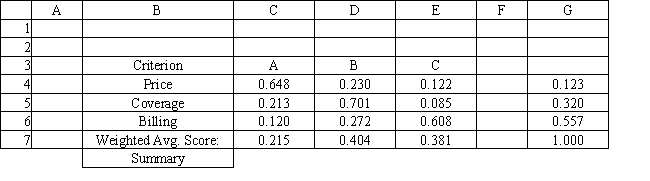 -A circular node in a decision tree is called a(n) ____ node.
 (Multiple Choice)
4.8/5 (79)
(79) Exhibit 14.14
The following questions use the Decision Tree model and strategy table information below. 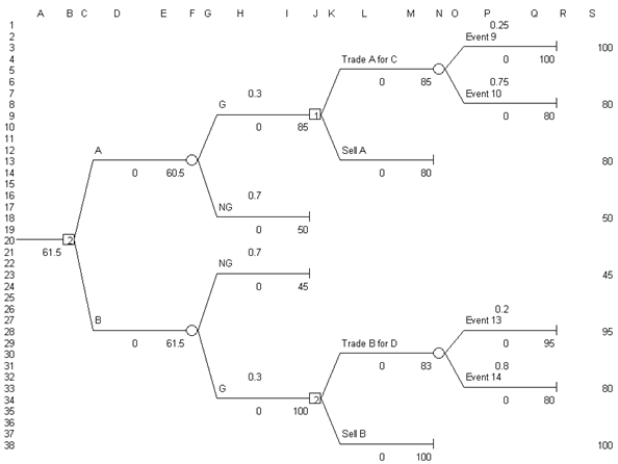
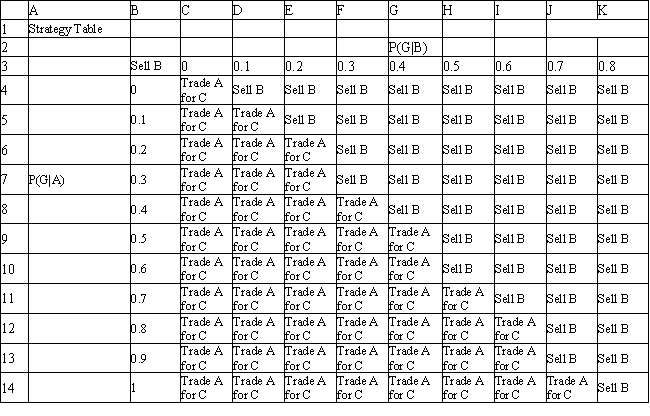 -Refer to Exhibit 14.14. You want to conduct a risk analysis on P(G|A) and P(G|B). What Decision Tree model changes must you make to be able to use a strategy table?
 (Essay)
4.8/5 (66)
(66) Exhibit 14.9
The following questions are based on the information below.
An investor is considering 4 investments, W, X, Y, and Z. The payoff from each investment is a function of the economic climate over the next 2 years. The economy can expand or decline. The following payoff matrix has been developed for the investment decision problem.  -An investor is considering 4 investments, A, B, C, D. The payoff from each investment is a function of the economic climate over the next 2 years. The economy can expand or decline. The following decision tree has been developed for the problem. The investor has estimated the probability of a declining economy at 25% and an expanding economy at 75%. What is the correct decision for this investor based on an expected monetary value criteria? Draw the decision tree for this problem.
 (Essay)
4.9/5 (87)
(87) Exhibit 14.5
The following questions are based on the information below.
An investor is considering 4 investments, A, B, C, D. The payoff from each investment is a function of the economic climate over the next 2 years. The economy can expand or decline. The following decision tree has been developed for the problem. The investor has estimated the probability of a declining economy at 40% and an expanding economy at 60%.
-The decision with the smallest expected opportunity loss (EOL) will also have the
-The decision with the smallest expected opportunity loss (EOL) will also have the (Multiple Choice)
4.8/5 (72)
(72) The expected monetary value decision rule selects the decision alternative with the largest expected regret.
(True/False)
4.8/5 (80)
(80) Exhibit 14.5
The following questions are based on the information below.
An investor is considering 4 investments, A, B, C, D. The payoff from each investment is a function of the economic climate over the next 2 years. The economy can expand or decline. The following decision tree has been developed for the problem. The investor has estimated the probability of a declining economy at 40% and an expanding economy at 60%.
-The decision rule which selects the alternative associated with the smallest maximum opportunity loss is the
-The decision rule which selects the alternative associated with the smallest maximum opportunity loss is the (Multiple Choice)
4.9/5 (78)
(78) 
Filters
- Essay(0)
- Multiple Choice(0)
- Short Answer(0)
- True False(0)
- Matching(0)