



 Chat with AI
Exam 5: Running Water and Groundwater

Exam 1: Introduction to Earth Science106 Questions
Exam 2: Matter and Minerals114 Questions
Exam 3: Rocks: Materials of the Solid Earth120 Questions
Exam 4: Weathering, soil, and Mass Wasting125 Questions
Exam 5: Running Water and Groundwater133 Questions
Exam 6: Glaciers, deserts, and Wind90 Questions
Exam 7: Plate Tectonics: a Scientific Revolution Unfolds88 Questions
Exam 8: Earthquakes and Earths Interior85 Questions
Exam 9: Volcanoes and Other Igneous Activity100 Questions
Exam 10: Crustal Deformation and Mountain Building97 Questions
Exam 11: Geologic Time105 Questions
Exam 12: Earths Evolution Through Geologic Time134 Questions
Exam 13: The Ocean Floor92 Questions
Exam 14: Ocean Water and Ocean Life75 Questions
Exam 15: The Dynamic Ocean119 Questions
Exam 16: The Atmosphere: Composition,structure,and Temperature82 Questions
Exam 17: Moisture, clouds, and Precipitation113 Questions
Exam 18: Air Pressure and Wind98 Questions
Exam 19: Weather Patterns and Severe Weather95 Questions
Exam 20: World Climates and Global Climate Change107 Questions
Exam 21: Origin of Modern Astronomy111 Questions
Exam 22: Touring Our Solar System93 Questions
Exam 23: Light,astronomical Observations,and the Sun96 Questions
Exam 24: Beyond Our Solar System85 Questions
Select questions type


The unsaturated zone above the water table is also known as the ________.
(Short Answer)
4.8/5  (82)
(82) Sinkholes are actively forming in portions of the southeastern United States.
(True/False)
4.8/5 (87)
(87) Most of the water that evaporates from the oceans falls on land where it runs off to the oceans again.
(True/False)
4.9/5 (97)
(97) A river is flowing in a broad,alluvial valley and the river is silt-laden but also moves sand and a small amount of gravel.The government decides to build a dam across the valley for power and flood control.What will happen to the river,upstream of the dam?
(Multiple Choice)
4.8/5 (81)
(81) The formation of stalactites and stalagmites occurs in the zone of saturation.
(True/False)
4.8/5 (83)
(83) The Mississippi River today is a classic meandering river.20,000 years ago the Mississippi River was a major outwash channel for the Laurentide ice sheet,and was characterized by dramatic variations in flow with huge discharge during summer ice melt and a dramatic falloff in discharge during the winter.The river also carried coarser sediment than today,with abundant sand and even gravel in its upper reaches.What does this suggest about the ancient Mississippi?
(Multiple Choice)
4.9/5 (67)
(67) Assuming rivers of comparable discharge,which type of stream would most likely be crossable by wading rather than having to swim?
(Multiple Choice)
4.9/5 (76)
(76) The type and amount of material carried in the suspended load of a stream depends on ________.
(Multiple Choice)
4.7/5 (74)
(74) The Mississippi River is North America's largest river in terms of discharge.
(True/False)
4.8/5 (68)
(68) The Trellis drainage pattern shown below develops ________. 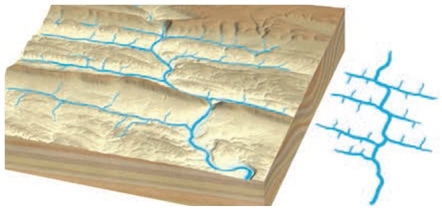
(Multiple Choice)
4.9/5 (88)
(88) Sinkholes and karst topography are a clear indication that ________.
(Multiple Choice)
4.9/5 (80)
(80) ________ is the boundary line separating adjacent stream drainage basins.
(Short Answer)
4.9/5 (69)
(69) The textbook makes the point that stream transport is a mechanism for sorting material.Explain how a stream sorts rocks.
(Essay)
4.9/5 (81)
(81) When a stream is in a v-shaped valley running on bedrock,the stream is ________.
(Multiple Choice)
4.8/5 (78)
(78) 
Filters
- Essay(0)
- Multiple Choice(0)
- Short Answer(0)
- True False(0)
- Matching(0)