



 Chat with AI
Exam 6: Glaciers, deserts, and Wind

Exam 1: Introduction to Earth Science106 Questions
Exam 2: Matter and Minerals114 Questions
Exam 3: Rocks: Materials of the Solid Earth120 Questions
Exam 4: Weathering, soil, and Mass Wasting125 Questions
Exam 5: Running Water and Groundwater133 Questions
Exam 6: Glaciers, deserts, and Wind90 Questions
Exam 7: Plate Tectonics: a Scientific Revolution Unfolds88 Questions
Exam 8: Earthquakes and Earths Interior85 Questions
Exam 9: Volcanoes and Other Igneous Activity100 Questions
Exam 10: Crustal Deformation and Mountain Building97 Questions
Exam 11: Geologic Time105 Questions
Exam 12: Earths Evolution Through Geologic Time134 Questions
Exam 13: The Ocean Floor92 Questions
Exam 14: Ocean Water and Ocean Life75 Questions
Exam 15: The Dynamic Ocean119 Questions
Exam 16: The Atmosphere: Composition,structure,and Temperature82 Questions
Exam 17: Moisture, clouds, and Precipitation113 Questions
Exam 18: Air Pressure and Wind98 Questions
Exam 19: Weather Patterns and Severe Weather95 Questions
Exam 20: World Climates and Global Climate Change107 Questions
Exam 21: Origin of Modern Astronomy111 Questions
Exam 22: Touring Our Solar System93 Questions
Exam 23: Light,astronomical Observations,and the Sun96 Questions
Exam 24: Beyond Our Solar System85 Questions
Select questions type


The Basin and Range region of the western United States is an excellent example of a mountainous desert landscape.
(True/False)
4.9/5  (82)
(82) During the Ice Age,the climate was occasionally warmer than it is today.
(True/False)
4.8/5 (63)
(63) Ice Age glaciers had many indirect effects.Which one of the following was not such an effect?
(Multiple Choice)
4.9/5 (76)
(76) The major difference between floods in humid regions and in dry regions is ________.
(Multiple Choice)
4.8/5 (79)
(79) Antarctica's ice represents approximately 65% of the earth's fresh water supply and many populated regions need that water.Should we develop a program to mine Antarctica's ice and redistribute it to areas where it is needed? Explain your answer.
(Essay)
4.9/5 (87)
(87) A cirque represents an erosional feature formed in what was an important accumulation zone for snow and ice at the upstream head of a glacier.
(True/False)
4.8/5 (78)
(78) Climatologist define a "dry climate" as a climate in which ________.
(Multiple Choice)
4.8/5 (79)
(79) Abrasion and plucking generally involve what part of a glacier?
(Multiple Choice)
4.7/5 (79)
(79) What distinguishes Valley or Alpine Glaciers,Ice Sheets,Ice Shelves,and Sea Ice from each other?
(Essay)
4.8/5 (83)
(83) Examine the words and/or phrases for each question below and determine the relationship among the majority of words/phrases. Choose the option which does not fit the pattern.
-arroyo wadi inselberg nullah
(Short Answer)
4.8/5 (82)
(82) Which letter,S thru Z,corresponds to the object in the photo labeled "C"?
(Short Answer)
4.8/5 (83)
(83) Today,glaciers cover approximately ________ percent of the earth's surface.
(Multiple Choice)
4.8/5 (80)
(80) On the blanks provided,fill in the name of the labeled features that formed as a product of alpine glaciation. 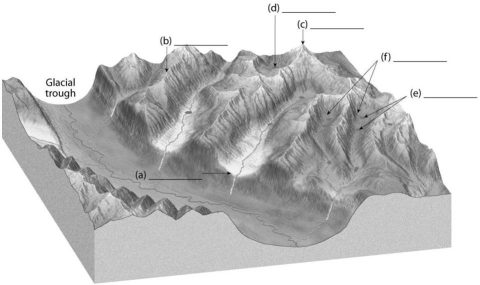
(Essay)
4.8/5 (85)
(85) What term denotes a glacial valley that was partly flooded as sea level rose?
(Short Answer)
4.8/5 (90)
(90) 
Filters
- Essay(0)
- Multiple Choice(0)
- Short Answer(0)
- True False(0)
- Matching(0)