



 Chat with AI
Exam 9: Volcanoes and Other Igneous Activity

Exam 1: Introduction to Earth Science106 Questions
Exam 2: Matter and Minerals114 Questions
Exam 3: Rocks: Materials of the Solid Earth120 Questions
Exam 4: Weathering, soil, and Mass Wasting125 Questions
Exam 5: Running Water and Groundwater133 Questions
Exam 6: Glaciers, deserts, and Wind90 Questions
Exam 7: Plate Tectonics: a Scientific Revolution Unfolds88 Questions
Exam 8: Earthquakes and Earths Interior85 Questions
Exam 9: Volcanoes and Other Igneous Activity100 Questions
Exam 10: Crustal Deformation and Mountain Building97 Questions
Exam 11: Geologic Time105 Questions
Exam 12: Earths Evolution Through Geologic Time134 Questions
Exam 13: The Ocean Floor92 Questions
Exam 14: Ocean Water and Ocean Life75 Questions
Exam 15: The Dynamic Ocean119 Questions
Exam 16: The Atmosphere: Composition,structure,and Temperature82 Questions
Exam 17: Moisture, clouds, and Precipitation113 Questions
Exam 18: Air Pressure and Wind98 Questions
Exam 19: Weather Patterns and Severe Weather95 Questions
Exam 20: World Climates and Global Climate Change107 Questions
Exam 21: Origin of Modern Astronomy111 Questions
Exam 22: Touring Our Solar System93 Questions
Exam 23: Light,astronomical Observations,and the Sun96 Questions
Exam 24: Beyond Our Solar System85 Questions
Select questions type


Which of the following best describes Shiprock,a famous volcanic feature in New Mexico?
(Multiple Choice)
4.9/5  (72)
(72) ________ magma is the most abundant type of magma erupted on Earth.
(Multiple Choice)
4.9/5 (65)
(65) What type of volcano would be most likely to generate large landslides?
(Multiple Choice)
4.9/5 (78)
(78) In the movie "Volcano" basaltic lava flows are shown running down flat streets at speeds faster than humans could run.From your knowledge of magma viscosity,is this realistic?
(Multiple Choice)
4.8/5 (79)
(79) Many magmas are generated when solid rocks are carried to higher levels in the earth by flow and partially melted by decompression melting.
(True/False)
4.8/5 (76)
(76) Briefly summarize at least 4 major volcanic hazards.Describe the level of risk from most dangerous to least dangerous to human life.For each hazard indicate where the hazard is located relative to the volcano (on the volcano slopes,anywhere within several km of the volcano,anywhere within thousands of km of the volcano,in river valleys near the volcano,near bodies of water near the volcano,etc.)and consider if the probability of the hazard is very low,low,medium,high,or high,within the danger zone of the hazard.
(Essay)
4.9/5 (74)
(74) Mt.Rainier in Washington State is often thought to be the most hazardous volcano in the lower 48 states of the United States because ________.
(Multiple Choice)
4.9/5 (81)
(81) A ________ is a near surface,intrusive igneous rock body that results from local inflation of a horizontal sill.
(Multiple Choice)
4.7/5 (85)
(85) Match the name of the tectonic feature with the Figure. 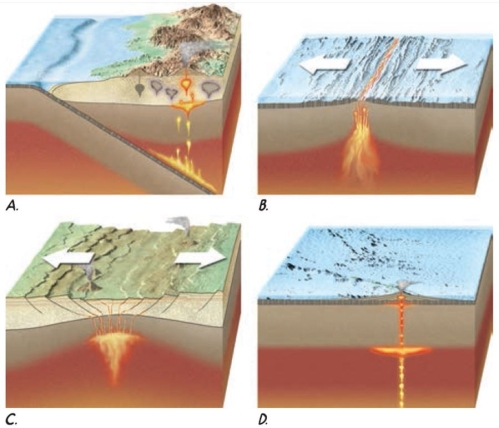 -oceanic spreading center
 (Short Answer)
4.8/5 (89)
(89) Pillow lavas are basaltic magmas extruded as piles of bombs that accumulate in piles of rocks that look like a pile of pillows.
(True/False)
4.8/5 (75)
(75) What volcanic events formed Crater Lake,Oregon? When did they take place?
(Multiple Choice)
4.8/5 (78)
(78) Which of the following is not a significant volcanic hazard?
(Multiple Choice)
4.9/5 (80)
(80) Which one of the following statements concerning volcanic blocks and bombs is true?
(Multiple Choice)
4.9/5 (89)
(89) When magma rises toward the surface,pressure decreases can lead to release of dissolved gases in a magma with a volume increase that can produce an explosion.
(True/False)
4.8/5 (85)
(85) 
Filters
- Essay(0)
- Multiple Choice(0)
- Short Answer(0)
- True False(0)
- Matching(0)