



 Chat with AI
Exam 12: Earths Evolution Through Geologic Time

Exam 1: Introduction to Earth Science106 Questions
Exam 2: Matter and Minerals114 Questions
Exam 3: Rocks: Materials of the Solid Earth120 Questions
Exam 4: Weathering, soil, and Mass Wasting125 Questions
Exam 5: Running Water and Groundwater133 Questions
Exam 6: Glaciers, deserts, and Wind90 Questions
Exam 7: Plate Tectonics: a Scientific Revolution Unfolds88 Questions
Exam 8: Earthquakes and Earths Interior85 Questions
Exam 9: Volcanoes and Other Igneous Activity100 Questions
Exam 10: Crustal Deformation and Mountain Building97 Questions
Exam 11: Geologic Time105 Questions
Exam 12: Earths Evolution Through Geologic Time134 Questions
Exam 13: The Ocean Floor92 Questions
Exam 14: Ocean Water and Ocean Life75 Questions
Exam 15: The Dynamic Ocean119 Questions
Exam 16: The Atmosphere: Composition,structure,and Temperature82 Questions
Exam 17: Moisture, clouds, and Precipitation113 Questions
Exam 18: Air Pressure and Wind98 Questions
Exam 19: Weather Patterns and Severe Weather95 Questions
Exam 20: World Climates and Global Climate Change107 Questions
Exam 21: Origin of Modern Astronomy111 Questions
Exam 22: Touring Our Solar System93 Questions
Exam 23: Light,astronomical Observations,and the Sun96 Questions
Exam 24: Beyond Our Solar System85 Questions
Select questions type


In Rodinia,a well-documented Precambrian supercontinent,________.
(Multiple Choice)
4.9/5  (81)
(81) Scientists have found evidence that life existed at least 3.5 billion years ago ________.
(Multiple Choice)
4.8/5 (93)
(93) On each continent,large "core areas" of Precambrian rocks,called ________,dominate the surface.
(Short Answer)
4.8/5 (79)
(79) The rock formations of the ________ era are more widespread and less disturbed than those of any other time.
(Short Answer)
4.9/5 (78)
(78) Examine Figure 12.12 below which illustrates the distribution of cratons and orogens (mountain belts)on Earth today.Briefly discuss how have these regions have developed over time using the concept of plate tectonics.Include the relationship between specific types of plate boundaries to the various regions if possible. 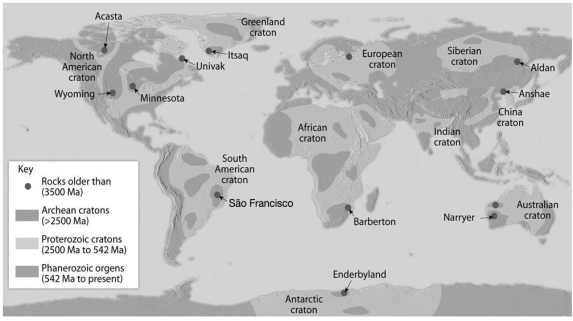
(Essay)
4.9/5 (77)
(77) Evidence that Gondwana formed near the South Pole include ________.
(Multiple Choice)
4.9/5 (72)
(72) Western North America is the leading edge of the ________ plate.
(Short Answer)
4.9/5 (92)
(92) Compare and contrast the patterns of life in the Paleozoic Era to the Mesozoic Era.What are the major differences between these two eras? Are there similarities or similar trends?
(Essay)
4.9/5 (81)
(81) Some elements are released from the earth's interior to the surface through a process called ________.
(Short Answer)
4.8/5 (85)
(85) Banded Iron Formations are interbedded iron oxides and chert that formed on the sea floor between 3.5 and 2 billion years ago because ________.
(Multiple Choice)
4.8/5 (74)
(74) Toward the end of the Mesozoic era,the ________ orogeny formed the southern ranges of the Rocky Mountains.
(Short Answer)
5.0/5 (89)
(89) During the early Paleozoic era,South America,Africa,Australia,Antarctica,India,and perhaps China comprised the vast southern continent of ________.
(Multiple Choice)
4.9/5 (69)
(69) The slight eastward slope of the Great Plains was created during the Cenozoic by ________.
(Multiple Choice)
4.8/5 (77)
(77) Bacteria that thrive in oxygen free environments are called ________ bacteria.
(Short Answer)
4.9/5 (83)
(83) 
Filters
- Essay(0)
- Multiple Choice(0)
- Short Answer(0)
- True False(0)
- Matching(0)