



 Chat with AI
Exam 13: The Ocean Floor

Exam 1: Introduction to Earth Science106 Questions
Exam 2: Matter and Minerals114 Questions
Exam 3: Rocks: Materials of the Solid Earth120 Questions
Exam 4: Weathering, soil, and Mass Wasting125 Questions
Exam 5: Running Water and Groundwater133 Questions
Exam 6: Glaciers, deserts, and Wind90 Questions
Exam 7: Plate Tectonics: a Scientific Revolution Unfolds88 Questions
Exam 8: Earthquakes and Earths Interior85 Questions
Exam 9: Volcanoes and Other Igneous Activity100 Questions
Exam 10: Crustal Deformation and Mountain Building97 Questions
Exam 11: Geologic Time105 Questions
Exam 12: Earths Evolution Through Geologic Time134 Questions
Exam 13: The Ocean Floor92 Questions
Exam 14: Ocean Water and Ocean Life75 Questions
Exam 15: The Dynamic Ocean119 Questions
Exam 16: The Atmosphere: Composition,structure,and Temperature82 Questions
Exam 17: Moisture, clouds, and Precipitation113 Questions
Exam 18: Air Pressure and Wind98 Questions
Exam 19: Weather Patterns and Severe Weather95 Questions
Exam 20: World Climates and Global Climate Change107 Questions
Exam 21: Origin of Modern Astronomy111 Questions
Exam 22: Touring Our Solar System93 Questions
Exam 23: Light,astronomical Observations,and the Sun96 Questions
Exam 24: Beyond Our Solar System85 Questions
Select questions type


Earlier we discussed the concept of isostasy,where lower density rocks rise higher than higher density rocks.How is the variation of water depth at spreading centers (ridges)controlled by isostasy?
(Multiple Choice)
4.8/5  (83)
(83) What is the difference between an active continental margin and a passive continental margin?
(Multiple Choice)
4.9/5 (81)
(81) African dust from the Sahara desert is observed across the Atlantic as far west as the Caribbean region where it produces a hazy sky condition during the annual dry season.You are a climate scientist and make a prediction that the Sahara was not a desert during glacial periods in the northern hemisphere.How could you test this hypothesis by looking at deep sea sediments from the Atlantic off west Africa?
(Multiple Choice)
4.8/5 (75)
(75) The gently sloping submerged surface extending from the shoreline toward the deep ocean is termed the ________.
(Short Answer)
4.8/5 (77)
(77) Micro-organisms called foraminifera have tiny coiled shells with chambers,not unlike the chambering nautilus but much smaller.In modern oceans the coiling direction of foraminifera shells is correlated to temperature.Using coiling direction from foraminifera fossils is an example of ________.
(Multiple Choice)
4.8/5 (60)
(60) Minerals that crystallize directly from seawater are examples of ________.
(Multiple Choice)
5.0/5 (85)
(85) What type of continental margin is illustrated in the diagram below? 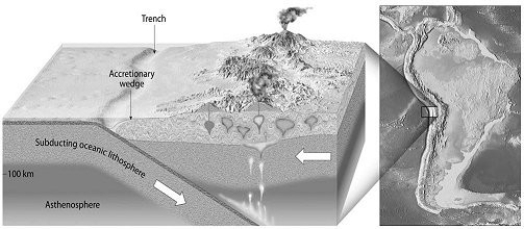
(Short Answer)
4.8/5 (77)
(77) Examine Figure 13.B from Earth Science,14e below.Briefly explain the main points of Charles Darwin's hypothesis on coral atoll formation.Have we tested his hypothesis and is it still thought to be correct today? Can you think of another possible explanation that would explain the origin of such coral atolls? 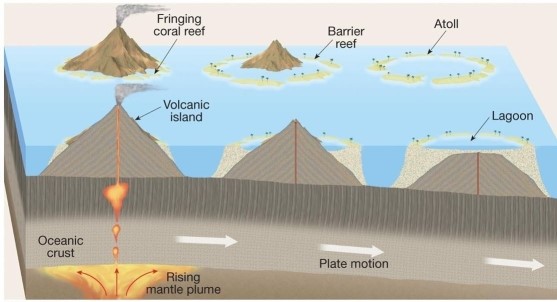
(Essay)
4.8/5 (65)
(65) ________ continental margins typically exhibit wide,extensive,continental shelves.
(Short Answer)
4.7/5 (78)
(78)  -calcareous ooze
Sand,silt,and clays deposited on the ocean floor are described as terrigenous sediments.
(True/False)
4.9/5 (73)
(73) Which one of the following concerning mid-ocean ridges is false?
(Multiple Choice)
4.8/5 (73)
(73) The oceans cover approximately ________ percent of Earth's surface.
(Multiple Choice)
4.9/5 (94)
(94) A prominent feature of the Mid-Atlantic Ridge is a very deep linear valley known as a(n)________ valley.
(Short Answer)
4.7/5 (88)
(88) 
Filters
- Essay(0)
- Multiple Choice(0)
- Short Answer(0)
- True False(0)
- Matching(0)