



 Chat with AI
Exam 22: Touring Our Solar System

Exam 1: Introduction to Earth Science106 Questions
Exam 2: Matter and Minerals114 Questions
Exam 3: Rocks: Materials of the Solid Earth120 Questions
Exam 4: Weathering, soil, and Mass Wasting125 Questions
Exam 5: Running Water and Groundwater133 Questions
Exam 6: Glaciers, deserts, and Wind90 Questions
Exam 7: Plate Tectonics: a Scientific Revolution Unfolds88 Questions
Exam 8: Earthquakes and Earths Interior85 Questions
Exam 9: Volcanoes and Other Igneous Activity100 Questions
Exam 10: Crustal Deformation and Mountain Building97 Questions
Exam 11: Geologic Time105 Questions
Exam 12: Earths Evolution Through Geologic Time134 Questions
Exam 13: The Ocean Floor92 Questions
Exam 14: Ocean Water and Ocean Life75 Questions
Exam 15: The Dynamic Ocean119 Questions
Exam 16: The Atmosphere: Composition,structure,and Temperature82 Questions
Exam 17: Moisture, clouds, and Precipitation113 Questions
Exam 18: Air Pressure and Wind98 Questions
Exam 19: Weather Patterns and Severe Weather95 Questions
Exam 20: World Climates and Global Climate Change107 Questions
Exam 21: Origin of Modern Astronomy111 Questions
Exam 22: Touring Our Solar System93 Questions
Exam 23: Light,astronomical Observations,and the Sun96 Questions
Exam 24: Beyond Our Solar System85 Questions
Select questions type


Saturn's moon Titan has rain like earth,but the rain is ________,not water.
(Short Answer)
4.9/5  (80)
(80) Which planet,in addition to Earth,shows clear evidence of water erosion?
(Short Answer)
4.8/5 (83)
(83) Carefully examine the telescopic view of the lunar surface (near side)below and the features labeled A,B,and C. 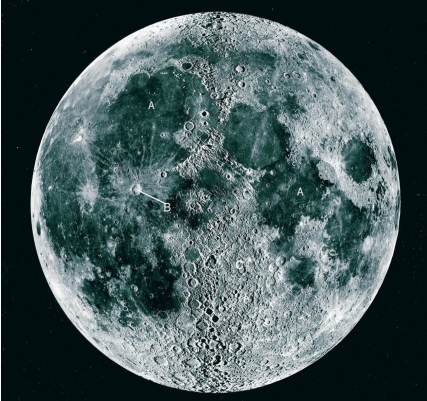 (a)Give a brief description that characterizes the bright area around C.
(b)Notice the features like those labeled A.What are such features called?
(c)How are craters like the one labeled B different from the craters of the area labeled C?
(d)In what order (from first to latest)did the features form that are labeled A,B,and C?
(a)Give a brief description that characterizes the bright area around C.
(b)Notice the features like those labeled A.What are such features called?
(c)How are craters like the one labeled B different from the craters of the area labeled C?
(d)In what order (from first to latest)did the features form that are labeled A,B,and C? (Essay)
4.8/5 (80)
(80) Which planet rotates the opposite direction it revolves around the sun?
(Multiple Choice)
4.9/5 (93)
(93) We know from the Apollo missions and unmanned probes that the moon's surface is covered with loose,unconsolidated material with a texture similar to soil on earth.How did this material form on the moon?
(Multiple Choice)
4.8/5 (85)
(85) The four largest moons of Jupiter are comets and asteroids captured by the intense gravity of Jupiter.
(True/False)
4.9/5 (86)
(86) A popular modern theory for the origin of the Earth-Moon system is that the early Earth collided with another planet the size of ________.
(Short Answer)
4.9/5 (88)
(88) Of the terrestrial planets,Mercury exhibits the greatest lateral variations in surface temperatures.
(True/False)
4.9/5 (70)
(70) An extreme example of the greenhouse effect is thought to be associated with an abundance of carbon dioxide in the Martian atmosphere.
(True/False)
4.8/5 (105)
(105) Rays in the rings of Saturn are bright,radial streaks that converge inward toward the planet's surface.
(True/False)
4.7/5 (88)
(88) The lunar maria are large impact craters filled with ________.
(Short Answer)
4.8/5 (72)
(72) The Moon has highland areas which approach the height of mountains on Earth.
(True/False)
4.8/5 (69)
(69) Examine the words and/or phrases for each question below and determine the relationship among the majority of words/phrases. Choose the option which does not fit the pattern.
-Mercury Saturn Uranus Jupiter
(Short Answer)
5.0/5 (86)
(86) Which observation supports the theory that the planets formed from a disk shaped nebula?
(Multiple Choice)
4.8/5 (82)
(82) 
Filters
- Essay(0)
- Multiple Choice(0)
- Short Answer(0)
- True False(0)
- Matching(0)