



 Chat with AI
Exam 11: Soil Organic Matter Overview

Exam 1: The Soils Around Us 42 Questions
Exam 2: Formation of Soils From Parent Materials52 Questions
Exam 3: Soil Classification47 Questions
Exam 4: Soil Architecture and Physical Properties44 Questions
Exam 5: Soil Water: Characteristics and Behavior40 Questions
Exam 6: Soil and the Hydrologic Cycle44 Questions
Exam 7: Soil Aeration and Temperature42 Questions
Exam 8: The Colloidal Fraction: Seat of Soil Chemical and Physical Activity40 Questions
Exam 9: Soil Acidity, Alkalinity, Aridity and Salinity83 Questions
Exam 10: Organisms and Ecology of the Soil41 Questions
Exam 11: Soil Organic Matter Overview41 Questions
Exam 12: Nutrient Cycles and Soil Fertility81 Questions
Exam 13: Practical Nutrient Management40 Questions
Exam 14: Soil Erosion and Its Control41 Questions
Exam 15: Soils and Chemical Pollution41 Questions
Select questions type


Practices that increase the soil organic matter level generally have favorable effects on the chemical and biological properties of soils, but have little or no effect on soil physical properties.
(True/False)
4.7/5  (71)
(71) Microbial metabolism in the guts of termites and in waterlogged soils are two major sources of excess methane that is contributing to the global greenhouse effect.
(True/False)
4.8/5 (75)
(75) Green plant residues such as grass clippings or a green manure crop generally have a water content of about ____% by weight.
(Multiple Choice)
4.7/5 (73)
(73) Which of the following added to a soil would be likely to result in the greatest level of soil organic matter after several years of decomposition?
(Multiple Choice)
4.8/5 (91)
(91) The species of microorganisms that are able to sustain themselves by slowly attacking stable soil organic matter are the most active decomposers of freshly added organic materials because of the head start they enjoy over other organisms which were present only in inactive forms prior to the addition.
(True/False)
4.9/5 (97)
(97) The active fraction of soil organic matter largely accounts for which of the benefits of adding organic matter to soils?
(Multiple Choice)
4.8/5 (93)
(93) Mineralization of soil organic matter results in the addition of inorganic nutrient ions to the soil solution.
(True/False)
4.9/5 (76)
(76) 40 In the United States, a national goal of maintaining 5% organic matter in all agricultural soils would be a practical and beneficial policy in the long term.
(True/False)
4.8/5 (77)
(77) Well aerated soils enriched with organic amendments can help reduce the methane load in the atmosphere.
(True/False)
4.9/5 (83)
(83) Poorly drained soils generally contain more organic matter than well drained soils.
(True/False)
4.8/5 (89)
(89) After drying to eliminate the water in plant litter, which two elements account for about 80% of the dry weight?
(Multiple Choice)
4.9/5 (92)
(92) The soils of the world contain more carbon than all the world's vegetation and the entire atmosphere, combined.
(True/False)
4.7/5 (86)
(86) Suppose leaves containing 1000 kg of carbon fell to the forest floor in a humid temperate environment. After a year or so, how many kg of that carbon would you expect to remain in the soil as microbial biomass and humus?
(Multiple Choice)
4.8/5 (74)
(74) The main contributions of the active fraction of soil organic matter are increased CEC and water holding capacity of the soil.
(True/False)
4.8/5 (62)
(62) Which of the following is a greenhouse gas contributed to the atmosphere by soils?
(Multiple Choice)
4.8/5 (70)
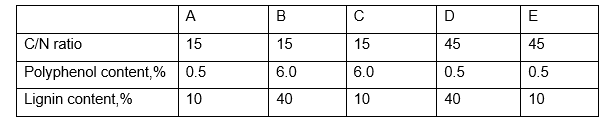
(70) Given this Table of plant residue analyses, choose the "highest quality" residue in terms of suitability to support an active community of soil organisms and rapid nutrient cycling.
(Short Answer)
4.8/5 (78)
(78) Removing all the straw with the harvest of paddy rice would increase the amount of methane produced by the paddy soil microorganisms.
(True/False)
4.8/5 (80)
(80) 
Filters
- Essay(0)
- Multiple Choice(0)
- Short Answer(0)
- True False(0)
- Matching(0)