



 Chat with AI
Exam 5: The Generation of Lymphocyte Antigen Receptors

Exam 1: Basic Concepts in Immunology44 Questions
Exam 2: Innate Immunity: the First Lines of Defense32 Questions
Exam 3: The Induced Responses of Innate Immunity39 Questions
Exam 4: Antigen Recognition by B-Cell and T-Cell Receptors28 Questions
Exam 5: The Generation of Lymphocyte Antigen Receptors33 Questions
Exam 6: Antigen Presentation to T Lymphocytes30 Questions
Exam 7: Lymphocyte Receptor Signaling42 Questions
Exam 8: Development and Survival of Lymphocytes37 Questions
Exam 9: T-Cell-Mediated Immunity37 Questions
Exam 10: The Humoral Immune Response30 Questions
Exam 11: Integrated Dynamics of Innate and Adaptive Immunity28 Questions
Exam 12: The Mucosal Immune System27 Questions
Exam 13: Failures of Host Defense Mechanisms43 Questions
Exam 14: Allergy and Allergic Diseases26 Questions
Exam 15: Autoimmunity and Transplantation31 Questions
Exam 16: Manipulation of the Immune Response34 Questions
Select questions type


In some cases, antibody binding to a pathogen will prevent the pathogen from adhering to and/or from infecting host cells. This antibody function does not require the Fc region of the antibody. Nonetheless, the Fc region is still required to facilitate the removal of the antibody:pathogen complex from the body. Explain why.
(Essay)
4.9/5  (84)
(84) The different classes of immunoglobulins differ in the sequences of their heavy chain constant regions. As a result, each class of antibody has distinct effector functions. Nonetheless, they are all found at about equal concentrations in the serum of healthy individuals.
(True/False)
4.9/5 (73)
(73) Most of the enzymes involved in immunoglobulin gene rearrangement are ubiquitously expressed in all cells of the body. However, the specific recombination events between V, J, and D gene segments that generate antibody diversity occur only in developing B cells. How do RAG-1 and RAG-2 ensure that recombination takes place at antibody gene segments?
(Essay)
4.9/5 (79)
(79) The variable lymphocyte receptors (VLRs) of lampreys represent a highly diverse set of proteins with structural similarity to the mammalian Toll-like receptors. Yet the VLRs and the lymphocytes that produce them are thought to be components of the lamprey's adaptive immune system. This is because:
(Multiple Choice)
4.7/5 (96)
(96) Figure shows the germ-line configuration of three V gene segments (#1, 2, 3), and two J gene segments (#4, 5). Which of the choices below represents a DNA configuration that would result from V-to-J recombination?
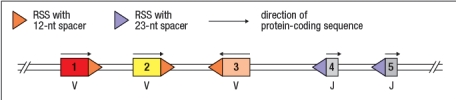
(Multiple Choice)
4.7/5 (77)
(77) In rare instances, B cells can be found that have two immunoglobulin light chain alleles, both of which are rearranged in frame, and can encode functional light chain proteins. Yet, on the surface of the B cell, only one of the two light chain proteins is detected in the membrane-bound immunoglobulin receptor. The reason these rare cells have two functional light chain rearrangements but only express one of the two light chains as part of the B-cell receptor is:
(Multiple Choice)
4.9/5 (79)
(79) For : T-cell receptors, sequence diversity is heavily concentrated at the junctions formed by the rearrangement of gene segments during the generation of the expressed V and V regions. The result of this organization is to position the most variable part of the T-cell receptor over a certain region of the ligand recognized by this receptor. Which region (outlined in red in Figure ) indicates this part of the ligand recognized by the T-cell receptor?
(Multiple Choice)
4.9/5 (75)
(75) Some T cells express : T-cell receptors rather than : T-cell receptors. The organization of the locus and the locus helps to ensure that each T cell cannot express both types of T-cell receptors. The mechanism involved is that:
(Multiple Choice)
4.7/5 (77)
(77) When first discovered, investigators found it surprising that some single-gene defects causing immunodeficiency syndromes were associated with hypersensitivities to ionizing radiation, thereby leading to increased rates of cancer. The genes accounting for this dual impairment encode ubiquitously expressed DNA repair proteins.
(True/False)
4.9/5 (76)
(76) The addition and subtraction of nucleotides at the junctions between V, D, and J gene segments creates antibody proteins with wide variations in the numbers of amino acids in their CDR3 regions. This variability in CDR3 length is important as:
(Multiple Choice)
4.8/5 (71)
(71) In spite of their low affinity for binding to their antigen, IgM antibodies can be quite effective at promoting the elimination of extracellular bacterial infections. This is due to:
(Multiple Choice)
4.8/5 (92)
(92) A mutagenesis screen performed on mice identified a gene with an important function in B cells. Analysis of B cells from the spleens of these mutant mice showed the results shown in Figure. However, when the C coding sequences were determined, no mutations in these DNA sequences were found. To study this further, genetic crosses were set-up with another mouse strain carrying an allelic variant of the immunoglobulin heavy chain locus. The original mutant mouse strain (strain A) carries IgMa and IgDa alleles of these heavy chain genes. The second mouse strain (strain B) carries the IgMb and IgDb alleles of the heavy chain genes. These two parental strains were crossed together, generating progeny that were all heterozygous for IgM and IgD alleles B were obtained. 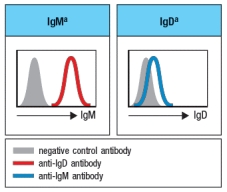
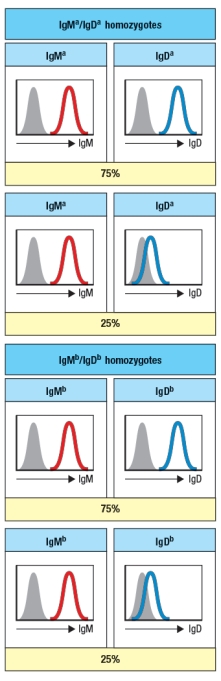 Based on these data, the mutation in the original mutant mouse strain most likely inactivates:
 (Multiple Choice)
4.7/5 (83)
(83) Recombination signal sequences are conserved heptamer and nonamer sequences that flank the V, J, and D gene segments which undergo recombination to generate the final V region coding exon. Some of these have 12-nucleotide spacers between the heptamer and nonamer, and others have 23-nucleotide spacers. The reason recombination signal sequences come in these two forms is:
(Multiple Choice)
4.8/5 (88)
(88) 
Filters
- Essay(0)
- Multiple Choice(0)
- Short Answer(0)
- True False(0)
- Matching(0)